


Effects of artificial intelligence based physiotherapy educational approach in developing clinical reasoning skills: a randomized controlled trial
- PMID: 41068907
- PMCID: PMC12512892
- DOI: 10.1186/s12909-025-07926-w
Effects of artificial intelligence based physiotherapy educational approach in developing clinical reasoning skills: a randomized controlled trial
Abstract
Background: Artificial intelligence (AI) tools such as ChatGPT are increasingly being integrated into health professions education, but evidence regarding their application in physiotherapy remains limited. This study aims to investigate the impact of AI-assisted problem-based learning (AI-PBL) on theoretical knowledge, clinical competence, AI self-efficacy, internet addiction, and reading motivation compared with traditional PBL.
Methods: A randomized controlled trial was conducted with undergraduate physiotherapy students assigned to AI-PBL or PBL groups. Participants completed assessments before, immediately after, and two weeks after the group intervention. Outcome measures included a theoretical knowledge test, the Mini Clinical Evaluation Exercise (Mini-CEX), the AI Self-Efficacy Scale (AI-SES), the Internet Addiction Test (IAT), and the Adult Reading Motivation Scale (ARMS).
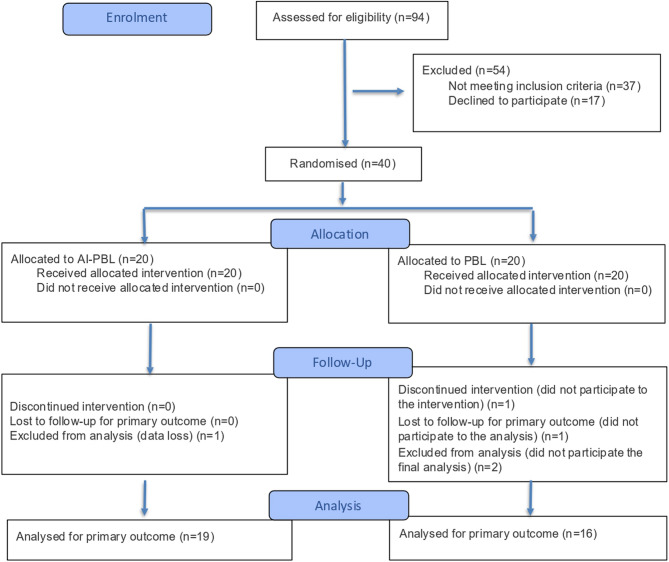
Results: Forty students were randomized equally into two groups: AI-PBL (n = 20) and traditional PBL (n = 20). Both groups showed significant improvements in knowledge and reading motivation. The AI-PBL group showed significantly greater improvement in knowledge retention at 2 weeks (Cohen's d = 3.14) and greater gains in AI self-efficacy. Although Mini-CEX scores were higher in the AI-PBL group, the differences between groups were not statistically significant. No significant increase in internet addiction was observed in the AI-PBL group.
Conclusion: These findings emphasize that supervised, structured use of generative AI in education can enhance sustained learning and digital self-efficacy without posing behavioral risks. The AI-PBL approach appears to foster active reflection, self-directed learning, and deeper academic engagement offering a promising direction for digital innovation in physiotherapy education. Future studies should explore long-term outcomes, track behavioral engagement, and further validate the benefits of AI-enhanced instructional strategies.
Trial registration: Prior to the initiation of the study, the protocol was registered on https//www.
Clinicaltrials: gov/, and registration status was made publicly available (Identifier NCT07010991 Date 08.06.2025). ( https://clinicaltrials.gov/study/NCT07010991?term=NCT07010991&rank=1 ).
Keywords: AI self-efficacy; Artificial intelligence; Clinical competence; Internet addiction; Physiotherapy education; Problem-based learning; Reading motivation.
© 2025. The Author(s).
Conflict of interest statement
Declarations. Ethics approval and consent to participate: The study was conducted in accordance with the Declaration of Helsinki, and approved by the Institutional Ethics Committee of Istanbul Medipol University (Decision no:536, E-10840098-202.3.02-2975 on 08.05.2025). Informed consent was obtained from all subjects involved in the study. Consent for publication: Not applicable. Competing interests: The authors declare no competing interests.
Figures
References
-
- Palliyil V, Cai M, Karam H, Phatthanachaisuksiri L, Suhre N, Kaßens-Noor E. Artificial intelligence use cases adopted by people and their impact on achieving sustainable development goals: a systematic review. Open Res Eur. 2025;5:117. 10.12688/openreseurope.20023.1.
Publication types
MeSH terms
Associated data
LinkOut - more resources
Full Text Sources
Medical
