


Dimethyl fumarate reprograms cervical cancer cells to enhance antitumor immunity by activating mtDNA-cGAS-STING pathway
- PMID: 41116174
- PMCID: PMC12538808
- DOI: 10.1186/s12929-025-01187-x
Dimethyl fumarate reprograms cervical cancer cells to enhance antitumor immunity by activating mtDNA-cGAS-STING pathway
Abstract
Background: Cervical cancer (CC) remains a significant global health challenge for women, especially in advanced stages where effective treatments are limited. Current immunotherapies, including PD-1/PD-L1 blockades and adoptive T cell therapies, show limited response rates and durability. Dimethyl fumarate (DMF), an FDA-approved drug for autoimmune diseases, has demonstrated direct antitumor activity in several cancers. However, its influence on anti-tumor immunity and its function in CC remain poorly understood. This study aims to investigate the therapeutic potential of DMF in CC models and elucidate its underlying mechanisms of action.
Methods: CC cell lines and mouse models were treated with DMF. Transcriptomics profiling of cervical cancer cells following DMF treatment were analyzed by RNA-seq and bioinformatic methods. Mitochondrial DNA (mtDNA) release, and cGAS-STING activation were assessed via qPCR, immunofluorescence, immunoblotting and ELISA. CD8+ T cell recruitment was analyzed by flow cytometry. Combinatorial therapies (DMF + anti-PD-1/TILs) were tested in syngeneic or patient-derived xenografts (PDX) models.
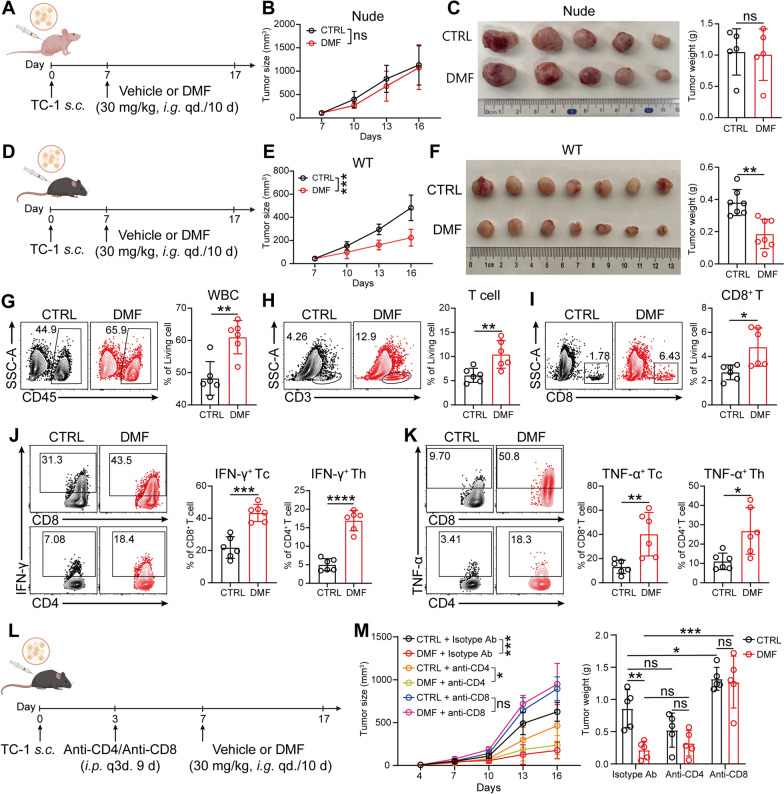
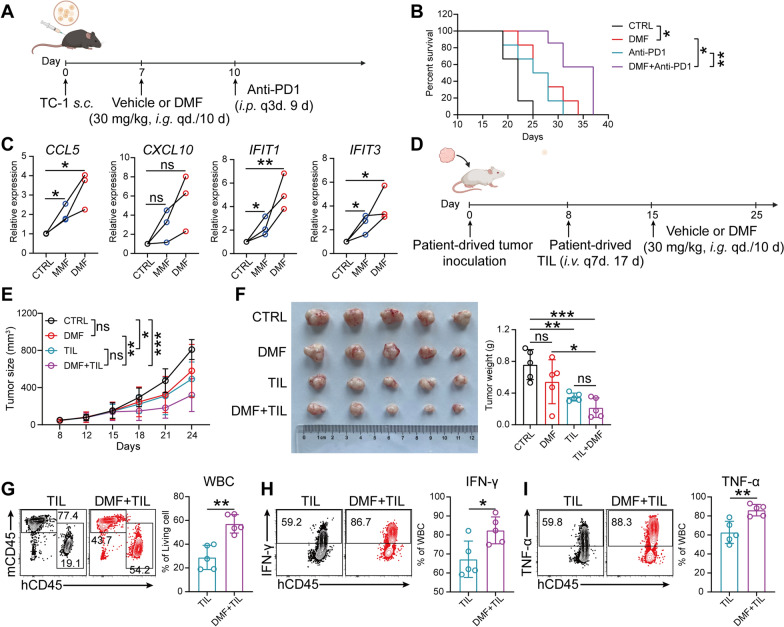
Results: DMF treatment induces mitochondrial dysfunction in tumor cells, resulting in the release of mtDNA into the cytosol. The cytosolic mtDNA in turn activates the cGAS-STING-TBK1 pathway and type I interferon response, leading to the secretion of CCL5 and CXCL10, thereby enhancing CD8⁺ T cell infiltration. Additionally, DMF exhibits synergistic effect with PD-1 blockade in murine CC model, and can enhance the therapeutic efficacy of adoptively transferred T cells toward CC in patient-derived xenografts model.
Conclusion: This work elucidated that DMF reprograms CC cells to activate the mtDNA-cGAS-STING pathway, fostering a chemokine-rich microenvironment that recruits CD8+ T cells. The synergistic effect of DMF and PD-1 blockade or TIL therapy underscores its potential as an immunostimulatory adjuvant. These findings suggest that DMF holds promise as a novel immunotherapeutic strategy for improving clinical outcomes in CC.
Keywords: CCL5; CD8+ T; CXCL10; Cervical cancer; Dimethyl fumarate; Immunotherapy.
© 2025. The Author(s).
Conflict of interest statement
Declarations. Ethics approval and consent to participate: This study was reviewed and approved by the Institutional Animal Care and Use Committee (IACUC) of Huazhong University of Science and Technology. ([2024] IACUC Number:4334). Consent for publication: Not applicable. Competing interests: The authors have declared that no competing interests exist.
Figures


References
-
- Tewari KS. Cervical cancer. N Engl J Med. 2025;392(1):56–71. - PubMed
-
- Bray F, Laversanne M, Sung H, Ferlay J, Siegel RL, Soerjomataram I, et al. Global cancer statistics 2022: GLOBOCAN estimates of incidence and mortality worldwide for 36 cancers in 185 countries. CA Cancer J Clin. 2024;74(3):229–63. - PubMed
-
- How JA, Patel A, Jazaeri AA. Immuno-oncology for gynecologic malignancies. Adv Exp Med Biol. 2021;1342:193–232. - PubMed
MeSH terms
Substances
Grants and funding
LinkOut - more resources
Full Text Sources
Medical
Research Materials
Miscellaneous
