


Electronic community health information system usability evaluation in Ethiopia
- PMID: 41121028
- PMCID: PMC12539133
- DOI: 10.1186/s12911-025-03228-9
Electronic community health information system usability evaluation in Ethiopia
Abstract
Background: A community-level electronic health information system (eCHIS) was introduced in Ethiopia to support proper routine data management and use. Though large investments were made to implement this digital information system, the outcome was not as expected in terms of data quality and information use. Furthermore, the usability, effectiveness, efficiency, and overall satisfaction of the application's users have remained unexplored. Therefore, this study aimed to investigate the eCHIS usability factors in Ethiopia.
Methods: We followed a two-stage approach. First, we reviewed the existing literature to identify suitable protocols and usability metrics based on usability factors, criteria, and attributes. The Goal Question Metric approach was adopted to define the goal into several questions. A set of 26 questionnaires was developed and refined to encompass usability metrics across various dimensions. These dimensions included learnability (9/26), efficiency (1/26), effectiveness (3/26), trustfulness (4/26), and satisfaction (9/26). Each questionnaire was measured on a five-point Likert scale. Following that, a cross-sectional study was conducted among eCHIS users in purposefully selected districts of Oromia, Amhara, and Sidama regions of Ethiopia. The selection of study sites was based on their utilization and experience with eCHIS, in addition to considering their internet connectivity.
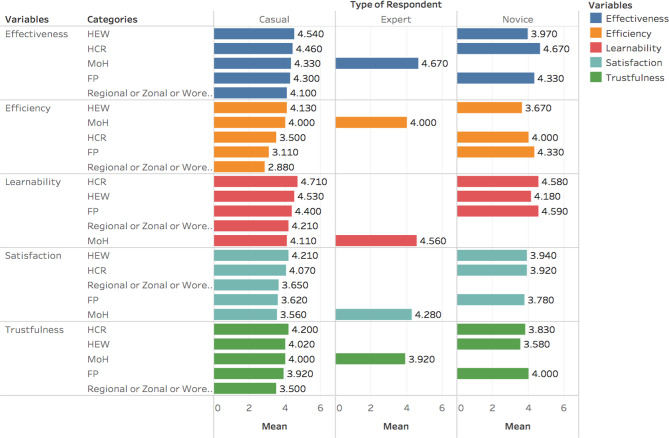
Results: A total of 81 participants completed the questionnaires. Overall, we observed a high level of satisfaction among health extension workers, midwives, and focal persons regarding the eCHIS application. However, we also identified some discrepancies in terms of learnability, efficiency, effectiveness, trustfulness, and satisfaction. We found that most health workers who casually utilize eCHIS applications had service experience greater than 10 years, eCHIS experience less than 2 years, and were in good connectivity areas, and were satisfied with the usability of eCHIS applications. Furthermore, the eCHIS usability was examined using the five metrics across the different eCHIS users (health extension workers, health professionals, focal persons, and staff at the Ministry of Health, regional, zonal, and woreda levels), which revealed relatively comparable mean score values for novice, casual, and expert users.
Conclusions: The usability evaluation of the eCHIS in Ethiopia revealed that users with experience and good internet connectivity were satisfied. Future generations of eCHIS will require standardizing the user interface, rules, and guidelines based on user experience, language translation consistency, and establishing a baseline standard for assessing user competency.
Keywords: Effectiveness; Efficiency; Ethiopia; GQM approach; HMIS; Learnability; Satisfaction; Trustfulness; Usability; eCHIS.
© 2025. The Author(s).
Conflict of interest statement
Declarations. Ethics approval and consent to participate: This study was conducted in accordance with the principles of the national and international guidelines for research involving human participants, and in line with the principles of the Declaration of Helsinki. Ethical approval was obtained from Jimma University Institute of Health Ethics review board (Reference no. IHRPGD/561/22) and a study permission letter from the Ministry of Health. Informed written consent was taken from study participants. Participation responses to questionnaires and interviews were anonymized to protect confidentiality. The data analysis and interpretation were conducted with integrity and transparency. The results presented in this study accurately reflect the findings obtained from the collected data. Proper acknowledgment and citation of the works of other researchers were given to ensure academic integrity. Consent for publication: Not applicable. Competing interests: The authors declare no competing interests.
Figures
References
-
- Damtew ZA, Moges AS. From multiple register to family folder: the transition of data collection and reporting tools for health extension workers in Ethiopia. J Health Inform Dev Ctries. 2023;7(2):2. Available: https://www.jhidc.org/index.php/jhidc/article/view/102. Accessed: Nov. 21, 2023.
-
- Community Health Information System Data Recording and Reporting. User’s Manual — MEASURE Evaluation. Accessed: Nov. 21, 2023. Available: https://www.measureevaluation.org/resources/publications/ms-13-69.html.
-
- Ethiopia’s Electronic Community Health Information System Journey: How Vision And Governance Has Fostered The Collaboration Required To Develop And Deploy An Integrated Primary Health Care Service Delivery And Reporting Tool For Health Extension Workers I. Accessed: Nov. 21, 2023. Available: https://gdhf2019.dryfta.com/program-schedule/program/105/ethiopia-s-elec....
-
- eCHIS | Ministry of Health - Ethiopia. Accessed: Nov. 20, 2023. Available: https://www.moh.gov.et/site/projects-3-col/echis.
MeSH terms
LinkOut - more resources
Full Text Sources
