. 2025 Oct 23;15(1):37118.
doi: 10.1038/s41598-025-20994-8.

Cancer-associated fibroblasts promote tumor progression in fusion-positive rhabdomyosarcoma

Affiliations

Cancer-associated fibroblasts promote tumor progression in fusion-positive rhabdomyosarcoma

Patrick Sipila et al. Sci Rep. .

Abstract

In children, rhabdomyosarcoma is the most common tumor originating in soft connective tissue. The PAX3/PAX7-FOXO1 fusion-positive alveolar subtype has poor clinical outcomes, with frequent recurrence, metastasis, and low survival. Current therapies may be limited by the tumor microenvironment containing cancer, immune, and fibroblast cells. In cancer, cells that transform into cancer-associated fibroblasts support growth and other malignant properties of the tumor. To study the role of cancer-associated fibroblasts, we isolated cells from the lung metastases of a patient with rhabdomyosarcoma that are positive for fibroblast biomarkers. Compared to normal lung fibroblasts, these cancer-associated fibroblasts secreted distinct factors that specifically supported the growth and migration of fusion-positive rhabdomyosarcoma cells. The cancer-associated fibroblasts also promoted expression of immune checkpoints and conferred resistance to cyclophosphamide, a chemotherapy commonly used to treat this disease. We further characterized the secretory phenotype of cytokines and growth factors produced by these cancer-associated fibroblasts and targeted CXCR4 expression inhibition, which induced cytotoxicity at increased sensitivity. This study establishes a model of cancer-associated fibroblasts from metastatic fusion-positive rhabdomyosarcoma. Altogether, our results describe tumor-promoting mechanisms of growth, migration, and treatment resistance supported by the tumor microenvironment, and offer a novel therapeutic strategy for the treatment of rhabdomyosarcoma.

Keywords: CXCR4; Cancer-associated fibroblast; Fusion-positive rhabdomyosarcoma; PAX3-FOXO1; Pediatric oncology; Tumor microenvironment.


Conflict of interest statement

Declarations. Competing interests: The authors declare no competing interests.

Figures
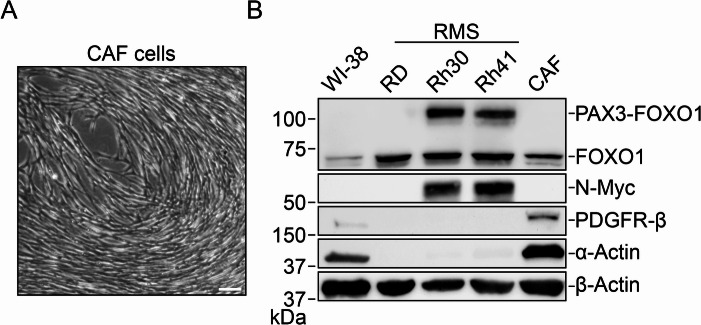
Fig. 1
Fig. 1
CAF cells exhibit spindle morphology, mesenchymal biomarkers, and lack characteristics of the patient’s tumor. (A) Fibroblast-like CAF cells isolated from a PAX3-FOXO1 FP-RMS tumor specimen were imaged by phase-contrast microscopy. Scale bar = 100 μm. (B) WI-38 fibroblasts, RMS cell lines (RD, Rh30, and Rh41), and CAF cell lysates were immunoblotted for tumor antigens (PAX3-FOXO1 and N-Myc), mesenchymal biomarkers (PDGFR-β and α-Actin), and protein loading (β-Actin).
Fig. 2
Fig. 2
CAF-conditioned media enhances FP-RMS cell proliferation. (A) Rh41, Rh30, and RD cells were cultured with increasing concentrations of CAF-conditioned media (CM) for 4 days and subjected to alamar blue assay to determine relative fluorescence intensity. (B) Rh41 cells were cultured with 10% conditioned media from WI-38 or CAF cells and subjected to proliferation assay by hemocytometer counting every 48 h. *p < 0.05.
Fig. 3
Fig. 3
CAF-conditioned media promotes FP-RMS cell migration. Rh41, Rh30, and RD cells cultured with 10% WI-38- or CAF-conditioned media (CM) were subjected to scratch assays. Representative images from the start (0 h) and end point (12 h) are shown. Scale bar = 100 μm. The relative migration was determined by wound closure at 12 h compared to 0 h. *p < 0.05.
Fig. 4
Fig. 4
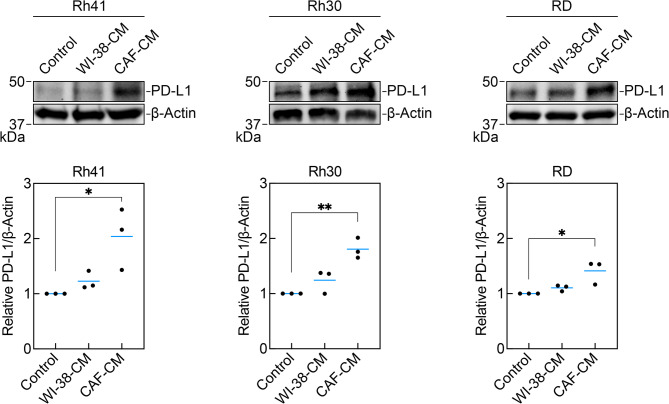
CAF-conditioned media increases the PD-L1 immune checkpoint in RMS cells. Rh41, Rh30, and RD cells cultured with 10% WI-38- or CAF-conditioned media (CM) for 48 h were immunoblotted for PD-L1 and β-Actin. The relative level of PD-L1 normalized to β-Actin was determined by densitometry. *p < 0.05.
Fig. 5
Fig. 5
CAF-conditioned media confers chemotherapeutic resistance to RMS cells. Rh41 cells cultured with 10% WI-38- or CAF-conditioned media (CM) were treated with increasing concentrations of cyclophosphamide (CTX), vincristine (VCR), or actinomycin D (ACD) for 96 h. The percent cell viability was determined by alamar blue assay and normalized to DMSO vehicle control. The mean and distribution of half maximal inhibitory concentration (IC50) values was determined from the dose-response curves. *p < 0.05.
Fig. 6
Fig. 6
CAF cells secrete key growth factors and cytokines regulating hallmarks of cancer. (A) The concentration of proteins in conditioned media (CM) from WI-38 and CAF cells was determined by multi-plex array. The proteins with detectable levels are shown in the heat map. (B and C) The top five upregulated (B) and downregulated (C) cytokines in CAF-CM are shown. *p < 0.05. (D) Rh41, Rh30, and RD cells cultured with 10% WI-38-CM or CAF-CM for 48 h were immunoblotted for phosphorylated and total STAT3 (Tyr705) and MAPK (Thr202/Tyr204). β-Actin was used to assess protein loading.
Fig. 7
Fig. 7
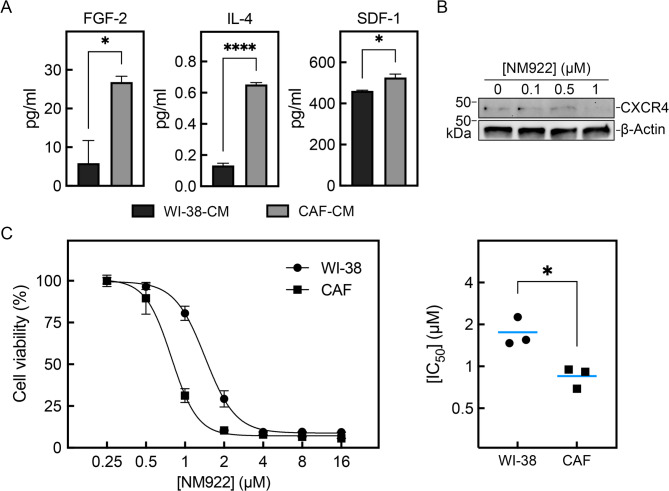
CXCR4 inhibition induces cytotoxicity in CAF cells. (A) The concentration of FGF-2, IL-4, and SDF-1 in conditioned media (CM) from WI-38 and CAF cells. (B) CAF cells treated with increasing concentrations of NM922, an inhibitor of CXCR4 expression, were immunoblotted for CXCR4 and β-Actin. (C) The percent cell viability in WI-38 and CAF cells treated with increasing concentrations of NM922 for 96 h was determined by alamar blue assay and normalized to DMSO vehicle control. The mean and distribution of half maximal inhibitory concentration (IC50) values was determined in WI-38 and CAF cells. *p < 0.05.

References

    1. Shern, J. F., Yohe, M. E. & Khan, J. Pediatric rhabdomyosarcoma. Crit. Rev. Oncog.20, 227–243 (2015). - PMC - PubMed
    1. Galili, N. et al. Fusion of a fork head domain gene to PAX3 in the solid tumour alveolar rhabdomyosarcoma. Nat. Genet.5, 230–235 (1993). - PubMed
    1. Davis, R. J., D’Cruz, C. M., Lovell, M. A., Biegel, J. A. & Barr, F. G. Fusion of PAX7 to FKHR by the variant t(1;13)(p36;q14) translocation in alveolar rhabdomyosarcoma. Cancer Res.54, 2869–2872 (1994). - PubMed
    1. Zarrabi, A. et al. Rhabdomyosarcoma: Current therapy, challenges, and future approaches to treatment strategies. Cancers. 15, 5269 (2023). - PMC - PubMed
    1. Chen, L. et al. The immunosuppressive niche of soft-tissue sarcomas is sustained by tumor-associated macrophages and characterized by intratumoral tertiary lymphoid structures. Clin. Cancer Res.26, 4018–4030 (2020). - PMC - PubMed

MeSH terms

LinkOut - more resources