Randomized Controlled Trial
. 2025 Oct 28;15(1):37710.
doi: 10.1038/s41598-025-21490-9.

Impact of meditation on brain age derived from multimodal neuroimaging in experts and older adults from a randomized trial

Affiliations
Randomized Controlled Trial

Impact of meditation on brain age derived from multimodal neuroimaging in experts and older adults from a randomized trial

Sacha Haudry et al. Sci Rep. .

Abstract

Meditation is thought to promote healthy aging by improving mental health, preserving brain integrity and reducing Alzheimer's disease risk. We examined the impact of long-term meditation expertise and an 18-month meditation training on brain aging in older adults using machine learning. We included 25 Older Expert Meditators (OldExpMed) with > 20 years of practice and 135 Cognitively Unimpaired Older Adults (CUOA) from the Age-Well randomized controlled trial. CUOA were randomized (1:1:1) into an 18-month meditation training, a non-native language training, and a no intervention group. Brain age was predicted using a machine learning model trained on gray and white matter volume and glucose metabolism data from ADNI and replicated with a second model. Brain Predicted Age Difference (BrainPAD) was computed as the gap between predicted and chronological age. We assessed meditation expertise effects on BrainPAD, its links with meditation hours, cognitive, and affective measures, and the impact of 18-month training. Compared to CUOA, OldExpMed exhibited significantly lower/more negative BrainPAD, linked to meditation hours, mental imagery, and prosocialness. No significant effect of 18-month training was observed. Results were consistent across the replication model. Long-term meditation is associated with younger brain age, but 18-month training has no effect, emphasizing the need for sustained practice to support healthy brain aging.


Conflict of interest statement

Declarations. Competing interests: The authors declare no competing interests.

Figures
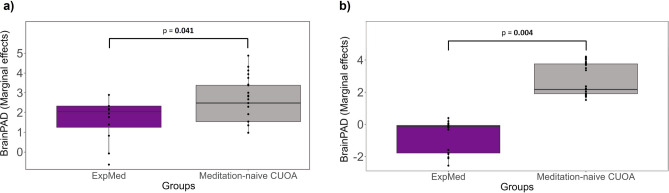
Fig. 1
Fig. 1
Comparison of BrainPAD between OldExpMed and CUOA. The boxplots show the difference of BrainPAD between OldExpMed (purple) and meditation-naive CUOA (gray) (a) with the main model and (b) with the replication model. Marginal effects were plotted to adjust for the effects of sex and education. Horizontal lines represent the median of each group, open boxes show the 25th and 75th percentile, and vertical lines show data range. BrainPAD, brain predicted age difference; OldExpMed, older expert meditators; CUOA, cognitively unimpaired older adults.
Fig. 2
Fig. 2
Associations between BrainPAD of OldExpMed and their accumulated hours of meditation practice. The scatter plots show the relationship between the accumulated hours of meditation practice and BrainPAD (a) with the main model and (b) with the replication model. Solid lines represent estimated regression lines, shaded areas represent 95% CI and β represents the slope of the regression. The regression was corrected for age for the main model. BrainPAD, brain predicted age difference; OldExpMed, older expert meditators; CI, confidence interval.
Fig. 3
Fig. 3
Evolution of BrainPAD from pre- to post-intervention in the three groups. Linear mixed models show no significant effects of the visit nor significant group x visit interaction for BrainPAD while controlling for age, sex and education. The boxplots show longitudinal change in BrainPAD (a) with the main model and (b) with the replication model. BrainPAD, brain predicted age difference.
Fig. 4
Fig. 4
Voxel-wise associations between the predicted brain age and the different neuroimaging modalities used for brain age prediction. The results are projected on medial and external 3D brain surface views of the MNI template. (a) Associations between GMV maps and the predicted brain age at a threshold of p < 0.001 (green) and at p(FWE) < 0.05 (yellow). (b) Associations between WMV maps and the predicted brain age at a threshold of p < 0.001 (blue) and at p (FWE) < 0.05 (red). (c) Associations between glucose metabolism maps and the predicted brain age at p < 0.001(purple) and at p(FWE) < 0.05 (orange). MNI, montreal neurological institute; GMV, gray matter volume, FEW, family-wise errors; WMV, white matter volume.
Fig. 5
Fig. 5
Design overview. Two models were used for Brain age prediction: the main model, trained using both structural MRI (GMV and WMV) and functional FDG-PET data from cognitively unimpaired elderly individual from ADNI with Lasso regression; and the replication model, trained on a larger, multi-cohort dataset spanning the entire adult lifespan using only structural MRI data (GMV and WMV) and applying Gaussian Process regression. Both trained models were applied to Age-Well participants, divided into two groups: CUOA (N = 135, age > 65 years) and OldExpMed (N = 25, age > 65 years, > 10,000 h of practice). As output, the models yielded the estimated brain age which was used to calculate BrainPAD by subtracting the chronological age from the predicted brain age for each modality. A multimodal BrainPAD score was derived by averaging BrainPAD values across the available imaging modalities. Bottom panel: First, using a cross-sectional design, a comparison between OldExpMed and CUOA at baseline was performed (1a). Then, if the difference was found significant, we investigated the links—in OldExpMed—between BrainPAD and the experts’ accumulated duration of practice (2a), cognitive performance, and affective regulation capacities (3a). Second, using a longitudinal design, we investigated the impact of the meditation training on BrainPAD in the cognitively unimpaired older adults using a linear mixed model (1b). If the interaction between group and time was found significant, we investigated—in the meditation training group—the links between ΔBrainPAD and the accumulated hours of practice (2b), cognitive performance, and affective regulation capacities (3b). MRI, magnetic resonance imaging, GMV, gray matter volume; WMV, white matter volume; FDG-PET, fluorodesoxyglucose-positron emission tomography; ADNI, Alzheimer’s disease neuroimaging initiative, CUOA, cognitively unimpaired older adults, OldExpMed, older expert meditators; BrainPAD, brain predicted age difference, ΔBrainPAD, longitudinal evolution of BrainPAD.

References

    1. Djernes, J. K. Prevalence and predictors of depression in populations of elderly: A review. Acta. Psychiatr. Scand.113, 372–387 (2006). - PubMed
    1. Horackova, K. et al. Prevalence of late-life depression and gap in mental health service use across European regions. Eur. Psychiatry57, 19–25 (2019). - PubMed
    1. Thomas, P. & Hazif-Thomas, C. Depression in elderly. Rev. Prat.58, 389–393 (2008). - PubMed
    1. Lutz, A., Slagter, H. A., Dunne, J. D. & Davidson, R. J. Attention regulation and monitoring in meditation. Trends Cogn. Sci.12, 163–169 (2008). - PMC - PubMed
    1. Tang, Y.-Y., Hölzel, B. K. & Posner, M. I. The neuroscience of mindfulness meditation. Nat. Rev. Neurosci.16, 213–225 (2015). - PubMed

Publication types
