


Safety and tolerability of astegolimab, an anti-ST2 monoclonal antibody: a narrative review
- PMID: 41163220
- PMCID: PMC12574037
- DOI: 10.1186/s12931-025-03360-0
Safety and tolerability of astegolimab, an anti-ST2 monoclonal antibody: a narrative review
Abstract
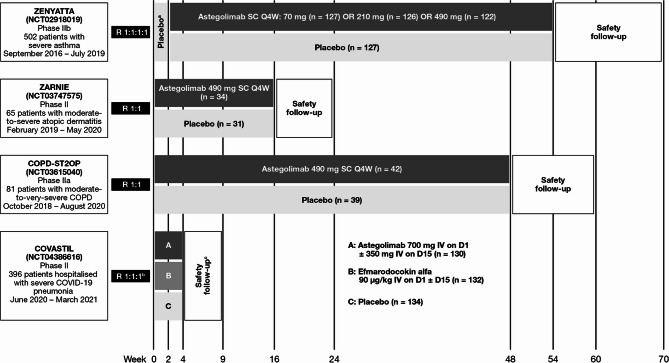
Chronic inflammation is an underlying feature of respiratory diseases such as chronic obstructive pulmonary disease (COPD). Novel therapies that target the inflammatory mechanisms driving acute exacerbations of COPD are required. The ST2 receptor, which binds the alarmin interleukin (IL)-33 to initiate an inflammatory response, is a potential target. Astegolimab, a fully human immunoglobulin G2 monoclonal antibody, which binds with high affinity to ST2 to prevent binding of IL-33, is a potential therapy for COPD. However, targeting inflammatory pathways that form part of the immune system may have unintended consequences, such as implications for the response to infection and cardiovascular function. Therefore, an understanding of astegolimab's safety profile in clinical use is essential. This narrative review summarizes clinical safety data from published clinical trials of astegolimab with a focus on adverse events of interest, including infections and cardiac events. Astegolimab was shown to be well tolerated in > 580 patients with asthma, atopic dermatitis, COPD, and severe COVID-19 pneumonia who took part in Phase II trials. The frequency of adverse events (AEs) and serious AEs was similar between the astegolimab and placebo arms in each trial (AEs: 41-81% vs. 58-77%; serious AEs: 3-29% vs. 0-41%, respectively). The number of deaths was similar between treatment arms and there were no astegolimab-related deaths. Astegolimab did not increase the risk of infection or major adverse cardiac events. Ongoing Phase IIb and Phase III trials of astegolimab in patients with COPD who have a history of frequent acute exacerbation(s) of COPD will provide a future opportunity to confirm the safety profile of astegolimab.
Keywords: Astegolimab; Asthma; Chronic obstructive pulmonary disease; Immunogenicity; Infection; Inflammation; Interleukin-33 (IL-33); Major adverse cardiac events; ST2; Safety.
© 2025. The Author(s).
Conflict of interest statement
Declarations. Ethics approval and consent to participate: The ZENYATTA, ZARNIE, and COVASTIL trials were conducted in conformance with the International Council for Harmonisation E6 guideline for Good Clinical Practice, the principles of the Declaration of Helsinki, or the laws/regulations of the country where the research occurred, whichever provided better protection to the individual, and the trials complied with requirements of the International Council for Harmonisation E2A guideline. Ethics Committees for each site approved the protocols in each study. The COPD-ST2OP trial was performed in accordance with the principles of the Declaration of Helsinki and ethics approval given by East Midlands – Leicester South Research Ethics Committee. In all trials, patients (or their legally authorized representatives) provided written, informed consent. Consent for publication: Not applicable. Competing interests: SGK has received funding from Genentech Inc., Syneos, and Teva. MM was recently a speaker and/or advisor for and/or had received research funding from Alexion, Allakos, Almirall, Alvotech, Amgen, Aquestive Therapeutics, Arcensus, argenX, AstraZeneca, Astria Therapeutics, BioCryst Pharmaceuticals, Blueprint Medicines, Celldex Therapeutics, Celltrion, Clinuvel, Cogent Biosciences, CSL Behring, Escient Pharmaceuticals, Evommune, Excellergy Therapeutics, Genentech, Inc., GSK, Incyte, Jasper Therapeutics, KalVista Pharmaceuticals, Kashiv Biosciences, Kyowa Kirin, Leo Pharma, Lilly, Menarini, Mitsubishi Tanabe Pharma, Moxie, Noucor, Novartis, Orion Biotechnology, Pharvaris, Resonance Medicine, Sanofi/Regeneron, Santa Ana Bio, Septerna, Servier, Takeda, Teva, Third Harmonic Bio, ValenzaBio, Vitalli Bio, Yuhan Corporation, and Zura Bio. MW has no competing interests to declare. GA and WT are employees of F. Hoffmann-La Roche, Ltd. AD, AF, and XY are employees of Genentech, Inc. DM is an employee of Genentech, Inc. and a shareholder of F. Hoffmann-La Roche, Ltd./Genentech, Inc. CEB has received grants and consultancy fees from 4D Pharma, Areteia, AstraZeneca, Chiesi, F. Hoffmann-La Roche, Ltd., Genentech, Inc., GlaxoSmithKline, Mologic, Novartis, Regeneron Pharmaceuticals, and Sanofi paid to his institution.
Figures
References
-
- Maspero J, Adir Y, Al-Ahmad M, et al. Type 2 inflammation in asthma and other airway diseases. ERJ Open Res. 2022;8(3):00576-2021. https://doi.org/10.1183/23120541.00576-2021 . - PMC - PubMed
-
- Aghasafari P, George U, Pidaparti R. A review of inflammatory mechanism in airway diseases. Inflamm Res. 2019;68(1):59–74. 10.1007/s00011-018-1191-2. - PubMed
-
- GOLD. Global strategy for the diagnosis, management, and prevention of chronic obstructive pulmonary disease (2024 Report). 2024. https://goldcopd.org/2024-gold-report/. Accessed 27 August 2024.
-
- Barnes PJ. Inflammatory mechanisms in patients with chronic obstructive pulmonary disease. J Allergy Clin Immunol. 2016;138(1):16–27. 10.1016/j.jaci.2016.05.011. - PubMed
-
- Hurst JR, Skolnik N, Hansen GJ, et al. Understanding the impact of chronic obstructive pulmonary disease exacerbations on patient health and quality of life. Eur J Intern Med. 2020;73:1–6. 10.1016/j.ejim.2019.12.014. - PubMed
Publication types
MeSH terms
Substances
LinkOut - more resources
Full Text Sources
Medical
