. 2025 Oct 30;91(6):70.
doi: 10.1007/s00285-025-02299-6.

Mapping Incidence and Prevalence Peak Data for SIR Modeling Applications

Affiliations

Mapping Incidence and Prevalence Peak Data for SIR Modeling Applications

Alexander C Murph et al. J Math Biol. .

Abstract

Infectious disease modeling and forecasting have played a key role in helping assess and respond to epidemics and pandemics. Recent work has leveraged data on disease peak infection and peak hospital incidence to fit compartmental models for the purpose of forecasting and describing the dynamics of a disease outbreak. Incorporating these data can greatly stabilize a compartmental model fit on early observations, where slight perturbations in the data may lead to model fits that forecast wildly unrealistic peak infection. We introduce a new method for incorporating historic data on the value and time of peak incidence of hospitalization into the fit for a Susceptible-Infectious-Recovered (SIR) model by formulating the relationship between an SIR model's starting parameters and peak incidence as a system of two equations that can be solved computationally. We demonstrate how to calculate SIR parameter estimates - which describe disease dynamics such as transmission and recovery rates - using this method, and determine that there is a noticeable loss in accuracy whenever prevalence data is misspecified as incidence data. To exhibit the modeling potential, we update the Dirichlet-Beta State Space modeling framework to use hospital incidence data, as this framework was previously formulated to incorporate only data on total infections. This approach is assessed for practicality in terms of accuracy and speed of computation via simulation.

Keywords: Compartmental Models; Disease Forecasting; Hospital Incidence; Prevalence.


Conflict of interest statement

Declarations. Competing Interests: The authors have no non-financial or other financial competing interests to declare that are relevant to the content of this article other than the aforementioned declared funding sources. Code Availability: All software used to perform the simulations and studies in this paper are publicly available at https://github.com/lanl/precog .

Figures
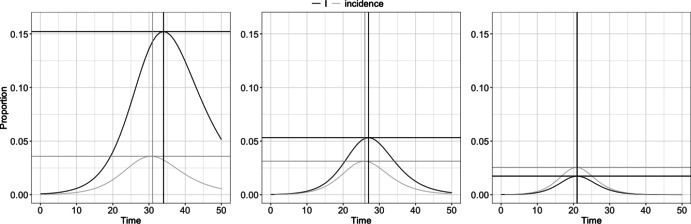
Fig. 1
Fig. 1
Three SIR models with incidence and starting values S0=0.9 and I0=R0=0.05. While it is possible for incidence to be greater than prevalence, this is not of practical interest
Fig. 2
Fig. 2
MAE of estimates on ρ using (correctly) specified incidence data as incidence and using (incorrectly) specified prevalence data as incidence
Fig. 3
Fig. 3
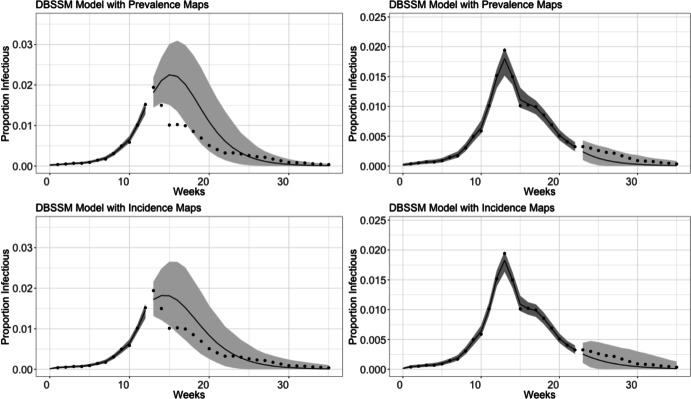
The DBSSM fit to the 2010 US nationwide influenza outbreak starting at week 13 (left column) and week 22 (right column). The dark grey regions correspond to the 95% credible regions of the posterior density while the light grey regions correspond to the 95% prediction intervals. The top plots reproduces the forecasting model of Osthus et al. (2017), which incorrectly treated incidence data as though it were prevalence data. The bottom plots fit the forecasting model described in Section 3, which correctly treats incidence data as incidence data. Earlier on in the outbreak, the model developed in this paper has a tighter prediction interval. The forecasts starting at week 22 are quite similar
Fig. 4
Fig. 4
Infection rates, recovery rates, and reproductions numbers drawn from the Gibbs sampler used to fit the DBSSM using both specifications of incidence data. Using incidence data specified as prevalence leads to different estimates for these parameters. These values were calculated using the data up through timepoint 22 (t=22)
Fig. 5
Fig. 5
The DBSSM fit to the 2014 US nationwide influenza outbreak starting at week 13 (left column) and week 22 (right column). The dark grey regions correspond to the 95% credible regions of the posterior density while the light grey regions correspond to the 95% prediction intervals. The top plots reproduces the forecasting model of Osthus et al. (2017), which incorrectly treated incidence data as though it were prevalence data. The bottom plots fit the forecasting model described in Section 3, which correctly treats incidence data as incidence data
Fig. 6
Fig. 6
The DBSSM fit to the 2014 US nationwide influenza outbreak starting at weeks 8-12 compared against the model from Hickmann et al. (2015). The top plot visualizes predictions of PIV from each model; the bottom plot visualizes predictions of PIT
Fig. 7
Fig. 7
The DBSSM fit to the 2010 US nationwide influenza outbreak starting at week 11 (left column) and week 14 (right column). The dark grey regions correspond to the 95% credible regions of the posterior density while the light grey regions correspond to the 95% prediction intervals. The top plots reproduces the forecasting model of Osthus et al. (2017), which incorrectly treated incidence data as though it were prevalence data. The bottom plots fit the forecasting model described in Section 3, which correctly treats incidence data as incidence data

References

    1. Abbey H ( 1952) An examination of the reed-frost theory of epidemics. Human Biology 24( 3), 201– 233. Accessed 2024-03-21 - PubMed
    1. Amaro JE (2023) Systematic description of covid-19 pandemic using exact SIR solutions and gumbel distributions. Nonlinear Dyn 111(2):1947–1969. 10.1007/s11071-022-07907-4 - PMC - PubMed
    1. Anderson RM (1988) The role of mathematical models in the study of hiv transmission and the epidemiology of aids. J Acquir Immune Defic Syndr 1(3):241–256 - PubMed
    1. Abolmaali S, Shirzaei S (2021) A comparative study of SIR model, linear regression, logistic function and arima model for forecasting covid-19 cases. AIMS Public Health 8(4):598–613. 10.3934/publichealth.2021048 - PMC - PubMed
    1. Burr T, Chowell G (2006) Observation and model error effects on parameter estimates in susceptible-infected-recovered epidemiological models. Far East Journal of Theoretical Statistics 19(2):163–183

LinkOut - more resources