


doi: 10.1016/j.xrrt.2025.04.013.
eCollection 2025 Nov.
Arthroscopic posterior J-bone graft technique
Affiliations
- PMID: 41179457
- PMCID: PMC12573608
- DOI: 10.1016/j.xrrt.2025.04.013
Item in Clipboard
Arthroscopic posterior J-bone graft technique
JSES Rev Rep Tech.
.
No abstract available
Keywords: Arthroscopic shoulder stabilization dynamic posterior shoulder instability; Bone graft augmentation; Iliac crest autograft; J-bone graft; Posterior shoulder instability; Static posterior shoulder instability.
Figures

Arthroscopic J-bone graft instruments: (1) guiding slide, (2) flat trocar, (3) 20 mm chisel thin wedge, (4) 20 mm chisel thick wedge, (5) trial implant, and (6) inserter.

Measurements of the J-shaped iliac crest autograft.
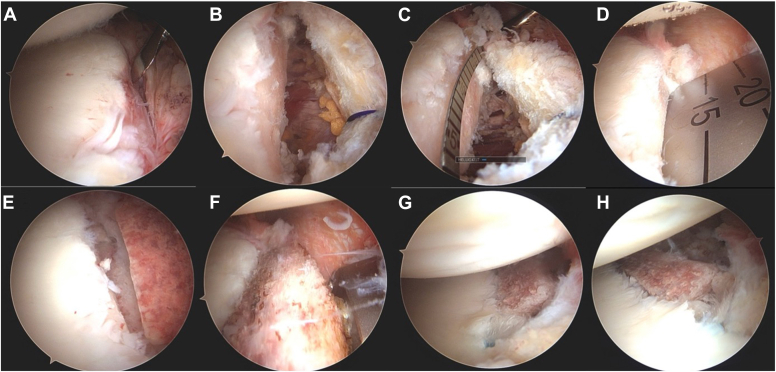
(A) Posterior glenonidal defect before any manipulation, (B) posterior glenoidal defect after straightening with a burr, (C) distance measurement for the length of the graft's length, (D) creating a monocortical osteotomy with a 20 mm chisel, (E) and (F) insertion of the J-bone-graft, and (G) and (H) inserted graft and fixated labrum.
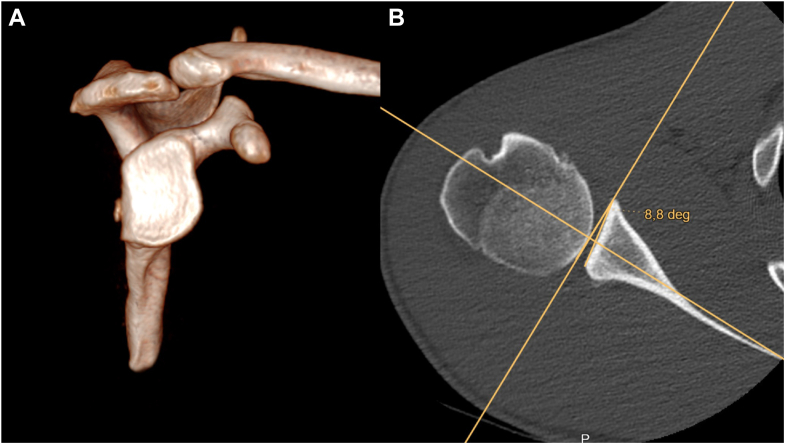
Preoperative imaging: (A) glenoidal retroversion, (B) osseos defect on 3D-CT scan. CT, computed tomography.

Postoperative imaging: (A) inserted J-bone graft on the dorsal glenoid, (B) slightly overcorrected glenoid version after J-bone-graft procedure.
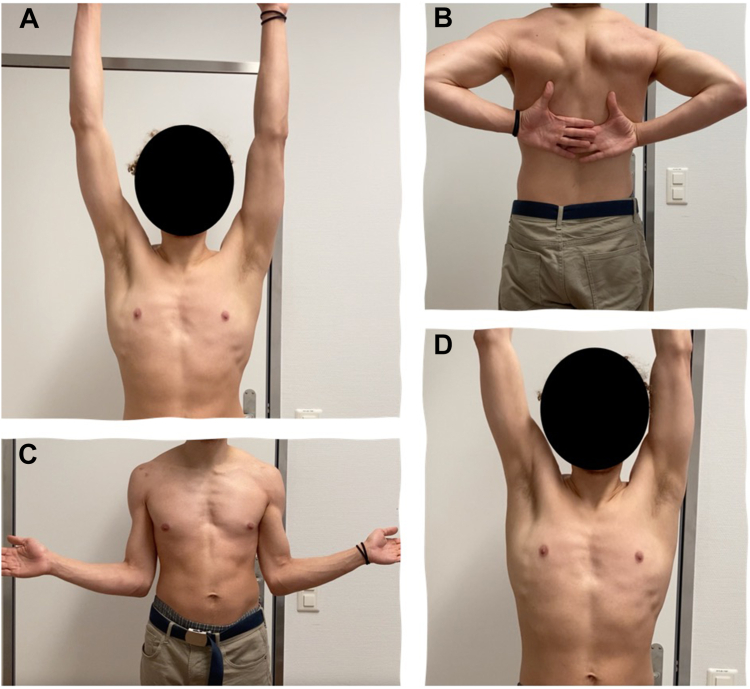
ROM 1 year after surgery: (A) flexion, (B) internal rotation in neutral position, (C) external rotation, and (D) abduction. ROM, range of motion.
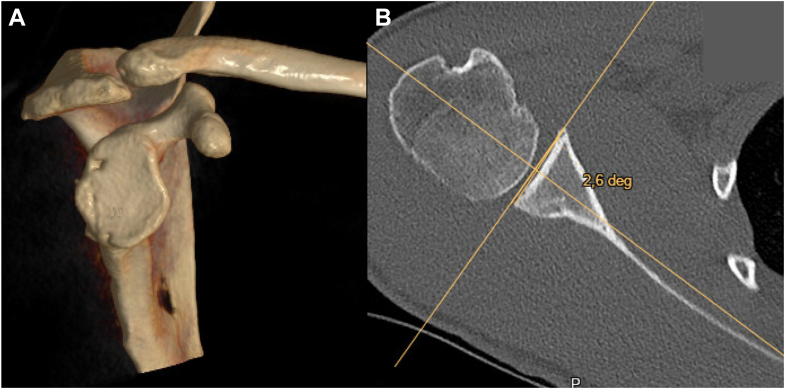
Computed tomography scan of the right shoulder joint 1 year postoperatively, (A) highlighting optimal integration and remodeling of the J-graft with (B) anatomical reconstruction of the glenoid articular surface.
References
-
- Baudi P., Righi P., Bolognesi D., Rivetta S., Rossi Urtoler E., Guicciardi N., et al. How to identify and calculate glenoid bone deficit. Chir Organi Mov. 2005;90:145–152. - PubMed
LinkOut - more resources
Full Text Sources
