Review
. 2025 Nov 6;6(11):e70461.
doi: 10.1002/mco2.70461. eCollection 2025 Nov.

Trained Immunity in Health and Disease

Affiliations
Review

Trained Immunity in Health and Disease

Meng Yao et al. MedComm (2020). .

Abstract

Trained immunity as a critical regulator of host defense and disease pathogenesis bridges the gap between innate and adaptive immunity. For decades, the classic dichotomy of innate immunity and adaptive immunity has shaped our knowledge of immune function. Innate immunity has traditionally been regarded as a rapid, nonspecific first line of defense without memory capacity, while adaptive immunity is characterized by slower, antigen-specific responses and long-term immune memory. However, emerging evidence that innate immunity exhibits memory-like properties challenges the paradigm. Basically, innate immune cells with nonspecific memory retain functional imprints of prior encounters with diverse stimuli. Here, we comprehensively explore the intricate molecular and cellular mechanisms that underpin trained immunity, encompassing epigenetic inheritance, metabolic reprogramming, and transcriptional rewiring. Its dual roles are highlighted in health and disease. On one hand, it bolsters host defense against a broad spectrum of pathogens from bacteria to viruses, and enhances vaccine efficacy through heterologous protection. On the other hand, its dysregulation contributes to infection, inflammation, and cancer progression. As for the promising opportunities on therapeutic intervention, the challenges in precisely modulating trained immunity are tackled to offer a holistic perspective on the dynamically evolving field.

Keywords: epigenetic inheritance; immune cells; immunotherapy; metabolic reprogramming; trained immunity.


Conflict of interest statement

The authors declare no conflicts of interest.

Figures

FIGURE 1
FIGURE 1
Growth and timescale of medical publications on trained immunity and its related health and disease. This figure illustrates the number of published papers over time, from 2000 to 2025 (by August 14, 2025), related to trained immunity and its related health and disease. The data are visualized through two layered area graphs, each representing a different category of publications: research on trained immunity (blue area), its related diseases (red area), and purple represents the combination of the two entities. This graph underscores the expanding research and clinical importance of trained immunity and its related diseases. The x‐axis represents the ages, ranging from 2000 to 2025, and the y‐axis quantifies the number of published papers. After trained immunity was named in 2011 to describe the memorization of innate immunity, the literature in related fields increased. We mapped the development of trained immunity and its related health and disease, and marked the nodes where key events occurred over the past 25 years.
FIGURE 2
FIGURE 2
Trained immunity and its regulatory mechanisms. Trained immunity enables memory formation in innate immune cells through metabolic reprogramming and epigenetic inheritance. Dectin‐1, upon recognizing and binding to β‐glucan, activates the AKT–mTOR–HIF‐1α pathway, leading to an increase in glycolysis. Glucose is metabolized to pyruvic acid, and simultaneously, fatty acid oxidation is inhibited by SDH. The TCA cycle is involved, with its metabolites such as fumarate and citrate playing important roles. Fumarate inhibits KDM5 enzymes like H3K4, increasing chromatin methylation. Citrate participates in the mevalonate pathway and also influences epigenetic regulation. Lactate induces mtDNA release and chromatin opening. UMLILO regulates epigenetics by increasing H3K4 methylation in the WDR5–MLL1 complex in chromatin, along with other histone modifications like H3K4me1, H3K27ac, H3K18ac, and H3K27me3, which are all involved in the regulation of immune genes and the overall process of trained immunity.
FIGURE 3
FIGURE 3
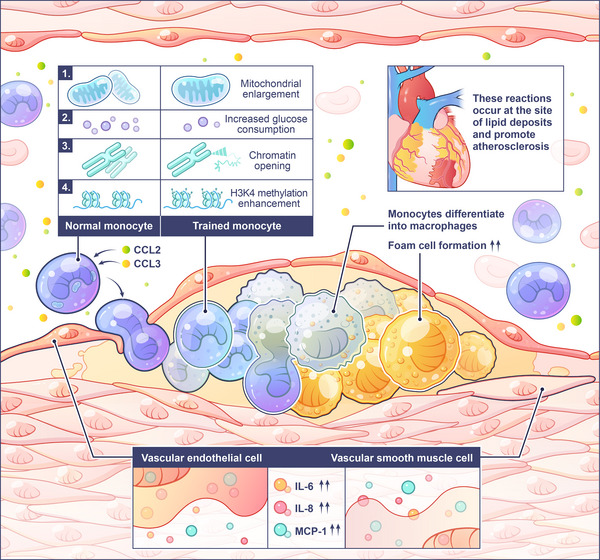
Trained immunity promotes atherosclerosis. In the early stage of AS, vascular endothelial permeability increases at the injured site, and Ox‐LDL is deposited subcutaneously in the blood vessels. Monocytes accumulate at the Ox‐LDL deposition site under the action of chemokines such as CCL2 and CCL3. Subsequently, monocytes are trained under the action of Ox‐LDL, with enlarged mitochondria, increased glucose consumption, enhanced glycolysis, and epigenetic inheritance such as methylation. After training, monocytes differentiate into macrophages under the endoderm. Their ability to phagocytose lipids is enhanced, resulting in an increase in foam cells. Endothelial cells and vascular smooth muscle cells can also be trained under the action of Ox‐LDL, and the secretion of IL‐6, IL‐8, MCP‐1, and other cytokines increases, further promoting vascular inflammation, resulting in an increase in foam cells.
FIGURE 4
FIGURE 4
Enhanced trained immunity facilitates the eradication of tumors. Tumors are closely related to the immune system. Trained immunity is expected to be a new tumor therapeutic strategy based on increasing the tumor killing capacity of innate immune cells. (1) β‐Glucan accumulates in the pancreas, stimulating the infiltration of bone marrow immune cells and inducing trained immunity. These trained cells differentiate into specific proinflammatory macrophage/monocyte populations with enhanced phagocytosis and ROS‐mediated cytotoxicity to kill tumor cells effectively. (2) Influenza A virus (IAV) infection induces the trained immunity of AM cells in the lung, which requires the involvement of IFNγ and NK cells. Trained AM cells upregulate the expression of transcripts associated with antitumor function, including antigen processing and presentation, phagocytosis, and Toll‐like receptor signaling pathways, and enhance mitochondrial oxidation, leading to improved phagocytosis and tumor cytotoxicity. (3) β‐glucan induces trained immunity in neutrophils and granulocyte–monocyte progenitors (GMPs) in mouse bone marrow, and type I IFN signaling is involved in trained granulocyte production and the antitumor phenotype of neutrophils. After training, neutrophils exhibited antitumor activity in a ROS‐dependent manner by activating NCF1 and NCF2, genes related to ROS production. (4) BCG is injected into the bladder and absorbed by tumor cells to initiate an immune response. The increase in inflammatory factors released by the cells promotes the migration of monocytes to the bladder epithelium to become domesticated macrophages, thereby mediating the killing of tumor cells.

References

    1. Hajishengallis G., Netea M. G., and Chavakis T., “Trained Immunity in Chronic Inflammatory Diseases and Cancer,” Nature Reviews Immunology 25, no. 7 (2025): 497–514. - PMC - PubMed
    1. Huang M., Wu Z., Li J., Ding Y., Chen S., and Li X., “Plant Protection Against Viruses: An Integrated Review of Plant Immunity Agents,” International Journal of Molecular Sciences 24, no. 5 (2023): 4453. - PMC - PubMed
    1. Netea M. G., Joosten L. A., Latz E., et al., “Trained Immunity: A Program of Innate Immune Memory in Health and Disease,” Science 352, no. 6284 (2016): aaf1098. - PMC - PubMed
    1. Katzmarski N., Domínguez‐Andrés J., Cirovic B., et al., “Transmission of Trained Immunity and Heterologous Resistance to Infections Across Generations,” Nature Immunology 22, no. 11 (2021): 1382–1390. - PubMed
    1. Wang R., Lan C., Benlagha K., et al., “The Interaction of Innate Immune and Adaptive Immune System,” MedComm 5, no. 10 (2024): e714. - PMC - PubMed

LinkOut - more resources