


Superparamagnetic MnFe2O4@Fe2O3 lipid-coated small nanoparticles: Synthesis, physicochemical characterization and biocompatibility assessment in drosophila melanogaster
- PMID: 41211527
- PMCID: PMC12589892
- DOI: 10.1016/j.bbiosy.2025.100124
Superparamagnetic MnFe2O4@Fe2O3 lipid-coated small nanoparticles: Synthesis, physicochemical characterization and biocompatibility assessment in drosophila melanogaster
Abstract
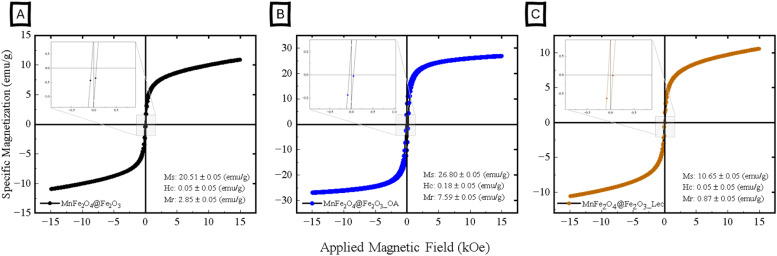
Magnetic nanoparticles (MNPs), particularly manganese ferrite (MnFe2O4), have emerged as promising candidates for biomedical applications due to their tunable magnetic properties, biocompatibility, and functionalization potential. In this study, we synthesized superparamagnetic MnFe2O4@Fe2O3 core-shell nanoparticles (5.8 nm inorganic core, ∼10 nm lipid-coated) functionalized with oleic acid (OA) or soy lecithin (Lec) to enhance biocompatibility. To the best of our knowledge, this work is the first to combine this unique hybrid core-shell structure with lipid coatings and evaluate its safety in an animal model. To characterize the MNPs we provided structural, magnetic, and physical-chemistry studies using transmission electron microscopy (TEM), energy dispersive X-ray spectroscopy (EDS), dynamic light scattering (DLS), X-ray diffraction (XRD), magnetization hysteresis, Fourier transform infrared spectroscopy (FTIR) measurements. To assess acute and chronic nanotoxicity, fruit flies from parental and F1 generations were fed a diet containing MNPs at concentrations of 0.0, 0.1, and 1.0 mg/mL, and were evaluated throughout all developmental stages. The findings revealed that the MNPs showed no signs of toxicity at any of the concentrations tested. We combined hybrid core-shell superparamagnetic nanoparticles with organic lipid-coated that exhibit unique physicochemical characteristics, confirming their low in vivo nanotoxicity in Drosophila melanogaster and supporting their potential as biocompatible, magnetically responsive and small-sized platforms for biomedical application such as drug delivery due to their biocompatibility, magnetic properties, and physicochemical stability.
Keywords: Biocompatibility; Drosophila melanogaster; Nanotoxicity; Oleic acid; Soy lecithin; Superparamagnetic nanoparticles.
© 2025 The Authors. Published by Elsevier Ltd.
Conflict of interest statement
The authors declare that they have no known competing financial interests or personal relationships that could have appeared to influence the work reported in this article.
Figures



References
-
- Kalaiselvan C.R., Laha S.S., Somvanshi S.B., Tabish T.A., Thorat N.D., Sahu N.K. Manganese ferrite (MnFe2O4) nanostructures for cancer theranostics. Coord Chem Rev. 2022;473
-
- Epple M., Rotello V.M., Dawson K. The why and how of ultrasmall nanoparticles. Acc Chem Res. 2023;56(23) - PubMed
-
- Chao X., Zhao L., Ma N., Mou Y., Zhang P. Nanotechnology-based drug delivery systems for the improved sensitization of tamoxifen. J Drug Deliv Sci Technol. 2021;61
LinkOut - more resources
Full Text Sources
Molecular Biology Databases