


Age-stratified optimal non-HDL cholesterol and all-cause mortality in a healthy Taiwanese population considering personal risk factors
- PMID: 41216627
- PMCID: PMC12597053
- DOI: 10.1016/j.ijcrp.2025.200537
Age-stratified optimal non-HDL cholesterol and all-cause mortality in a healthy Taiwanese population considering personal risk factors
Abstract
Background: Non-high-density lipoprotein cholesterol (non-HDL-C) is a key cardiovascular risk factor, yet its optimal range in healthy individuals remains unclear.
Methods: This study analyzed data from 134,343 adults aged 40-79 in the MJ Health Check-up Cohort in Taiwan (2000-2017). Participants with prior cardiovascular disease or extreme/incomplete BMI data (≥50 kg/m2) were excluded. Covariates included lifestyle, blood pressure, and diet. All-cause mortality was assessed using Cox proportional hazards models.
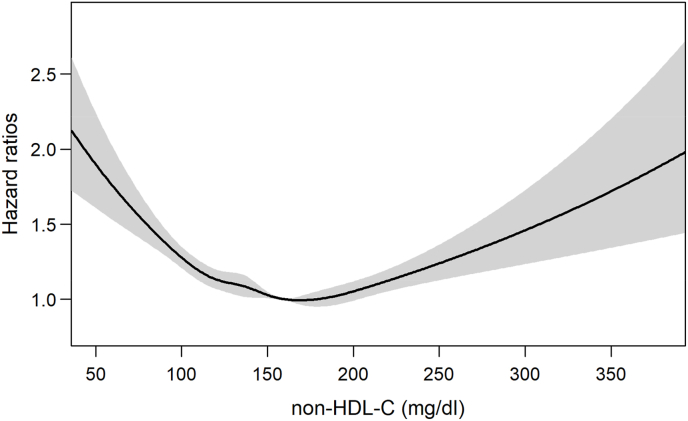
Results: The mean age was 51.8 years, and 47.3 % were male. Most participants (62.7 %) had a BMI of 18.5-25. The average non-HDL-C level was 146.8 mg/dL. A U-shaped association was observed between non-HDL-C levels and all-cause mortality. Compared with the reference group (160-179 mg/dL), non-HDL-C levels of <100, 100-119, 120-139, and ≥200 mg/dL were linked to elevated mortality risk, with hazard ratios (HR) of 1.42 (95 % CI: 1.31-1.54), 1.19 (1.11-1.27), 1.11 (1.04-1.18), and 1.11 (1.03-1.20), respectively. The highest risk was noted in the 40-49 age group with non-HDL-C ≥200 mg/dL, particularly among females (HR 1.72, 95 % CI: 1.15-2.58). However, no significant increase in risk was observed for the same category in older age groups.
Conclusions: A non-HDL-C range of 160-179 mg/dL was associated with the lowest all-cause mortality among healthy Taiwanese adults. Both lower and higher levels were linked to increased mortality risk, highlighting the importance of maintaining moderate non-HDL-C levels to support longevity and overall health.
Keywords: Health behaviors; Mortality risk; Non-HDL-C.
© 2025 The Authors. Published by Elsevier B.V.
Conflict of interest statement
The authors declare that they have no conflict of interest.
Figures


References
-
- Joseph P., Leong D., McKee M., Anand S.S., Schwalm J.-D., Teo K., Mente A., Yusuf S. Reducing the global burden of cardiovascular disease, part 1: the epidemiology and risk factors. Circ. Res. 2017;121(6):677–694. - PubMed
-
- Jaspers N.E.M., Blaha M.J., Matsushita K., Van Der Schouw Y.T., Wareham N.J., Khaw K.-T., Geisel M.H., Lehmann N., Erbel R., Jöckel K.-H., et al. Prediction of individualized lifetime benefit from cholesterol lowering, blood pressure lowering, antithrombotic therapy, and smoking cessation in apparently healthy people. Eur. Heart J. 2020;41(11):1190–1199. - PMC - PubMed
-
- Cholesterol Treatment Trialists C Efficacy of cholesterol-lowering therapy in 18 686 people with diabetes in 14 randomised trials of statins: a meta-analysis. Lancet. 2008;371(9607):117–125. - PubMed
-
- Reiner Ž. Managing the residual cardiovascular disease risk associated with HDL-cholesterol and triglycerides in statin-treated patients: a clinical update. Nutr. Metabol. Cardiovasc. Dis. 2013;23(9):799–807. - PubMed
LinkOut - more resources
Full Text Sources