. 2025 Nov 3;26(21):10698.
doi: 10.3390/ijms262110698.

Xanthohumol Alters Gut Microbiota Metabolism and Bile Acid Dynamics in Gastrointestinal Simulation Models of Eubiotic and Dysbiotic States

Affiliations

Xanthohumol Alters Gut Microbiota Metabolism and Bile Acid Dynamics in Gastrointestinal Simulation Models of Eubiotic and Dysbiotic States

Paige E Jamieson et al. Int J Mol Sci. .

Abstract

Xanthohumol (XN), a polyphenol from hops (Humulus lupulus), exhibits antioxidant, anti-inflammatory, antihyperlipidemic, and chemo-preventive activity. Preclinical evidence suggests gut microbiota are critical to mediating some of these bioactivities. Nevertheless, its precise impact on human gut microbiota, particularly at supplemental doses, remains poorly characterized. We evaluated 200 mg/day XN for 3 weeks on human gut microbiota in a eubiotic and dysbiotic model using the Simulator of the Human Intestinal Microbial Ecosystem (SHIME®). Functional assessments of microbiota included quantification of XN metabolites, short-chain fatty acids (SCFAs), and untargeted metabolomics of the digestive metabolome. Bacterial composition was assessed by 16S rRNA gene sequencing. XN reduced alpha-diversity and short-chain fatty acid production in both models, as well as altered taxa abundance variably between models. XN disrupted bile acid metabolism through inhibition of microbial bile salt hydrolase (BSH). The modulation of bile acid metabolism has important implications for host-level bioactivity of XN.

Keywords: Humulus lupulus; SHIME; bile acids; dysbiosis; gut microbiota; phytochemical; polyphenol; xanthohumol.


Conflict of interest statement

The authors declare no conflicts of interest.

Figures

Figure 1
Figure 1
Microbiota-derived metabolites of XN by colon compartment. (A) Microbial metabolism of XN. Metabolite generation increased over time and along distal compartments in both model systems (B,D). Data points represent mean measurements from each model. Error bars represent the standard deviation. Stacked bar charts show metabolite composition at each time point (C,E). Measurements were performed in triplicate. AC: ascending colon; TC: transverse colon; DC: descending colon; B: baseline; T1: treatment week 1; T2: treatment week 2; T3: treatment week 3.
Figure 2
Figure 2
XN significantly reduces SCFA formation in colonic SHIME compartments. Greater changes in SCFA concentration were observed in H-SHIME reactors, where acetic acid, propionic acid, and butyric acid decreased compared to baseline. Within the D-SHIME, acetic acid only significantly decreased in the DC compartment compared to baseline. Significant changes within each SHIME model were determined by one-way ANOVA followed by post hoc Bonferroni analysis to compare against baseline. Shapes represent mean measurements from each model. Measurements were performed in triplicate. Error bars represent the standard deviation. AC: ascending colon; TC: transverse colon; DC: descending colon; B: baseline; T1: treatment week 1; T2: treatment week 2; T3: treatment week 3. *, p ≤ 0.05; **, p ≤ 0.01.
Figure 3
Figure 3
XN significantly reduces alpha diversity of colon microbiota. Observed richness (at T2 and T3) and Shannon’s entropy (at T3) was significantly reduced in the TC compartment of the H-SHIME compared to baseline. Observed richness (at T2 and T3) was significantly reduced in the DC compartment of the D-SHIME compared to baseline. Significant changes within each SHIME model were determined by one-way ANOVA followed by post hoc Bonferroni analysis compared to baseline. Shapes represent mean measurements from each model. Measurements were taken in triplicate. Error bars represent the standard deviation. AC: ascending colon; TC: transverse colon; DC: descending colon; B: baseline; T1: treatment week 1; T2: treatment week 2; T3: treatment week 3. *, p ≤ 0.05; **, p ≤ 0.01.
Figure 4
Figure 4
Abundance of bacterial genera changing over time in response to XN exposure and by SHIME model. Taxa were first agglomerated to the genus level. Count data were rarefied and center log-ratio transformed prior to statistical comparisons. The Bonferroni multiple testing correction was used to control for the Family-Wise Error Rate. Measurements were taken in triplicate. Error bars represent the standard deviation. AC: ascending colon; TC: transverse colon; DC: descending colon; B: baseline; T1: treatment week 1; T2: treatment week 2; T3: treatment week 3. *, p ≤ 0.05; **, p ≤ 0.01; ***, p ≤ 0.001.
Figure 5
Figure 5
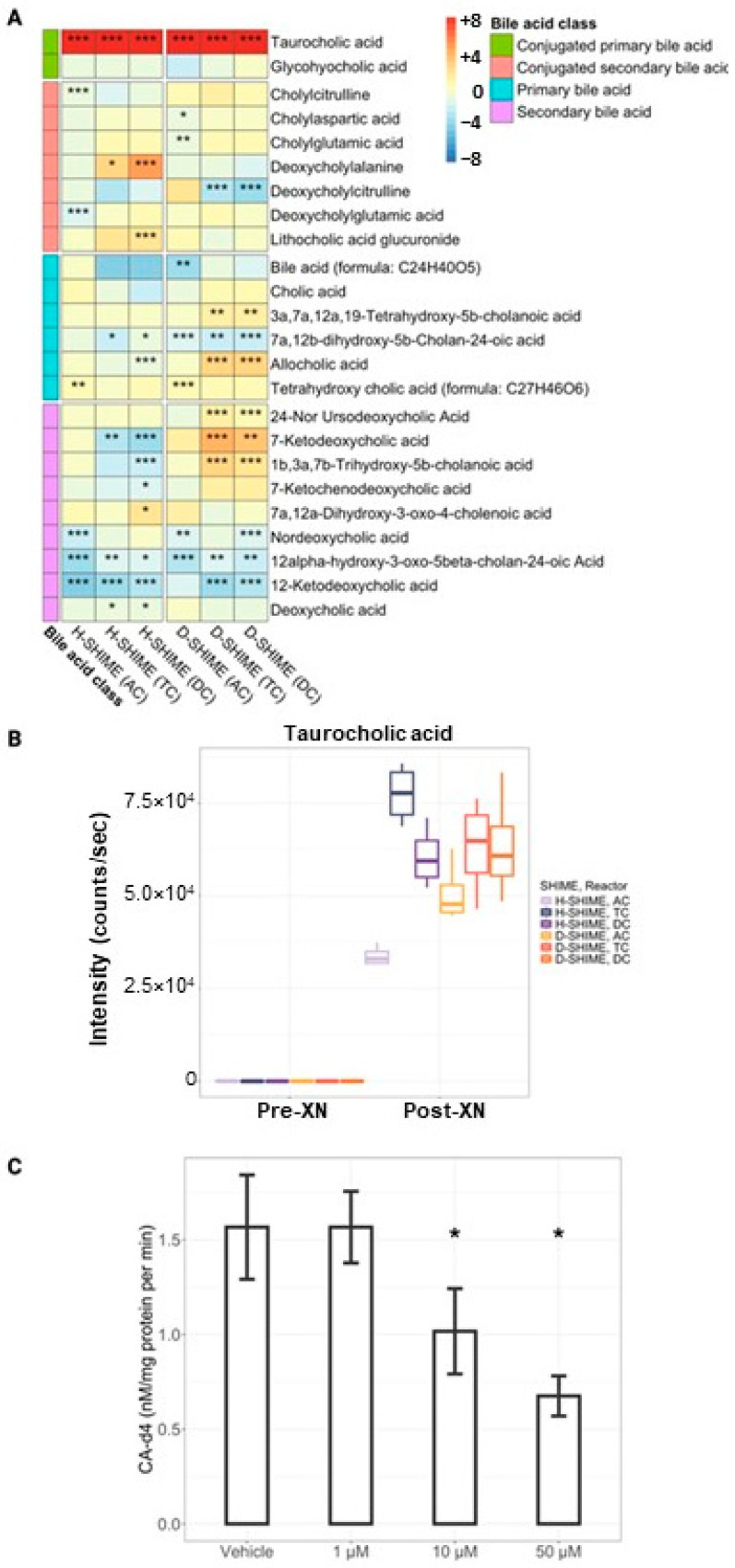
XN exposure disrupts microbiota-derived bile acid metabolism. (A) Heatmap of bile acid metabolites. The cell color represents the log 2-fold change in intensity compared to baseline, and the colored block annotations represent the bile acid class of each metabolite. (B) Taurocholic acid (TCA) levels by reactor vessel. TCA significantly accumulates across all colon compartments of both SHIME models in response to XN exposure. Each color represents a colon reactor. Purple colors denote H-SHIME reactors. Orange colors denote D-SHIME reactors. (C) XN concentration-dependent decrease in enzymatic conversion of TCA into CA via inhibition of fecal bile salt hydrolase (BSH). Fecal BSH enzymes were extracted from stool by sonication and incubated with labeled taurocholic acid-d4 (TCA-d4) and increasing concentrations of XN. Each incubation was performed in triplicate. BSH activity was measured by the rate of cholic acid-d4 (CA-d4) generation. For comparison, the concentration of XN was ~408 µM in SHIME colon reactors during treatment period. AC: ascending colon; TC: transverse colon; DC: descending colon. *, p ≤ 0.05; **, p ≤ 0.01; ***, p ≤ 0.001.

References

    1. Dietz B.M., Kang Y.-H., Liu G., Eggler A.L., Yao P., Chadwick L.R., Pauli G.F., Farnsworth N.R., Mesecar A.D., van Breemen R.B., et al. Xanthohumol Isolated from Humulus Lupulus Inhibits Menadione-Induced DNA Damage through Induction of Quinone Reductase. Chem. Res. Toxicol. 2005;18:1296–1305. doi: 10.1021/tx050058x. - DOI - PMC - PubMed
    1. Colgate E.C., Miranda C.L., Stevens J.F., Bray T.M., Ho E. Xanthohumol, a Prenylflavonoid Derived from Hops Induces Apoptosis and Inhibits NF-kappaB Activation in Prostate Epithelial Cells. Cancer Lett. 2007;246:201–209. doi: 10.1016/j.canlet.2006.02.015. - DOI - PubMed
    1. Paraiso I.L., Tran T.Q., Magana A.A., Kundu P., Choi J., Maier C.S., Bobe G., Raber J., Kioussi C., Stevens J.F. Xanthohumol Ameliorates Diet-Induced Liver Dysfunction via Farnesoid X Receptor-Dependent and Independent Signaling. Front. Pharmacol. 2021;12:643857. doi: 10.3389/fphar.2021.643857. - DOI - PMC - PubMed
    1. Zhang Y., Bobe G., Revel J.S., Rodrigues R.R., Sharpton T.J., Fantacone M.L., Raslan K., Miranda C.L., Lowry M.B., Blakemore P.R., et al. Improvements in Metabolic Syndrome by Xanthohumol Derivatives Are Linked to Altered Gut Microbiota and Bile Acid Metabolism. Mol. Nutr. Food Res. 2020;64:1900789. doi: 10.1002/mnfr.201900789. - DOI - PMC - PubMed
    1. Vicente de Andrade Silva G., Demaman Arend G., Antonio Ferreira Zielinski A., Di Luccio M., Ambrosi A. Xanthohumol Properties and Strategies for Extraction from Hops and Brewery Residues: A Review. Food Chem. 2023;404:134629. doi: 10.1016/j.foodchem.2022.134629. - DOI - PubMed

LinkOut - more resources