. 2025 Nov 12;15(11):e72443.
doi: 10.1002/ece3.72443. eCollection 2025 Nov.

The Role of Live and Dead Corals in Shaping Fish Assemblages Across Life Stages

Affiliations

The Role of Live and Dead Corals in Shaping Fish Assemblages Across Life Stages

Felipe M G Mattos et al. Ecol Evol. .

Abstract

Coral reef fishes face unprecedented threats, as extensive habitat degradation compromises their ecological functions by modifying assemblage structure. It remains unknown how resistant reef fishes are to widespread losses in coral cover, and most studies tend to focus on adults, overlooking the important role of recruits. This study employed taxonomic and trait-based approaches to investigate how live and dead branching corals influence reef fish assemblages across life stages. Over 1 year, we monitored recruitment and the migration of post-recruits (juveniles and adults) on manually constructed 1 m2 patches of live and dead branching corals in a degraded reef. Recruit assemblages, composed mainly of two trophic groups, exhibited similar abundance and richness in the complex structures of dead and live coral patches, compared to flat control patches. Conversely, post-recruit fishes were more abundant, species-rich, and functionally diverse in live coral patches, encompassing several trophic groups and displaying a dominance shift between mobile and sedentary species. Our findings reveal that while dead coral structures can serve as temporary shelters for mobile recruits, live corals are essential for supporting long-term biodiversity and diverse functional traits. This study underscores the complementary roles of both live and dead corals in promoting reef fish recovery and highlights the value of integrative strategies for reef ecosystem restoration.

Keywords: fish recruits; functionality; habitat loss; recovery; trophic ecology.


Conflict of interest statement

The authors declare no conflicts of interest.

Figures

FIGURE 1
FIGURE 1
The present study employed four replicate blocks, each including three patches: a live coral treatment (a), a dead coral treatment (b), and a control (c), located near Shanfu harbor in Xiaoliuqiu (d). The 1 m2 patches were placed approximately 5 m from each other (e). The replicate blocks were placed approximately 10 m apart from each other.
FIGURE 2
FIGURE 2
Abundance and species richness of recruit and post‐recruit reef fish assemblages in live coral, dead coral, and control patches over the one‐year experimental period. Points represent individual samples, and the lines and shaded areas represent the smoothed conditional means with 95% confidence intervals. Ticks at the x‐axis are scaled by date.
FIGURE 3
FIGURE 3
nMDS results displaying the similarity of recruit and post‐recruit reef fish assemblages in live coral, dead coral, and control patches, based on Bray‐Curtis distance matrices from Hellinger transformed data. Ellipses represent a 95% confidence interval. Due to high collinearity between recruits' data points in the control patches, the ellipse could not be calculated.
FIGURE 4
FIGURE 4
Mean abundance of recruits per month according to different mobility traits. Error bars indicate the standard deviation.
FIGURE 5
FIGURE 5
Mean abundance of recruits and post‐recruits per month according to different trophic groups. Error bars indicate the standard deviation. CAR, carnivore; CLN, cleaner; COR, corallivore; MIF, motile invertebrate feeder; OMN, omnivore; PLK, planktivore; RH, roving herbivore.
FIGURE 6
FIGURE 6
Mean abundance of post‐recruits per month according to different mobility traits. Error bars indicate the standard deviation.
FIGURE 7
FIGURE 7
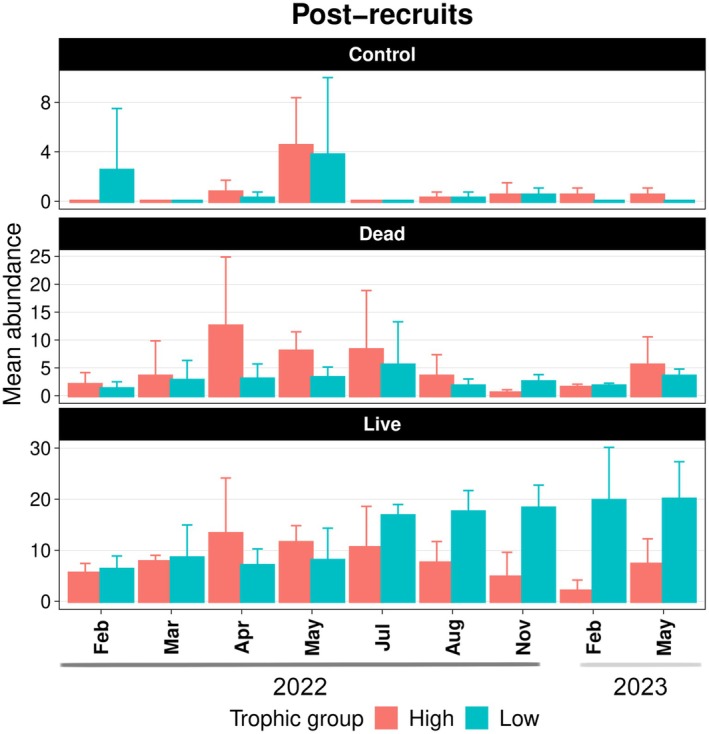
Mean abundance of post‐recruits per month according to different trophic groups. Error bars indicate the standard deviation. CAR, carnivore; CLN, cleaner; COR, corallivore; MIF, motile invertebrate feeder; OMN, omnivore; PLK, planktivore; RH, roving herbivore; SIF, sessile invertebrate feeder; TH, territorial herbivore.
FIGURE A1
FIGURE A1
Biplot from the Principal Component Analysis of the physical structure in live, dead, and control patches. Height, average height of habitat architecture in cm; LCC, Live coral cover; RC, number of refuge categories; Rug, visual rank of the rugosity. See Table A1 for definitions.
FIGURE A2
FIGURE A2
nMDS results displaying the original Bray–Curtis similarity from raw abundance‐count data for recruit and post‐recruit reef fish assemblages in the live dead, and control patches. This figure shows the over‐dispersion caused by one sample in recruit and three samples in post‐recruit assemblages. Ellipses indicate the 95% confidence interval. Stress < 0.001.
FIGURE A3
FIGURE A3
nMDS results comparing the results from DOV vs. UVC methods in the live coral dead coral, and control patches control area based on Bray‐Curtis distance matrices from the count data. Ellipses indicate a 95% confidence interval.
FIGURE A4
FIGURE A4
Residual diagnostics for GLMMs for the comparison of fish assemblages between patches. Residual diagnostics of (a) recruit abundance, (b) recruit richness, (c) post‐recruit abundance and (d) post‐recruit richness. Overdispersion was detected in post‐recruit richness. Significant heterogeneity of variances was detected in post‐recruit abundance and richness. Each dot represents a sampling unit from a single patch.
FIGURE A5
FIGURE A5
Residual diagnostics for GLMMs for the comparison of fish assemblages between patches according to high and low mobility traits. Residual diagnostics of (a) recruit assemblages, and (b) post‐recruit assemblages. Residuals followed a normal distribution with no overdispersion and outliers. Significant heterogeneity of variances was detected in post‐recruit assemblages. Each dot represents a sampling unit from a single patch.
FIGURE A6
FIGURE A6
Residual diagnostics for GLMMs for the comparison of fish assemblages between patches according to trophic group. Trophic groups: (CAR, carnivore; CLN, cleaner; COR, corallivore; MIF, motile invertebrate feeder; OMN, omnivore; PLK, planktivore; RH, roving herbivore; SIF, sessile invertebrate feeder; TH, territorial herbivore). Residual diagnostics of (a) recruit assemblages, and (b) post‐recruit assemblages. Residuals followed a normal distribution with no overdispersion and outliers. No significant heterogeneity of variances was detected. Each dot represents a sampling unit from a single patch.
FIGURE A7
FIGURE A7
Abundance and richness of recruits and post‐recruits per transect in the turf and the coral zones of Shanfu reef. Points represent individual samples, lines and the shaded areas represent the smoothed conditional means with the respective 95% confidence intervals.

References

    1. Acosta, C. , and Robertson D.. 2002. “Diversity in Coral Reef Fish Communities: The Effects of Habitat Patchiness Revisited.” Marine Ecology Progress Series 227: 87–96. 10.3354/meps227087. - DOI
    1. Agudo‐Adriani, E. A. , Cappelletto J., Cavada‐Blanco F., and Cróquer A.. 2019. “Structural Complexity and Benthic Cover Explain Reef‐Scale Variability of Fish Assemblages in Los Roques National Park, Venezuela.” Frontiers in Marine Science 6: 690. 10.3389/fmars.2019.00690. - DOI
    1. Ainsworth, C. H. , and Mumby P. J.. 2015. “Coral–Algal Phase Shifts Alter Fish Communities and Reduce Fisheries Production.” Global Change Biology 21, no. 1: 165–172. 10.1111/gcb.12667. - DOI - PMC - PubMed
    1. Allen, G. , Steene R., Humann P., and DeLoach N.. 2015. Reef Fish Identification: Tropical Pacific. 2nd ed. New World Publications.
    1. Almany, G. R. 2004a. “Differential Effects of Habitat Complexity, Predators and Competitors on Abundance of Juvenile and Adult Coral Reef Fishes.” Oecologia 141, no. 1: 105–113. 10.1007/s00442-004-1617-0. - DOI - PubMed

LinkOut - more resources