


Game-based learning in undergraduate medical education: evaluation of an interdisciplinary escape room
- PMID: 41241744
- PMCID: PMC12619439
- DOI: 10.1186/s12909-025-07990-2
Game-based learning in undergraduate medical education: evaluation of an interdisciplinary escape room
Abstract
Background: Educational escape rooms are an innovative pedagogical approach to encourage proactive learning among students. This study assessed the learning outcomes and student satisfaction with escape room-based teaching at a medical school in Germany.
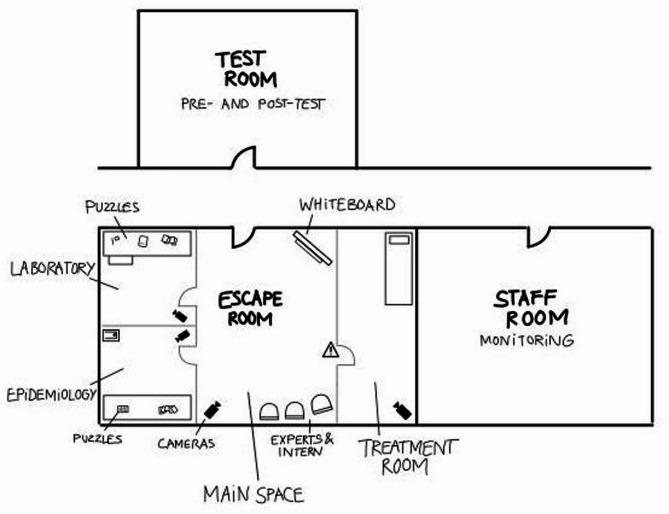
Methods: An interdisciplinary escape room was created based on learning goals from the fields of psychiatry, infectious diseases, and communication skills. The gameplay was repeated eight times and pre-post intervention questionnaires were used to assess knowledge gain of participants. Pre- and post-test scores were analyzed using t-tests and correlation analyses to examine their relationships with gender, age, and semester. Evaluation feedback was summarized with descriptive statistics (mean, SD). Three open-text questions recorded qualitative comments, which were analyzed thematically.
Results: Overall, 45 students (female = 82.2%; male = 17.8%; Mage=24.04 years, SDage=3.45) fulfilled inclusion criteria. The mean post-test score (M = 71.71, SD = 5.03) was significantly higher (t = 8.65, p < .001) than the mean pre-test score (M = 65.07, SD = 5.29). Female students scored higher than male students in pre-tests (r = .306, p = .041) and post-tests (r = .440, p = .002). A higher semester of study correlated with higher pre-test scores (r = .536, p < .001) and higher post-test scores (r = .411, p = .006). Students rated the teaching method as "good" (M = 1.58; SD = 0.53) and "recommendable to peers" (M = 1.20; SD = 0.45), "fun to play" (M = 1.22; SD = 0.52), and "relevant for teaching" (M = 1.24; SD = 0.48). Students mentioned collaborative teamwork as the best characteristic of escape room teaching and suggested comprehensive briefing and debriefing sessions for improving future sessions.
Conclusions: Escape room-based teaching resulted in significant knowledge gain. Female gender was associated with higher pre- and post-test knowledge. Students at later stages of their studies had higher pre-test knowledge. The escape room was well perceived by medical students and considered an enjoyable learning environment for medicine-related topics.
Keywords: Didactics; Escape room; Game-based teaching; Gamification; Gamified teaching; Infectious diseases; Medical education; Psychiatry.
© 2025. The Author(s).
Conflict of interest statement
Declarations. Ethics approval and consent to participate: The study was conducted in accordance with the Declaration of Helsinki in its current version [63] and approved by the ethics committee of Heidelberg University Medical Faculty (S-004/2024). Participation in the escape room was voluntary. All participants were given an information leaflet describing the aims and objectives of the study and provided their informed consent before completing the questionnaires. Consent for publication: All participants provided their explicit consent for participation in the study, video recording of the escape room teaching session and eventual publication of their anonymized data in scientific publications. Competing interests: The authors declare no competing interests.
Figures

References
MeSH terms
LinkOut - more resources
Full Text Sources
