. 2025 Nov 17;8(1):665.
doi: 10.1038/s41746-025-02025-y.

A large language model-based approach to quantifying the effects of social determinants in liver transplant decisions

Affiliations

A large language model-based approach to quantifying the effects of social determinants in liver transplant decisions

Emily Robitschek et al. NPJ Digit Med. .

Abstract

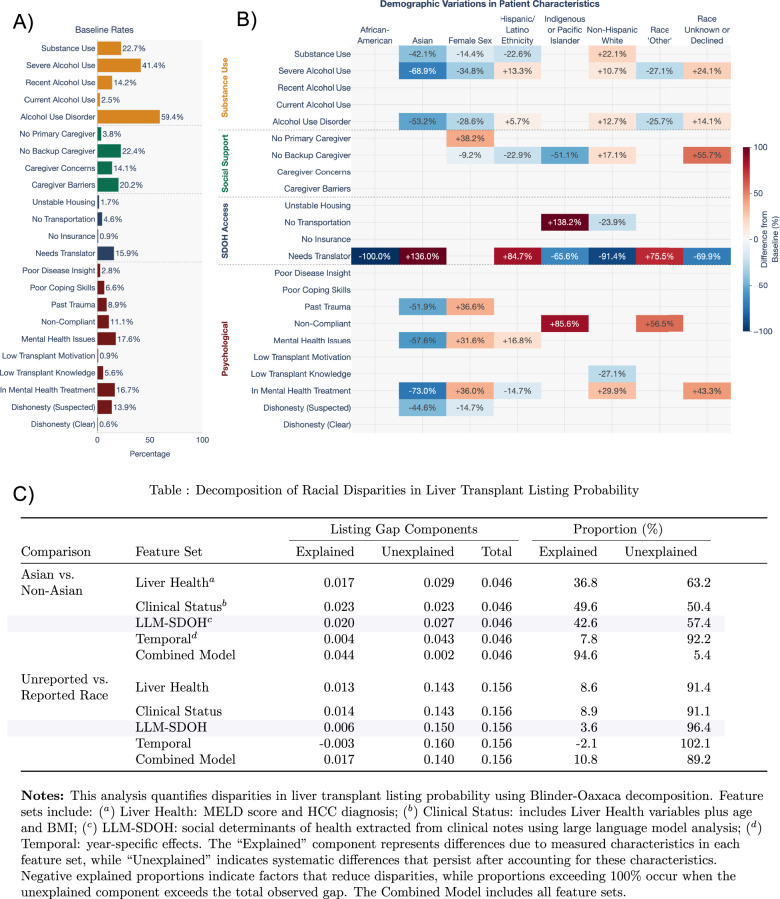
Psychosocial risk factors and social determinants of health (SDOH) contribute to persistent disparities in liver transplantation access. We developed a large language model framework to extract and analyze how these factors influence care trajectories. Prevalence of key modifiable barriers varied by demographics: social support gaps (35.4%, disproportionately affecting females), recent substance use (14.2-22.7%), and mental health challenges (17.6%, with Hispanic/Latino treatment gaps). Each factor was associated with 5-14 percentage point reductions in listing probability, comparable to clinical metrics. Psychosocial risk and SDOH factors explained 42.6% of racial disparities in listing decisions for Asian patients, exceeding liver health metrics (36.8%) and contributing to 94.6% collective explanation of differences. Priority interventions should target caregiver support, substance use, mental health, and patient education. This framework for systematically analyzing patient circumstances could enhance understanding of care decisions and health disparities.


Conflict of interest statement

Competing interests: J.G. previously received research support from Merck and Co. He previously served on an advisory board for Gilead Sciences and previously consulted for Madrigal Pharmaceuticals and Astellas Pharmaceuticals/Iota Biosciences. J.C.L. receives research support from Lipocene and Vir Biotechnologies; receives an education grant from Nestle Nutrition Sciences; serves on an advisory board for Novo Nordisk; and consults for Genfit, Third Rock Ventures, and Boehringer Ingelheim. I.Y.C. receives research support from Alphabet/Google and Apple.

Figures
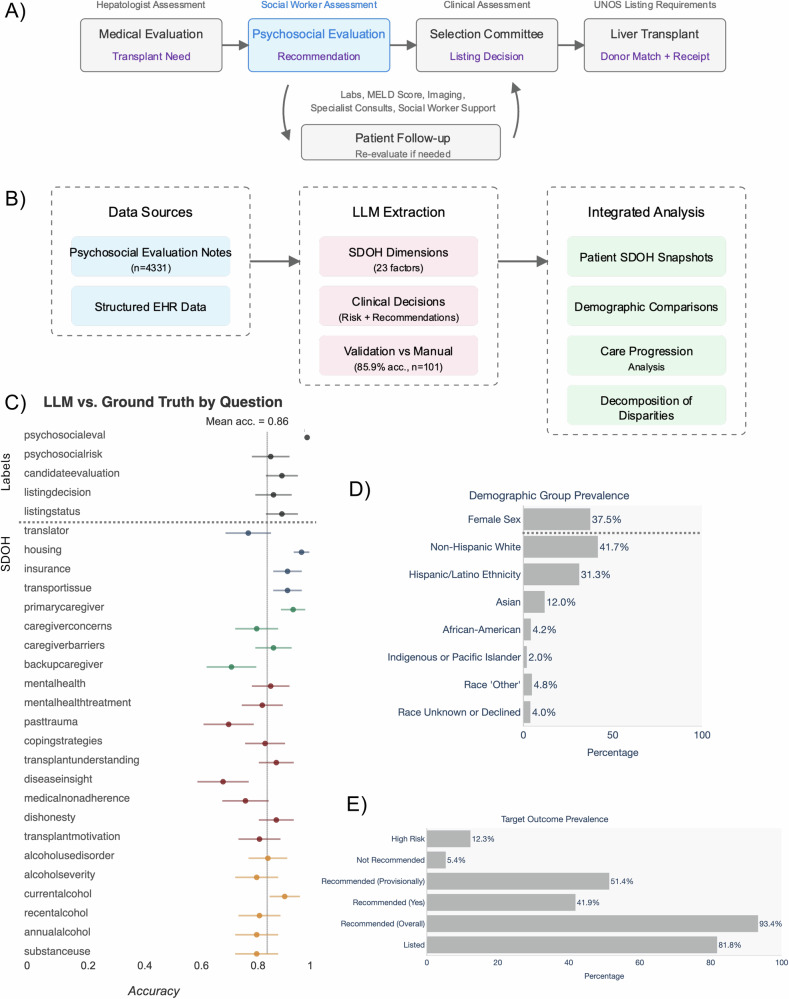
Fig. 1
Fig. 1. Framework for extracting and analyzing psychosocial risk and SDOH information from transplant evaluation notes.
A Schematic overview of the liver transplant care journey. Decision outcomes shown in purple. B Schematic overview of psychosocial risk and SDOH snapshot creation and analysis pipeline. Clinical notes are processed using LLMs to extract both (i) 23 psychosocial risk and SDOH dimensions describing patient circumstances* and (ii) clinical decisions/outcomes not captured in structured data (e.g., psychosocial risk assessments, transplant recommendations). These extracted elements are combined with structured clinical and demographic data from the EHR to create comprehensive patient snapshots at evaluation. The integrated data enables (i) comparison of psychosocial risk and SDOH factor prevalence across demographic groups, (ii) identification of transition points where specific factors impact care progression, and (iii) decomposition analysis of how psychosocial risk and SDOH patterns and clinical factors explain demographic differences in care access. This approach surfaces both individual-level circumstances and population-level patterns that can guide resource allocation and policy decisions. C Accuracy of GPT4-Turbo-128k vs. ground truth annotations (n = 101) for 28 questions, including 23 psychosocial risk and SDOH-related dimensions. D Demographic composition of the study cohort (n = 3704). E Prevalence of key clinical outcomes, including psychosocial recommendation status (Rec) and liver transplant (LT) listing rates. *Psychosocial risk and SDOH colored by related theme (yellow = ‘Substance Use’; green = ‘Social Support’; blue = ‘Access’, and red = ‘Psychological’).
Fig. 2
Fig. 2. Analysis of demographic disparities in liver transplant listing rates.
A Baseline prevalence rates for psychosocial and substance use factors identified in clinical notes. B Heatmap showing statistically significant differences in factor prevalence across demographic groups (two-proportion z-tests, p < 0.05, FDR-corrected), expressed as percentage-point differences from baseline; colored boxes represent statistically significant differences from patient average; blue indicates lower rates, red indicates higher rates. C Blinder-Oaxaca decomposition analysis quantifying explained and unexplained components of listing probability disparities, showing independent contributions of liver health metrics, psychosocial risk and SDOH features, and temporal effects.
Fig. 3
Fig. 3. Demographic and psychosocial risk/SDOH variation across liver transplant outcomes.
A Percentage of patients reaching each evaluation milestone stratified by demographic group, showing progression from initial psychosocial risk assessment through listing. Striped bars indicate significant differences from overall cohort means (FDR-corrected two-proportion z-tests). B Heatmap showing significant differences in psychosocial risk and SDOH factor prevalence between patients who did versus did not achieve each outcome (two-proportion z-tests, p < 0.05, FDR-corrected); blue indicates higher rates, red indicates lower rates, blank cells indicate non-significant differences. C OLS regression coefficients with LLM-derived, clinical, and demographic features. Significant coefficients marked (*p < 0.05, **p < 0.01, ***p < 0.001) and colored based on whether they have a positive (red) or negative (blue) impact on listing. Note on outcome classifications: “Recommended (Yes)” refers only to patients receiving unconditional recommendations, while “Recommended (Provisionally)” is a separate group. These two recommendation types are mutually exclusive. The “Overall” group includes both provisionally and unconditionally recommended patients. All other outcomes can co-occur.
Fig. 4
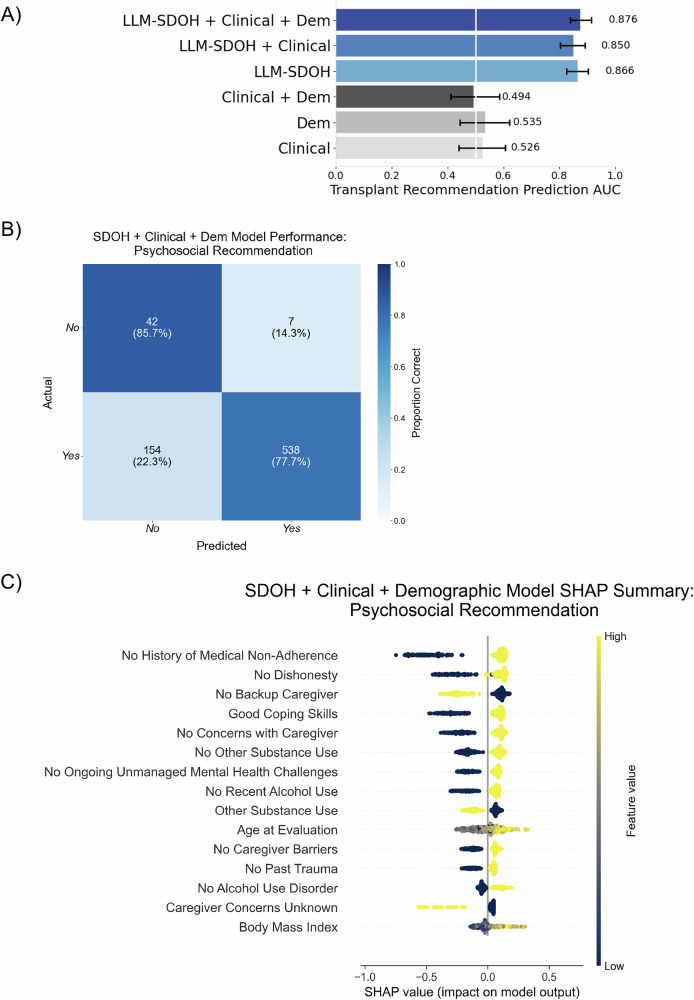
Fig. 4. Model performance and feature analysis for psychosocial recommendation prediction.
A Comparison of average AUROC (w. 95% CI) across six combinations of clinical, demographic, and LLM-derived feature sets. Feature sets including LLM-derived features shown in blue. B Confusion matrix for the LLM-SDOH + Clinical + Demographic combined feature model with normalized percentages over true values (rows). C SHAP (SHapley Additive exPlanations) values for the top 15 features for the model with all feature sets.
Fig. 5
Fig. 5. Model performance and feature analysis for liver transplant listing prediction.
A Comparison of average AUROC (w. 95% CI) across six combinations of clinical, demographic, and LLM-derived feature sets. Feature sets including LLM-derived features shown in blue. B Confusion matrix for the Clinical (left) and Clinical + LLM-SDOH combined feature model (right) with normalized percentages over true values (rows). C SHAP (SHapley Additive exPlanations) values for the top 15 features for the model with all feature sets.
Fig. 6
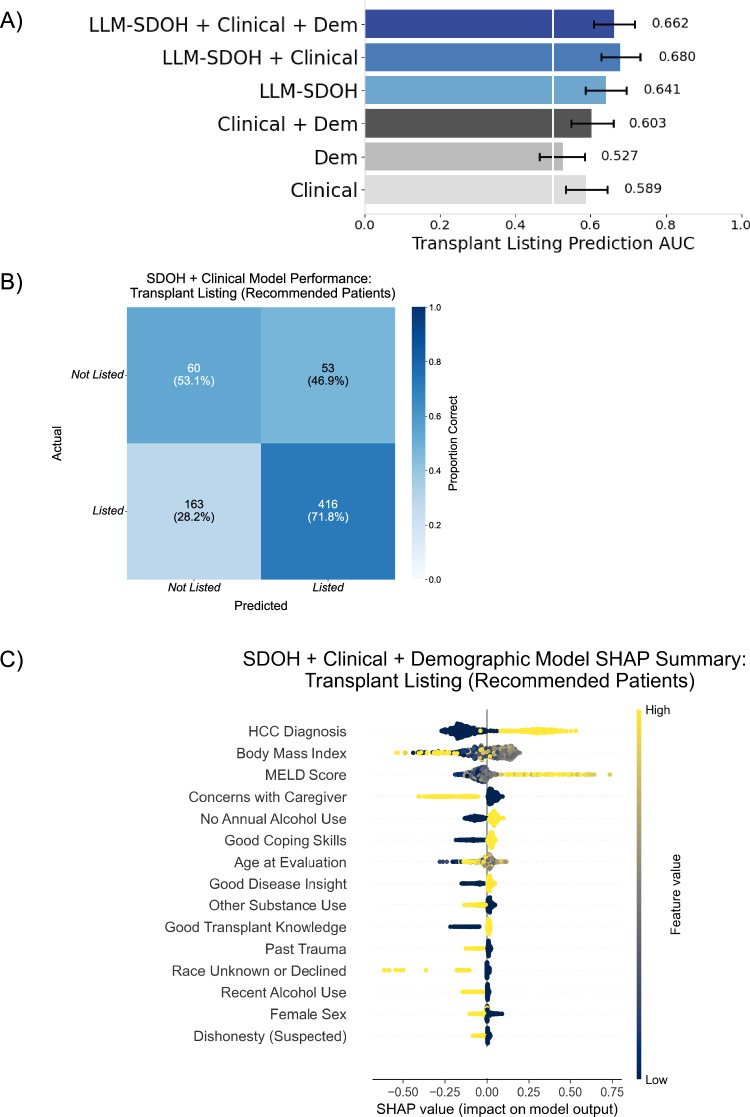
Fig. 6. Model performance and feature analysis for liver transplant listing prediction in patients with psychosocial recommendations.
A Comparison of average AUROC (w. 95% CI) across six combinations of clinical, demographic, and LLM-derived feature sets. Feature sets including LLM-derived features shown in blue. B Confusion matrix for the Clinical + LLM-SDOH combined feature model with normalized percentages over true values (rows). C SHAP (SHapley Additive exPlanations) values for the top 15 features for the model with all feature sets.

References

    1. Marmot, M. & Wilkinson, R. Social Determinants of Health (OUP, 2005).
    1. Marmot, M., Allen, J., Bell, R., Bloomer, E. & Goldblatt, P. WHO European review of social determinants of health and the health divide. Lancet380, 1011–1029 (2012). - PubMed
    1. Truong, H. P. et al. Utilization of social determinants of health ICD-10 Z-codes among hospitalized patients in the United States, 2016–2017. Med. Care58, 1037–1043 (2020). - PMC - PubMed
    1. Heidari, E., Zalmai, R., Richards, K., Sakthisivabalan, L. & Brown, C. Z-code documentation to identify social determinants of health among Medicaid beneficiaries. Res. Soc. Adm. Pharm.19, 180–183 (2023). - PubMed
    1. Wang, M., Pantell, M. S., Gottlieb, L. M. & Adler-Milstein, J. Documentation and review of social determinants of health data in the EHR: measures and associated insights. J. Am. Med. Inform. Assoc.28, 2608–2616 (2021). - PMC - PubMed

LinkOut - more resources