


This is a preprint.
Inactivating conditions of therapeutic mycobacteriophages
- PMID: 41256447
- PMCID: PMC12621657
- DOI: 10.1101/2025.09.30.679648
Inactivating conditions of therapeutic mycobacteriophages
Abstract
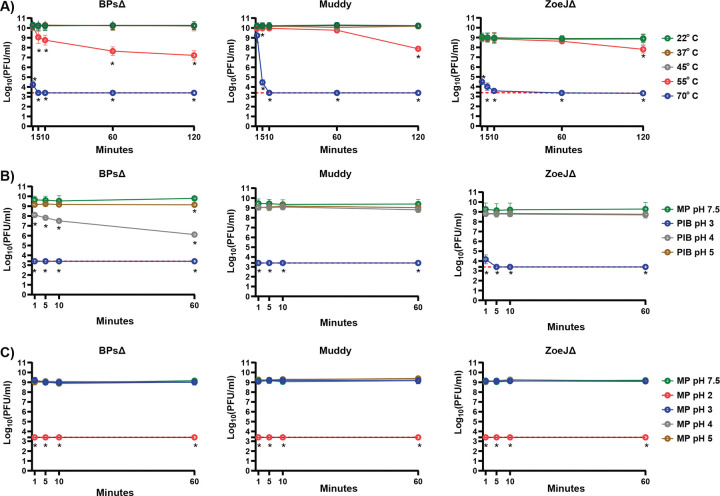
There is a need for new therapies to treat drug resistant nontuberculous mycobacteria (NTM) disease. Bacteriophages (phages), which are viruses that infect and kill bacteria, are actively being explored as an alternative approach for treating mycobacterial diseases. Several compassionate-use cases of phage therapy for drug resistant NTM infections exhibit favorable outcomes. To further the development of phage therapy it is important to recognize and avoid conditions that negatively impact phage activity during phage production, storage, formulation, or treatment. Conversely, there is a need to inactivate free phages in certain preclinical phage therapy experiments. In this study, we investigated three mycobacteriophages BPsΔ33HTH-HRM10, Muddy, and ZoeJΔ45 from compassionate-use NTM treatment cases for their sensitivity to a variety of conditions that included temperature, acid pH, detergents, mucus, and phage inactivating buffers. Several conditions resulted in dramatic and rapid reductions in the level of active phage while others had no effect. We also observed different sensitivities between the phages. The results provide valuable information to support further investigation and development of these phages as therapeutics.
Keywords: Bacteriophage; Nontuberculous Mycobacteria; mycobacteriophage.
Figures

References
-
- Dedrick RM, Smith BE, Cristinziano M, Freeman KG, Jacobs-Sera D, Belessis Y, Whitney Brown A, Cohen KA, Davidson RM, van Duin D, Gainey A, Garcia CB, Robert George CR, Haidar G, Ip W, Iredell J, Khatami A, Little JS, Malmivaara K, McMullan BJ, Michalik DE, Moscatelli A, Nick JA, Tupayachi Ortiz MG, Polenakovik HM, Robinson PD, Skurnik M, Solomon DA, Soothill J, Spencer H, Wark P, Worth A, Schooley RT, Benson CA, Hatfull GF. 2022. Phage Therapy of Mycobacterium Infections: Compassionate-use of Phages in Twenty Patients with Drug-Resistant Mycobacterial Disease. Clin Infect Dis doi: 10.1093/cid/ciac453. - DOI
-
- Jonczyk-Matysiak E, Lodej N, Kula D, Owczarek B, Orwat F, Miedzybrodzki R, Neuberg J, Baginska N, Weber-Dabrowska B, Gorski A. 2019. Factors determining phage stability/activity: challenges in practical phage application. Expert Rev Anti Infect Ther 17:583–606. - PubMed
-
- Jault P, Leclerc T, Jennes S, Pirnay JP, Que YA, Resch G, Rousseau AF, Ravat F, Carsin H, Le Floch R, Schaal JV, Soler C, Fevre C, Arnaud I, Bretaudeau L, Gabard J. 2019. Efficacy and tolerability of a cocktail of bacteriophages to treat burn wounds infected by Pseudomonas aeruginosa (PhagoBurn): a randomised, controlled, double-blind phase 1/2 trial. Lancet Infect Dis 19:35–45. - PubMed
Publication types
Grants and funding
LinkOut - more resources
Full Text Sources
