


Public knowledge and attitudes towards antibiotic use across England - pre- and post-pandemic
- PMID: 41272575
- PMCID: PMC12639946
- DOI: 10.1186/s12889-025-25233-3
Public knowledge and attitudes towards antibiotic use across England - pre- and post-pandemic
Abstract
Background: Antibiotic misuse is a major preventable driving factor for antimicrobial resistance (AMR). Most antibiotics are prescribed in primary care where demand for consultations for common self-limiting infections is greatest, meaning public knowledge may influence antibiotic prescribing. This study aims to explore how public knowledge of and attitudes towards antibiotics have changed over time.
Methods: Ipsos conducted interviews as part of routine surveys across England in 2020, 2021, 2022 and 2024. Random and quota sampling were used to ensure a representative sample. Questionnaire responses were weighted to ensure the results are broadly representative of the population. Pearson's Chi-squared test was used to test for differences in proportions across levels of categorical variables and between responses across the four years.
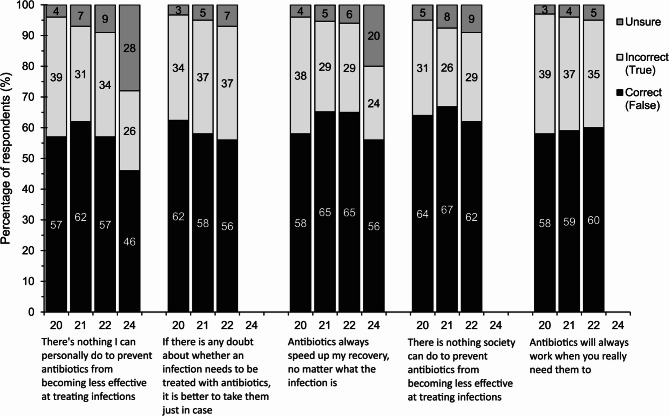
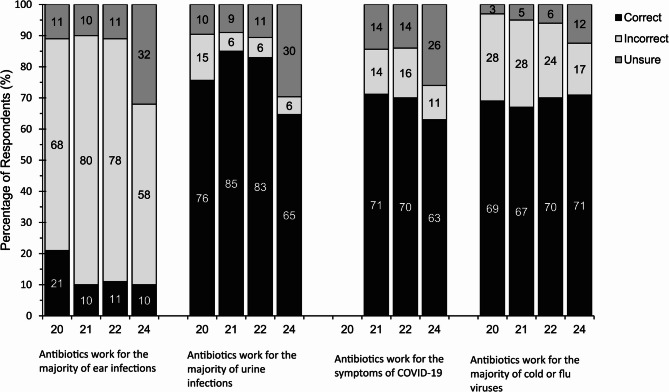
Results: Responses were obtained from 2,022 (pre-pandemic); 1,676 (pandemic-Y1); 1,663 (pandemic-Y2) and 3,024 (post-pandemic) respondents. The proportion of respondents who felt they had personal responsibility to tackle AMR increased from 57% pre-pandemic to 62% in pandemic-Y1 (p < 0.05), reducing to 46% post-pandemic. The proportion of respondents correctly answering the statement antibiotics will always speed up my recovery from an infection increased from 58% pre-pandemic to 65% in pandemic-Y1 and Y2 (p < 0.05), reducing to 56% post-pandemic. Knowledge regarding the use of antibiotics to treat ear, urine infections and COVID-19 was lowest post-pandemic. Trust in healthcare professionals (HCPs) regarding whether antibiotics are needed peaked during (range: 77% to 91%) and declined post-pandemic (range: 72% to 86%). The proportion of respondents who reported they would be pleased if their GP did not prescribe antibiotics was highest pre-pandemic (84%), decreasing to 65% post-pandemic. The proportion of respondents who were likely to request antibiotics from their GP declined from pre-pandemic (21%) to pandemic-Y1 (19%) but increased post-pandemic (25%). Demographic variations were observed across nearly all questions.
Conclusions: This paper highlights some concerning trends. Knowledge regarding AMR and the specific infections that antibiotics can treat has reverted to pre-pandemic levels, while levels of uncertainty about AMR and antibiotic use have increased. Although high, trust in HCPs has declined. Therefore, future interventions may wish to support HCPs to build trust with their patients and consider how care pathways can promote this.
Keywords: Antibiotic use; Antimicrobial resistance; Public attitudes; Public knowledge.
© 2025. Crown.
Conflict of interest statement
Declarations. Ethical approval and consent to participate: The Ipsos MORI surveys and interviews were undertaken outside the NHS setting, therefore NHS Research Ethics Committee review was not required. This ethical position was confirmed by the Head of Research Governance, Research Translation & Innovation Division at Public Health England. Ipsos is an independent research agency bound by the rules of the Market Research Society (MRS). The study was conducted in accordance with the MRS Code of Conduct ( https://www.mrs.org.uk/standards/code-of-conduct ). Consent for personal responses to be used by Ipsos clients for research purposes is indicated by verbal or written agreement and by the member of the household voluntarily completing the survey questionnaire/interview. Participants were free to withdraw their participation during the interview. All data processing and storage comply with the General Data Protection Regulation and UK Data Protection Act 2018. Consent for publication: Not applicable. Competing interests: The authors declare no competing interests.
Figures

References
-
- World Health Organisation. WHO strategic priorities on antimicrobial resistance: preserving antimicrobials for today and tomorrow. (2021) https://www.who.int/publications/i/item/9789240041387. Accessed 24 Oct 2025.
-
- Department of Health and Social Care. Confronting antimicrobial resistance 2024 to 2029. (2024) https://www.gov.uk/government/publications/uk-5-year-action-plan-for-ant.... Accessed 24 Oct 2025.
-
- UK Health Security Agency. English surveillance programme for antimicrobial utilisation and resistance (ESPAUR): Report 2023 to 202 4. (2024 ) https://assets.publishing.service.gov.uk/media/6734e208b613efc3f1823095/.... Accessed 24 Oct 2025.
MeSH terms
Substances
LinkOut - more resources
Full Text Sources
Medical
Research Materials
