[Preprint]. 2025 Oct 9:2025.10.09.681498.
doi: 10.1101/2025.10.09.681498.

Macrodomain ADP-ribose binding but not ADP-ribosylhydrolase activity is critical for chikungunya virus infection of Aedes mosquitoes

Affiliations

Macrodomain ADP-ribose binding but not ADP-ribosylhydrolase activity is critical for chikungunya virus infection of Aedes mosquitoes

Eugenia S Bardossy et al. bioRxiv. .

Abstract

Viral macrodomains are promising antiviral targets that counteract host ADP-ribosylation-mediated antiviral responses in mammals. However, their role in dual-host viruses within the mosquito vector is largely unknown. Here, we investigated the role of the chikungunya virus (CHIKV) macrodomain by mutating the active site asparagine 24 (N24). In both mammalian and mosquito cell lines, these enzymes rapidly acquired compensatory mutations at aspartate 31 (D31). We show that while N24 mutations abolish ADP-ribosylhydrolase catalytic activity and reduce folding stability, ADP-ribose binding remains intact. Furthermore, the D31 compensatory mutations do not markedly rescue catalytic activity or folding stability. Structures of the compensatory mutant macrodomains suggest the importance of ADP-ribose binding, rather than ADP-ribosylhydrolase catalysis as the selective pressure driving their accumulation. In mammalian cells, viral mutants bearing the catalytic and compensatory mutations replicated less efficiently than wild-type virus in interferon-competent cell lines. However, their replication remained unaffected in mosquito cells. In Aedes mosquitoes, macrodomain mutations had disparate impacts, either reducing or enhancing infectivity and transmission depending on the specific mutation and viral lineage. These findings emphasize that viral macrodomain function is complex and host-dependent, highlighting the need for multi-host understanding to develop effective antivirals.


Conflict of interest statement

Declaration of interests A.A. is a co-founder of Tango Therapeutics, Azkarra Therapeutics and Kytarro; a member of the board of Cytomx, Ovibio Corporation, Cambridge Science Corporation; a member of the scientific advisory board of Genentech, GLAdiator, Circle, Bluestar/Clearnote Health, Earli, Ambagon, Phoenix Molecular Designs, Yingli/280Bio, Trial Library, ORIC and HAP10; a consultant for ProLynx, Next RNA and Novartis; receives research support from SPARC; and holds patents on the use of PARP inhibitors held jointly with AstraZeneca from which he has benefited financially (and may do so in the future). J.S.F. is a consultant to, shareholder of, and receives sponsored research support from Relay Therapeutics and is a compensated member of the SAB of Vilya Therapeutics. The other authors declare no competing interests.

Figures

Figure 1.
Figure 1.. Asparagine 24 (N24) is not conserved in the macrodomains of mosquito-specific alphaviruses.
a, The CHIKV macrodomain is encoded within the first 160 amino acids of the viral nsP3 gene. b, Structure of the CHIKV macrodomain highlighting asparagine 24 (N24) and bound ADP-ribose (PDB 3GPO). c, Conservation analysis of residue 24 in macrodomains from 14 alphaviruses with different host tropisms: dual-host (CHIKV, SFV, SINV, VEEV, EEEV), mosquito-specific (ASALV, MWAV, EILV, TALV, YYV), and aquatic (SESV, SAV, SDV, SPDV). Macrodomain sequences from other human-pathogenic viruses (RuV, HEV, SARS-CoV-2) were also included. Protein sequences were obtained from the PDB or GenBank. Multiple sequence alignment (see Supplementary Figure 1a) and phylogram construction were performed using Clustal Omega tools. ZBD: zinc-binding domain; HVD: hypervariable domain; N: asparagine; K: lysine; T: threonine.
Figure 2.
Figure 2.. N24 mutations in the CHIKV macrodomain lead to the emergence of secondary mutations in D31 during viral stock production.
a, Point mutations were introduced into the CHIKV infectious clone in the viral macrodomain to change residue 24 from wild-type asparagine (N) to alanine (A) or aspartic acid (D) to generate two mutant viruses, N24A and N24D, respectively. b, For viral stock production, in vitro transcribed viral RNAs for WT, N24A, or N24D were transfected into Vero cells. Cell supernatant was collected after transfection (P0) and used to infect fresh Vero cells. The supernatant from this passage (P1) was then subjected to RNA extraction, RT-PCR amplification of the nsP3 gene, and Sanger sequencing. c, Sanger sequencing chromatograms of WT, N24A, and N24D viruses from P1. N24A and N24D sequences show novel mutations in residue 31 (D31N and D31H).
Figure 3.
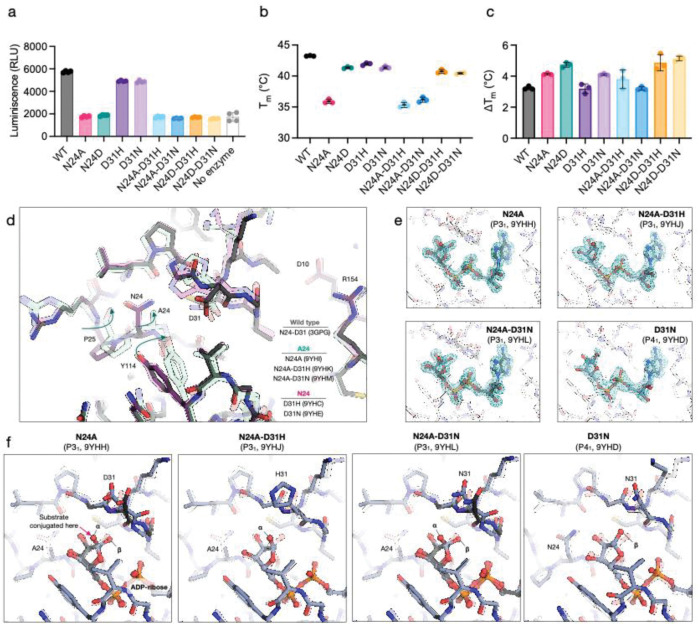
Figure 3.. Functional and structural characterization of CHIKV nsP3 macrodomain mutants.
a, Assays of the ADP-ribosylhydrolase activity of recombinantly expressed wild-type (WT) and mutant macrodomains. Macrodmains (200 nM) were incubated with auto-MARylated human PARP10 for 1 hour at room temperature and the production of ADP-ribose was measured using NUDT5 and an AMP-Glo luciferase assay. Data are plotted mean ± SD for four technical replicates. b, Thermostability of CHIKV nsP3 macrodomain mutants measured by DSF using SYPRO orange. Data are plotted mean ± SD for three technical replicates. c, Change in CHIKV nsP3 macrodomain thermostability upon incubation with 1 mM ADP-ribose. d, Alignment of the crystallographic structures of WT, N24A, N24A-D31N, N24A-D31H, D31H and D31N reveals a peptide flip in P25 and a coupled shift in Y114 in structures containing the N24A mutation. For clarity, only chain A is shown (see Supplementary Fig. 4a for all chains). e, Difference electron density maps (FO-FC, contoured at 3 σ) calculated prior to modeling ADP-ribose. Maps for all chains are shown in Supplementary Fig. 5. f, Crystal structures of N24A, D31N, N24A-D31H and N24A-D31N bound to ADP-ribose. Chain A is shown for the P31 structures and chain D for the P41 structure. Although the ADP-ribose binding pose is conserved, there is a rotameric shift at residue 31 that accompanies ADP-ribose binding, and mutations at position 31 change the character of the exit path of the substrate suggesting a role for substrate-specific recognition.
Figure 4.
Figure 4.. Effect of mutations in the macrodomain on CHIKV replication in mammalian and mosquito cells and in Aedes mosquitos.
a, Growth kinetics of Caribbean WT and mutant viruses (N24A-D31N and N24D-D31H/N) in BHK-21, Vero, and A549 mammalian cells, and in b, mosquito U4.4 cells. Error bars represent standard deviations from the mean. n = 3 for 0, 4, 8, 16, 32, 40 and 56 hours post infection (hpi), and n = 6 for 24 and 48 hpi. Data were analyzed using a mixed-effects model with the Geisser-Greenhouse correction followed by a Tukey’s multiple comparison test. Pink and blue asterisks indicate p-values in comparison to WT. c, Schematic representation of the in vivo experiments for infecting mosquitoes. Laboratory colonies of Aedes albopictus and Aedes aegypti were exposed to a blood meal containing WT, N24A-D31N (in pink) or N24A-D31H/N (in blue) viruses. After 2, 5 and 7 days, individual mosquitoes were collected for dissection. Plaque assays were performed on heads and bodies. d, Viral titers and prevalence of infection in the bodies (left panel) and heads (right panel) of Ae. albopictus and e, Ae. aegypti mosquitoes. The number of mosquitoes analyzed is indicated below (N). Error bars represent standard deviations from the mean. Viral titer data were analyzed using a two-way ANOVA followed by a Tukey’s multiple comparison test. Prevalences were compared using Fisher’s exact test.

References

    1. Leung A. K. L., Griffin D. E., Bosch J. & Fehr A. R. The Conserved Macrodomain Is a Potential Therapeutic Target for Coronaviruses and Alphaviruses. Pathogens 11, 94 (2022). - PMC - PubMed
    1. Taha T. Y. et al. A single inactivating amino acid change in the SARS-CoV-2 NSP3 Mac1 domain attenuates viral replication in vivo. PLOS Pathogens 19, e1011614 (2023). - PMC - PubMed
    1. Abraham R. et al. Both ADP-Ribosyl-Binding and Hydrolase Activities of the Alphavirus nsP3 Macrodomain Affect Neurovirulence in Mice. mBio 11, e03253–19 (2020). - PMC - PubMed
    1. McPherson R. L. et al. ADP-ribosylhydrolase activity of Chikungunya virus macrodomain is critical for virus replication and virulence. Proc Natl Acad Sci U S A 114, 1666–1671 (2017). - PMC - PubMed
    1. Aguilar E. G. et al. Sindbis Macrodomain Poly-ADP-Ribose Hydrolase Activity Is Important for Viral RNA Synthesis. J Virol 96, e0151621 (2022). - PMC - PubMed

Publication types

LinkOut - more resources