This is a preprint.
Patient and Health Care Facility Factors Associated with Advanced Cervical Lesions in Zambia Over 13-Year Period
- PMID: 41282226
- PMCID: PMC12633510
- DOI: 10.21203/rs.3.rs-7510691/v1
Patient and Health Care Facility Factors Associated with Advanced Cervical Lesions in Zambia Over 13-Year Period
Abstract
Introduction: Zambia has one of the highest burdens of cervical cancer worldwide, driven in part by its high HIV prevalence. In response, the country adopted nurse-led "screen and treat" services. Despite these efforts, anecdotal reports from Lusaka Province suggested an increase in advanced precancerous lesions among first-time screened women. This study aimed to examine patient and health care facility-level factors associated with the diagnosis and treatment of advanced cervical precancerous lesions (cervical intraepithelial neoplasia 2 and 3 (CIN2/3)) to inform targeted improvements in screening and referral practices.
Methods: This study included a retrospective cohort of first-time cervical cancer screened women in all six districts of Lusaka Province, Zambia, from 2010 to 2022. Screening data of women aged 18 and older who underwent visual inspection with acetic acid (VIA) screening were included. Patient-level variables analyzed included age, HIV status, VIA results, and treatment plan. Facility characteristics included facility level and district. Bivariate analyses assessed associations between patient/facility characteristics and advanced cervical lesion treatment. Multivariable logistic regression estimated the adjusted odds of presenting with advanced lesions requiring referral.
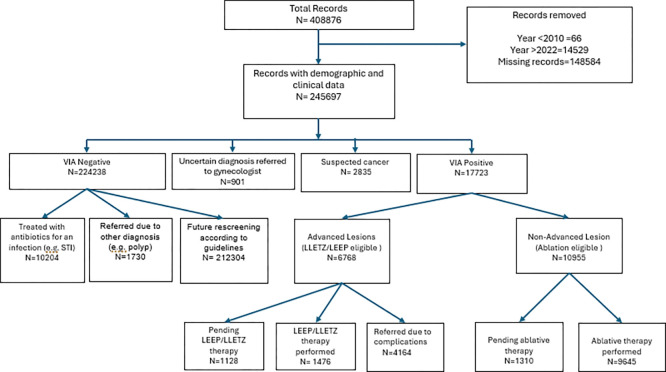
Results: A total of 6,768 women were diagnosed with advanced lesions eligible for loop electrosurgical excision procedure (LEEP) treatment. Among those, 1,476 (21.8%) received LEEP treatment, and 4,164 (61.5%) were referred due to complications. Between 2017 and 2022, 53.3% more women received treatment than between 2010 and 2016. Compared with HIV-negative women, newly diagnosed women with HIV were 2.09 times more likely to have complicated advanced lesions (p < 0.0001). Compared to rural facilities, urban facilities had 0.1 -fold lower odds of referral (p < 0.0001). Compared with third-Level hospitals, health posts had the highest odds of referrals (3.3, p < 0.0001), followed by health centers (1.7, p <0.0001).
Conclusion: Increases in screening facilities after 2016 led to increased rates of advanced lesion detection. HIV-positive women who were not receiving antiretroviral treatment (ART) were at increased risk of complicated lesions. Finally, lower-level, and rural facilities had higher referral rates for advanced cases. These findings highlight the need to improve provider training and treatment capacity to reduce unnecessary referrals and efficient local management of screened women at rural and lower-level facilities.
Keywords: Cervical cancer lesions; Cervical cancer screening; HIV; Zambia.
Conflict of interest statement
Additional Declarations: No competing interests reported.
Figures
References
-
- WHO. WHO Fact Sheet: Cervical cancer. November 17. 2023. Accessed February 7, 2024. https://www.who.int/news-room/fact-sheets/detail/cervical-cancer
-
- WHO. Zambia steps up cervical cancer screening with HPV testing. WHO | Regional Office for Africa. February 2. 2024. Accessed June 8, 2024. https://www.afro.who.int/countries/zambia/news/zambia-steps-cervical-can...
-
- WHO, Zambia, Cervical Cancer Profile. Published online 2021. Accessed February 7, 2024. https://cdn.who.int/media/docs/default-source/country-profiles/cervical-...
-
- Tsehaiu M. February. Global Fund support for screening and treatment of cervical cancer in Zambia. Presented at: 2020. https://togetherforhealth.org/wp-content/uploads/Global-Fund-support-to-...%
-
- Ministry of Health, Zambia. Zambia National Guidelines For Cervical Cancer Screening. Published online October; 2023.
Publication types
Grants and funding
LinkOut - more resources
Full Text Sources