. 2025 Dec;57(12):3165-3174.
doi: 10.1038/s41588-025-02400-1. Epub 2025 Nov 24.

Proteome-wide model for human disease genetics

Affiliations

Proteome-wide model for human disease genetics

Rose Orenbuch et al. Nat Genet. 2025 Dec.

Abstract

Missense variants remain a challenge in genetic interpretation owing to their subtle and context-dependent effects. Although current prediction models perform well in known disease genes, their scores are not calibrated across the proteome, limiting generalizability. To address this knowledge gap, we developed popEVE, a deep generative model combining evolutionary and human population data to estimate variant deleteriousness on a proteome-wide scale. popEVE achieves state-of-the-art performance without overestimating the burden of deleterious variants and identifies variants in 442 genes in a severe developmental disorder cohort, including 123 novel candidates. These genes are functionally similar to known disease genes, and their variants often localize to critical regions. Remarkably, popEVE can prioritize likely causal variants using only child exomes, enabling diagnosis even without parental sequencing. This work provides a generalizable framework for rare disease variant interpretation, especially in singleton cases, and demonstrates the utility of calibrated, evolution-informed scoring models for clinical genomics.


Conflict of interest statement

Competing interests: The authors declare no competing interests.

Figures

Fig. 1
Fig. 1. popEVE combines deep evolution and human variation.
popEVE combines variation from across evolutionary sequences, modeled with EVE and ESM-1v, with variation within the human population (UKBB or GnomAD), using a Gaussian process to learn the relationship between evolutionary scores and missense constraint.
Fig. 2
Fig. 2. popEVE captures variant severity and pathogenicity.
a, ClinVar pathogenic variants in phenotypes associated with premature death in childhood have more deleterious popEVE scores than those associated with death after maturation (left). Death labels were acquired from OrphaNet. At the fifth percentile of ClinVar benign variants, popEVE has a significantly larger odds ratio than any other method (right). b, Variants associated with onset in childhood have more deleterious popEVE scores than those associated with onset later in life (left), and popEVE has a greater odds ratio than other methods (right). c, popEVE scores for DNMs in SDD cases (top) and diagnosed cases (bottom) are shifted towards the deleterious end compared to controls (unaffected siblings from autism spectrum disorder family cohorts). d, Using DNMs from both SDD cases and controls, we define a severely and moderately deleterious score threshold by fitting a two-component Gaussian mixture model and finding the 99.99% and 99% likelihood of being in the more deleterious distribution. e, With increasingly pathogenic thresholds, de novo mutations in the SDD metacohort are significantly enriched (top). At our severely pathogenic threshold, popEVE pathogenic variants exhibit over 15-fold enrichment, while popEVE benign variants are in line with expectation (bottom). Moderately pathogenic variants are enriched fivefold. The expected number of variants is quantified using a background mutation rate based on the number of individuals in the metacohort.
Fig. 3
Fig. 3. popEVE recalls severe genetic disorder cases without overpredicting pathogenicity in the general population.
a, In the UKBB, individuals have at most one homozygous and up to three heterozygous severely deleterious variants; 96% of the 500k individuals have no severely pathogenic missense variants (left). Approximately 72% of UKBB individuals have no severely or moderately deleterious variants and at most five moderately deleterious variants (right). b, popEVE is better at separating diagnosed DD cases from controls based on DNMs than other state-of-the-art variant effect predictors with an average precision of 97%. Recall is adjusted based on the expected number of these cases to have a causal missense DNM (Methods). c, popEVE recalls more SDD diagnosed cases based on their DNMs without overpredicting pathogenicity in WES from relatively healthy controls from UKBB (gnomAD-trained popEVE). d, DNMs in SDD cases from the DDD Study are enriched for pathogenic variants in comparison to their rare inherited variants (MAF < 0.01) (two-sided Kolmogorov–Smirnov = 0.24, P < 0.0001). e, To recall 100% of de novo missense-diagnosed cases using their WES, popEVE predicts that far less of the general population will have a similarly deleterious variant than any other model. f, When applied to WES from a subset of the SDD cases, popEVE recalls more cases than other models without overpredicting pathogenicity in the general population of UKBB (using gnomAD-trained popEVE). Additionally, popEVE recalls 100% of cases expected to have a causal missense DNM for only 15% of the remaining cases and 16% of the general population (circles). Other models find that >78% of the UKBB has a variant as deleterious as these cases (inset).
Fig. 4
Fig. 4. popEVE finds evidence for 123 novel candidate genes in SDDs.
Both popEVE gene and variant-association methods achieve 94% recall of genes previously discovered in the cohort with solely missense variation. There is a greater overlap between popEVE gene collapsing and this previously discovered set than the thresholding approach, owing to the similarity in their approach.
Fig. 5
Fig. 5. Deleterious scoring variants lie in 3D interaction sites of candidate genes.
A total of 91% of our defined deleterious variants are within 8 Å (72% are within 5 Å) of an interaction partner. a, ETF1 (eRF1), a gene crucial for protein synthesis, contains our two most deleterious scoring variants (R192C and R68L), both close (<3.2 Å) to the ribosomal phosphate backbone (PDB 6D90 and PDB 7NWH) and are proximal to known functional motifs; R68 is part of the NIKS motif that determines stop codon recognition, and R192 to the GGQ motif that triggers the hydrolysis of the peptidyl-tRNA ester bond. b, Q60 in EIF4A2 (DDX2B) is <2 Å from the N6 of the adenine of phosphoaminophosphonic acid-adenylate ester (ANP). c, Many deleterious scoring variants are in the NuRD chromatin complex, such as M31R in HDAC2, which is 3.4 Å from the histone mimic inhibitor in 3MAX, and H37R in RBBP4, which is 3.8 Å from MTA1 in 4PC0. d, The calcium-gated ion channel complex contains deleterious scoring variants in key interaction sites, I637F in KCNN2 in the highly conserved T(V/I)GYG K+ pore motif, and D24Y in CALM1, which chelates the Ca2+ in the wild type (homologous complex structure PDB 6CNN).
Fig. 6
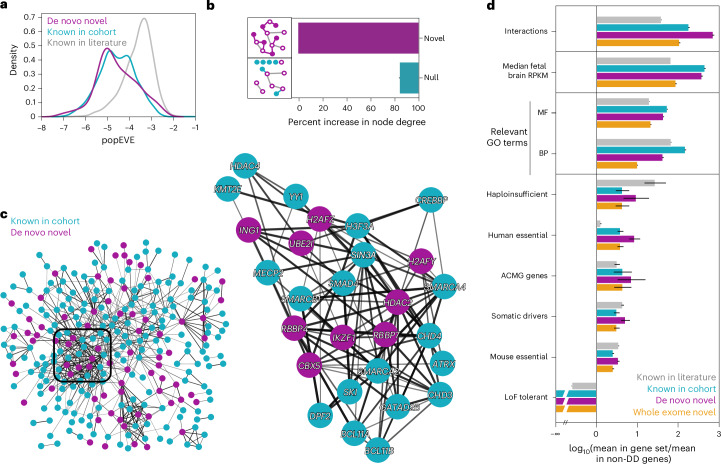
Fig. 6. popEVE novel candidates are functionally similar to known DD genes.
a, Novel candidate genes and genes previously identified in the same SDD cohort have a similar distribution of case DNMs compared to DD genes identified elsewhere. b, Novel genes have many biochemical interactions with genes previously identified in the same cohort—inclusion of novel genes increases node degree 100% compared to random sets (two-sided t-test, P < 0.0001). c, The densest portion of the network includes many genes involved in chromatin modeling. d, Novel (n = 123) and known DD genes (known in cohort n = 280, known in literature n = 2,235) show similar enrichment in properties known to differentiate known DD genes from non-DD genes (bar values show log ratio of mean in gene set of interest to mean of non-DD genes; error bars show 95% CI from bootstrapping with 1,000 simulations). RPKM, reads per kilobase of transcript per million mapped reads; GO, Gene Ontology; MF, molecular function; BP, biological processes; Extended Data Fig. 8.
Fig. 7
Fig. 7. popEVE recalls candidates without parental genomes.
a, popEVE ranks missense DNMs in known DD genes as most deleterious compared to their inherited variants in diagnosed SDD cases, better than any other model. b, Genes identified using DNMs compare with those identified using inherited variants. c, Novel candidate genes and genes previously identified in the same SDD cohort have a similar distribution of whole-exome case variants as compared to DD genes identified elsewhere, particularly at the deleterious end (inset shows entire distribution of scores).
Extended Data Fig. 1
Extended Data Fig. 1. Performance summary for separating Benign/Likely Benign from Pathogenic/Likely Pathogenic ClinVar labels.
Assessing the performance of popEVE and popular supervised and unsupervised variant effect prediction models on individual genes that have at least 5 benign and 5 pathogenic variants from the ClinGen curation of a. ClinVar 2019 and b. ClinVar 2020, using the area under the receiver-operating curve. The ClinGen dataset attempts to address data leakage in the estimation of performance of supervised methods by removing ClinVar variants used in training. This test lacks the resolution to distinguish state-of-the-art models. This is highlighted by the fact the ranking of AUCs in the ClinGen 2020 and ClinGen 2019 significantly changes. c. Breakdown of performance by gene.
Extended Data Fig. 2
Extended Data Fig. 2. Correlation of computational variant effect predicting models with high-throughput experimental assays.
Assessing the performance of popEVE compared to popular supervised and unsupervised variant effect prediction models when compared to high-throughput functional assays on human genes (from ProteinGym), averaging a and across individual assays b. On average popEVE outperforms other models.
Extended Data Fig. 3
Extended Data Fig. 3. Correlation between EVE and Esm1v scores.
Scores for a random sample of 1 million variants across the human proteome. Pearson correlation is low - 0.55 (p-value=0.0).
Extended Data Fig. 4
Extended Data Fig. 4. popEVE shows minimal population bias across diverse ancestries.
The distribution of popEVE scores for rare variants (AF<0.01) is consistent across populations found in gnomAD, indicating that despite using primarily non-Finnish European subjects for score adjustment there is no population bias. Variants not seen any gnomAD population are in grey. The 99.9% percentile for each distribution is marked with an arrow.
Extended Data Fig. 5
Extended Data Fig. 5. Correlation between popEVE gene-level statistics and gene-level constraint measures.
Pearson correlation between gene-level measures of constraint and EVE and popEVE minimum, maximum and mean score per gene. We find poor correlation between popEVE and gene-level constraint measures, except for MissenseZ and popEVE mean, with pearson = 0.61 (p-value = 0.0).
Extended Data Fig. 6
Extended Data Fig. 6. Odds ratios of ClinVar pathogenic variants in genes associated with premature death and onset.
Odds ratios (threshold for each model set at 5th percentile of benign variants in ClinVar) for various models of ClinVar pathogenic variants (with at least 1 star curation rating) in phenotypes associated with (a) death and (b) onset in childhood versus adulthood.
Extended Data Fig. 7
Extended Data Fig. 7. popEVE is better at separating developmental disorder cases from healthy controls than other state-of-the-art models.
a. Extension of Fig. 2c with all models - popEVE is better at separating “diagnosed” SDD cases whose disorder is likely to be caused by a de novo missense variant (cases with at least one missense variant in a known developmental disorder gene) from controls than other state of art variant effect predictors with an average precision of 97%. b. Precision recall for “high-confidence diagnosed” SDD cases (at least one de novo missense in a gene discovered by DeNovoWEST in the same cohort). c. Precision recall for all cases vs controls. d. Extension of Fig. 2d with all models - popEVE recalls more SDD cases (with at least one missense variant in DNW-discovered genes) without overpredicting pathogenicity in healthy controls from UKBB. While popEVE recalls 50% of these individuals for only 16% of the UKBB, the next best model, Alpha Missense, predicts 92% of UKBB has a variant as pathogenic as 50% of this SDD subset. e. Extension of Fig. 3b with all models - For each score threshold, we plot the percent of individuals with a de novo missense variant ranked as more deleterious than rare inherited variants. In individual cases, popEVE is better at ranking de novo mutations as more deleterious than rare inherited variants (MAF<0.01) than other models.
Extended Data Fig. 8
Extended Data Fig. 8. Functional enrichment of known and novel genes.
Novel (from de novo SDD case variants and whole exome DDD variants) and known developmental disorder genes (from literature and previously discovered in the SDD cohort) show similar enrichment in properties known to differentiate known DD-genes from non-developmental disorder genes (95% CI from bootstrapping shown).
Extended Data Fig. 9
Extended Data Fig. 9. Novel genes increase node connectivity of known developmental disorder genes.
a, Novel popEVE discovered genes are embedded into the network of previously-discovered disease associated genes from DDG2P and DeNovoWEST. Taking the set of 99.99 confidence threshold popEVE genes, we built a network using STRINGdb (‘experiments’ and ‘coexpression’ at a medium 0.4 score threshold). Colored nodes are novel discoveries and white nodes are known disease-associated genes. These nodes were clustered into four clusters using k-means clustering. b, When added to a network of know developmental disorder genes, novel genes from the full SDD meta-cohort had a 42% increase in node degree as compared to random sets of the same number of genes which saw an average of 9% (with p < 0.000, t-test). c, When added to a network of know developmental disorder genes, novel genes from the DDD sub-cohort had a 53% increase in node degree as compared to random sets of the same number of genes which saw an average of 19% (with p < 0.000, t-test).

Update of

References

    1. Kruglyak, L. & Nickerson, D. A. Variation is the spice of life. Nat. Genet.27, 234–236 (2001). - PubMed
    1. Shirts, B. H., Pritchard, C. C. & Walsh, T. Family-specific variants and the limits of human genetics. Trends Mol. Med.22, 925–934 (2016). - PMC - PubMed
    1. Veltman, J. A. & Brunner, H. G. De novo mutations in human genetic disease. Nat. Rev. Genet.13, 565–575 (2012). - PubMed
    1. Wright, C. F. et al. Genomic diagnosis of rare pediatric disease in the United Kingdom and Ireland. N. Engl. J. Med.388, 1559–1571 (2023). - PMC - PubMed
    1. 100,000 Genomes Project Pilot Investigators. 100,000 genomes pilot on rare-disease diagnosis in health care—preliminary report. N. Engl. J. Med.385, 1868–1880 (2021). - PMC - PubMed

LinkOut - more resources