. 2025 Nov 24;25(1):1629.
doi: 10.1186/s12870-025-07686-1.

A novel protocol for protoplast isolation, transfection, and culture in Cannabis sativa L

Affiliations

A novel protocol for protoplast isolation, transfection, and culture in Cannabis sativa L

Katarzyna Stelmach-Wityk et al. BMC Plant Biol. .

Abstract

Background: Protoplasts are a valuable tool for studying gene expression and applying genome editing techniques. Given the high medicinal and industrial potential of Cannabis sativa L., developing an efficient protoplast-to-plant regeneration protocol is highly desirable. Due to its recalcitrant nature, a complete plant regeneration from cannabis protoplasts has not yet been achieved.

Results: This study details a robust protocol for cannabis protoplast isolation, purification, transient transfection, and culture, additionally reporting somatic embryo-like structures derived from protoplast-derived callus. We demonstrated that the age of donor material, the composition of the enzyme solution, and the duration of enzymolysis are crucial for efficient protoplast isolation. Protoplast embedding, coupled with a rich culture medium and plant growth regulators, proved critical for initiating cell wall re-synthesis, cell division, and microcallus formation. Protoplasts isolated using the reported protocol were abundant (2.2 × 10⁶ protoplasts/1 g of fresh weight), viable (78.8% viability) and able to undergo cell wall re-synthesis (56.1% of viable cells), followed by cell divisions (15.8% plating efficiency). Polyethylene glycol-mediated transfection yielded a 28% transfection efficiency and 17% plating efficiency in 10-day cultures. Protoplast-derived microcalli successfully proliferated on six regeneration media containing various concentrations of 6-benzylaminopurine and thidiazuron, exhibiting further proliferation and greening within two months.

Conclusions: This system provides a reliable protocol for isolation, transfection and culture of cannabis protoplasts. It also offers a framework for investigating gene function, as well as advancing protoplast fusion and genome editing technologies for this species.

Keywords: 2-aminoindane-2-phosphonic acid; Hemp; Phytosulfokine; Protoplast embedding; Tissue cultures.


Conflict of interest statement

Declarations. Ethics approval and consent to participate: Not applicable. Consent for publication: Not applicable. Competing interests: The authors declare no competing interests.

Figures
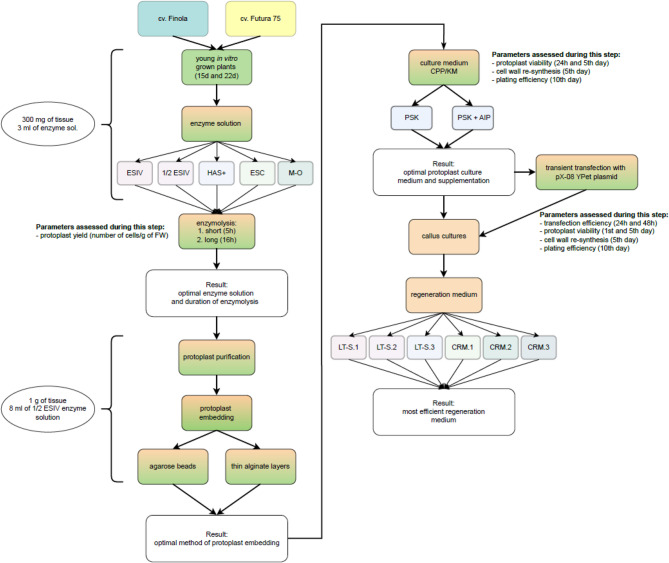
Fig. 1
Fig. 1
Flow chart illustrating a step-by-step approach to develop a protocol for protoplast isolation, purification, culture and regeneration in Cannabis sativa L. Details and used abbreviations are explained in the Materials and methods section and Table 1
Fig. 2
Fig. 2
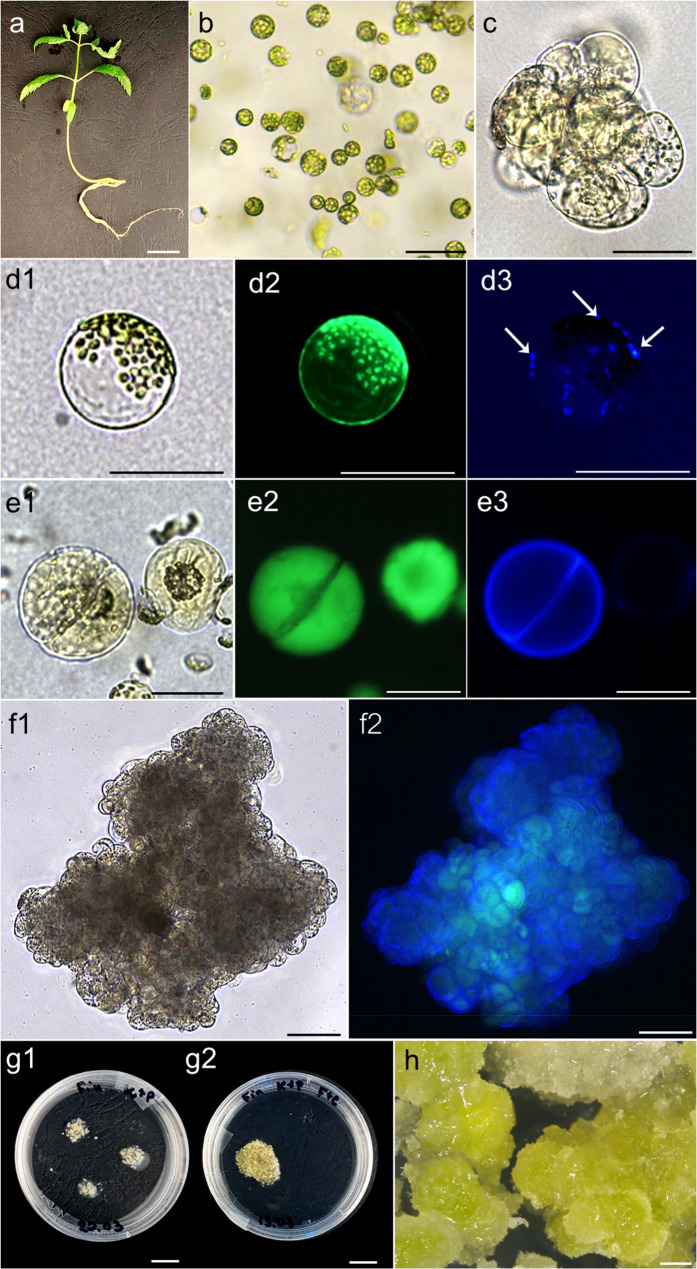
Isolation and culture of cannabis protoplasts. a a 15-day-old donor plant of ‘Finola’ germinated from seeds in vitro; b plant-derived intact protoplasts after long enzymolysis (16 h) in ½ESIV enzyme solution; c a multicellular protoplast-derived colony observed on the 10th day of culture in the KM medium; d1-3 a viable protoplast re-synthesizing cell wall stained with fluorescein diacetate (FDA; d2) and calcofluor white (CFW; d3) 24 h after embedding in alginate; d3 blue fluorescence signals marked with arrows indicate the presence of reconstituted cellulose on the cell surface; e1-3 first mitotic division of a viable (e2) protoplast-derived cell with a fully re-synthesized cell wall (e3) observed in the KM medium; f1-2 a viable multicellular protoplast-derived colony observed on the 15th day of culture in the KM medium (f1 – bright field, f2 – fluorescence: merged signals from FDA and CFW); g1 agarose droplets fully overgrown with protoplast-derived callus on the 20th day of culture; g2 alginate layer fully overgrown with protoplast-derived callus on the 20th day of culture; h protoplast-derived callus two weeks after transfer onto regeneration medium LT-S.1. Scale bar: 50 μm (b, c, d1-3, e1-3), 100 μm (f1-2), 1 mm (h), 1 cm (g1–2), 2 cm (a)
Fig. 3
Fig. 3
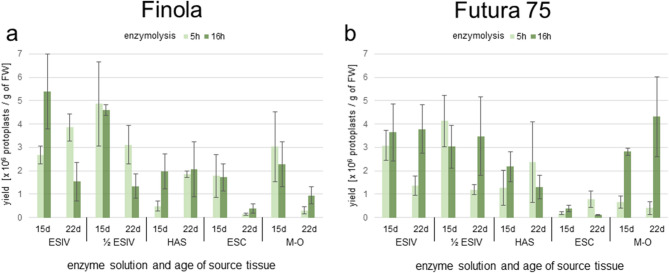
The effect of enzyme solutions on the protoplast yield of ‘Finola’ (a) and ‘Futura 75’ (b). The yield of protoplast isolations per 1 g of fresh weight (FW) with respect to the enzyme solution used (ESIV, 1/2ESIV, HAS, ESC and M-O), age of source tissue (15 and 22 days), and duration of enzymolysis (5 and 16 h). Each bar represent three replicates. No significant interactions between the age of donor, enzyme solution used and duration of enzymolysis were detected for either ‘Finola’ or ‘Futura 75’ (ANOVA)
Fig. 4
Fig. 4
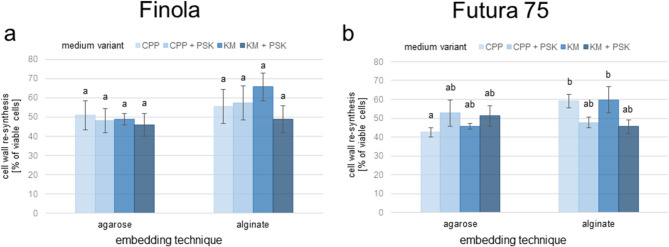
The effect embedding technique on cell wall re-synthesis of cannabis protoplasts. The efficiency of cell wall re-synthesis in five-day-old protoplast cultures of ‘Finola’ (a) and ‘Futura 75’ (b) with respect to the embedding technique and culture medium. Each bar represent three replicates. Means with the same letters were not significantly different at p ≤ 0.05 (ANOVA with separation of means done using the Tukey post-hoc test (HSD) for equal sample size)
Fig. 5
Fig. 5
Effect of protoplast embedding technique (a) and culture medium (b) on the plating efficiency in protoplast cultures of two cannabis cultivars. Plating efficiency is expressed as frequency of cell colonies formed assessed on the 10th day of the protoplast culture. Means with the same letters were not significantly different at p ≤ 0.05 (ANOVA with separation of means done using the Tukey post-hoc test (HSD) for equal sample size). Abbreviations: SE – standard error of the mean; PSK = 100 nM of phytosulfokine; AIP = 0.04 mg of 2-aminoindane2-phosphonic acid. Number of analyzed protoplast cultures (from at least three independent isolations) per cultivar: a n = 18; b n = 6
Fig. 6
Fig. 6
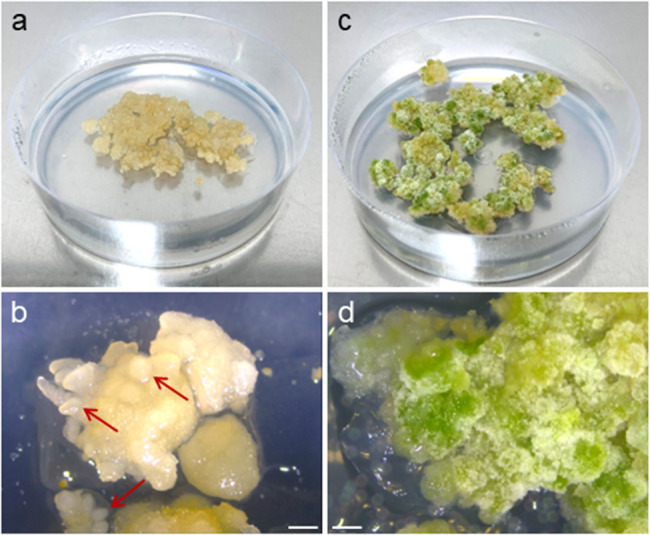
Cultures of protoplast-derived ‘Finola’ callus. a, b a 30-day-old callus culture on BI* proliferation medium with visible forming embryo-like structures (marked with arrows); c, d a 30-day-old green nodular callus cultured on LT-S.1 regeneration medium. Scale bar: 1 mm
Fig. 7
Fig. 7
PEG-mediated transfection of cannabis protoplasts. a1, a2 protoplasts 24 h after PEG-treatment with visible transient expression of YPet fluorescent protein (transfected cells marked with arrows); b1, b2 transfected protoplast with visible nuclear localization of expressed YPet protein (strong green fluorescence on b2); c1, c2 PEG-treated protoplast with re-synthesized cell wall undergoing first asymmetric mitotic division; d cell colonies formed in 14-day-old PEG-treated culture; e formation of protoplast-derived microcallus in 4-week-old cultures: PEG(-) callus cultures derived from protoplasts not treated with PEG (control), YPet + callus cultures derived from protoplasts transfected with 17.2 µg of pX-08 YPet plasmid. Scale bar: 10 μm (c1, c2), 25 μm (b1, b2), 50 μm (a1, a2), 100 μm (d), 1 cm (e)
Fig. 8
Fig. 8
The effect of PEG treatment on culture parameters of cannabis protoplasts and transfection efficiency. a protoplast viability assessed on the 1 st and 5th day of culture; b cell wall re-synthesis expressed as percent of cells undergoing or with a complete re-synthesis in relation to viable cells on the 5th day of culture; c number of cell colonies (plating efficiency) on the 10th day of culture; d transfection efficiency observed 24 and 48 h after transfection. Number of replicates: an = 3, bn = 3, cn = 3, dn = 3. Statistically significant differences were calculated using an unpaired T-test and are marked by asterisks. Abbreviations: PEG - ‒ protoplasts not subjected to PEG treatment; PEG + ‒ protoplasts subjected to PEG treatment
Fig. 9
Fig. 9
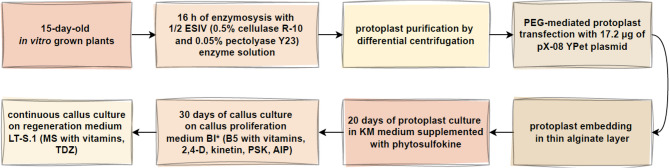
Flow chart illustrating the developed protocol for protoplast isolation, purification, transfection, culture, and regeneration in Cannabis sativa L. Details and used abbreviations are explained in the Materials and methods section

References

    1. Grand View Research market analysis report. Industrial hemp market size, share & trends analysis report by application (animal care, textiles, food & beverages), by product (seeds, fiber, shivs), by region (North America, Asia Pacific), and segment forecasts, 2024–2030. www.grandviewresearch.com/industry-analysis/industrial-hemp-market. Assessed 23 July 2025.
    1. Hesami M, Baiton A, Alizadeh M, Pepe M, Torkamaneh D, Jones AMP. Advances and perspectives in tissue culture and genetic engineering of cannabis. Int J Mol Sci. 2021;22:5671. - PMC - PubMed
    1. Reed KM, Bargmann BOR. Protoplast regeneration and its use in new plant breeding technologies. Front Genome Ed. 2021;3:20. - PMC - PubMed
    1. Andersson M, Turesson H, Olsson N, Fält A-S, Ohlsson P, Gonzalez MN, et al. Genome editing in potato via CRISPR-Cas9 ribonucleoprotein delivery. Physiol Plant. 2018;164:378–84. - PubMed
    1. Park J, Choi S, Park S, Yoon J, Park AY, Choe S. DNA-Free genome editing via ribonucleoprotein (RNP) delivery of CRISPR/Cas in lettuce. In: Qi Y, editor. Plant genome editing with CRISPR systems: methods and protocols. New York, NY: Springer; 2019. pp. 337–54. - PubMed

LinkOut - more resources