


Initiating community intermittent preventive treatment of malaria in pregnancy in Senegal: qualitative evaluation of stakeholder acceptability and experience
- PMID: 41291717
- PMCID: PMC12648916
- DOI: 10.1186/s12936-025-05646-6
Initiating community intermittent preventive treatment of malaria in pregnancy in Senegal: qualitative evaluation of stakeholder acceptability and experience
Abstract
Background: Uptake of community delivery of intermittent preventive treatment for malaria in pregnancy (c-IPTp) with sulfadoxine-pyrimethamine (SP) has increased in Senegal, but further gains are needed. This qualitative study aimed to identify modifiable factors to enhance c-IPTp uptake and improve health outcomes for pregnant women in Senegal.
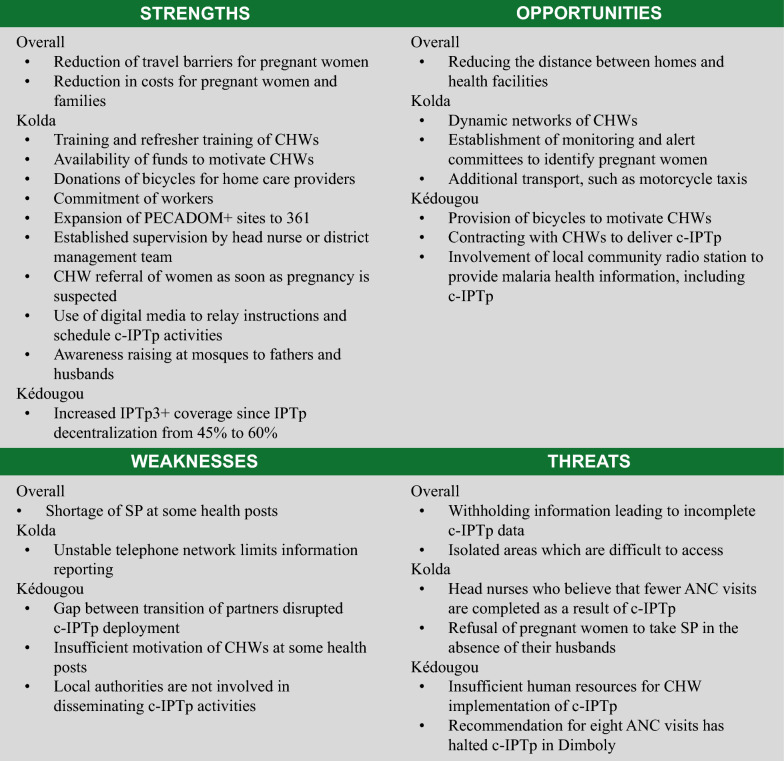
Methods: The study employed 111 semi-structured interviews and 16 focus group discussions to explore stakeholders' perspectives on c-IPTp in Senegal. Purposive sampling was used to select high malaria-endemic districts in Kolda and Kedougou. Inclusion criteria were experience of c-IPTp as a patient, caregiver, beneficiary, decision maker, or communicator/advocate (e.g., community leader). Individuals without experience in c-IPTp were excluded. Following thematic analysis, findings were synthesized into strengths, weaknesses, opportunities, and threats to inform the production of recommendations to promote and expand c-IPTp uptake in Senegal.
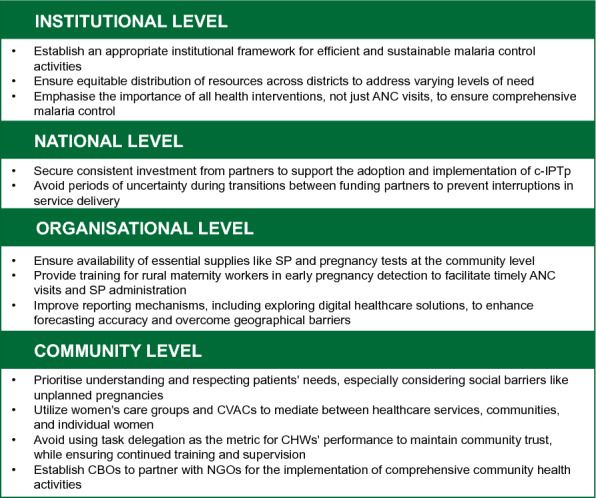
Results: Health providers perceived c-IPTp positively, reducing their workload, allowing midwives to focus on other consultations, and addressing access issues in remote villages. However, some healthcare providers perceived that c-IPTp undermined attendance at antenatal care visits. Stockouts of SP and the unavailability of pregnancy tests were key barriers to uptake. Appropriate incentivization of community health workers was also a key factor for service delivery. Pregnant women found c-IPTp acceptable, appreciating the risks of malaria in pregnancy and perceiving SP to be effective. However, they expressed concerns regarding adverse events and socio-cultural issues around unplanned pregnancies. Key recommendations to strengthen c-IPTp delivery include ensuring supplies of SP and pregnancy tests, improving reporting mechanisms, incentivising community health workers, gaining acceptance from pregnant women, and securing consistent funding. It is also key that patient's individual needs are prioritized and that communities are fully involved in decision-making.
Conclusion: The study identifies and addresses challenges to optimal deployment of c-IPTp in Senegal. Continued efforts to overcome these challenges will be crucial in realising the full potential of c-IPTp to improve maternal and child health outcomes in malaria-endemic regions.
Keywords: Chemoprevention; Community; Intermittent preventive treatment; Malaria; Pregnancy; Sulfadoxine–pyrimethamine.
© 2025. The Author(s).
Conflict of interest statement
Declarations. Ethics approval and consent to participate: Ethical approval was obtained from the national ethics committees of Senegal—Comité National d’Ethique pour la Recherche en Santé (CNERS) Protocol SEN23/76, numéro 292 MSAS/CNERS/SP. In addition, preliminary meetings were held with the National Malaria Control Programme, district health authorities and the chiefs of the concerned localities to present the content of the survey, obtain their commitment and assistance, and ensure data collection in the field. All participants provided written consent for use of their de-identified contributions. Competing interests: MML is an employee of MMV Medicines for Malaria Venture. TN, AMD, SS, MMP, KD and SLBF declare no competing interests.
Figures



References
-
- Desai M, ter Kuile FO, Nosten F, McGready R, Asamoa K, Brabin B, et al. Epidemiology and burden of malaria in pregnancy. Lancet Infect Dis. 2007;7:93–104. - PubMed
-
- Rogerson SJ, Unger HW. Pregnancy and malaria: the perfect storm. Curr Opin Infect Dis. 2022;35:410–6. - PubMed
-
- WHO. World malaria report 2024. Geneva: World Health Organization; 2024. https://www.who.int/teams/global-malaria-programme/reports/world-malaria.... Accessed on 4 Feb 2025.
-
- Eisele TP, Larsen DA, Anglewicz PA, Keating J, Yukich J, Bennett A, et al. Malaria prevention in pregnancy, birthweight, and neonatal mortality: a meta-analysis of 32 national cross-sectional datasets in Africa. Lancet Infect Dis. 2012;12:942–9. - PubMed
MeSH terms
Substances
LinkOut - more resources
Full Text Sources
Medical
