. 2025 Nov 29;15(1):42840.
doi: 10.1038/s41598-025-19956-x.

Tunable optoelectronic properties of reduced graphene oxide superlattices intercalated with poly(2-amino-1-mercaptobenzene) for Van der Waals photonic heterostructures

Affiliations

Tunable optoelectronic properties of reduced graphene oxide superlattices intercalated with poly(2-amino-1-mercaptobenzene) for Van der Waals photonic heterostructures

Amira Ben Gouider Trabelsi et al. Sci Rep. .

Abstract

We have discovered a novel class of van der Waals (vdW) materials composed of reduced graphene oxide (rGO) superlattices that can be intercalated with various polymeric compounds. The bandgap in these groundbreaking graphene oxide-derived materials can be modulated and set by altering the reduced oxygen concentration and varying the intercalating agent's quantity. As such, these vdW materials could possess superior electro-optical features and a broader scope of applications than traditional graphene. For clarity on this concept, we outline the synthesis of these materials. We have successfully produced them and confirmed their exceptional optoelectronic characteristics through measurement. For instance, we intercalated highly ordered layers of rGO using poly-2-amino-1-mercaptobenzene (P2AMB) as an exemplary case. The resulting novel vdW material demonstrated extraordinary optical broadband absorbance up to 690 nm due to its fine crystalline size of 16 nm and a small bandgap of 1.86 eV, which is further tunable by decreasing the oxygen concentration in the graphene oxide sheets. We tested this vdW thin film as a light-capturing optoelectronic device under various photon energies. The device generated a high current density (Jph) of up to 2.2 mA/cm² and a photoresponsivity (R) of up to 22.0 mA/W, demonstrating its high sensitivity and technical advantages. This vdW material can be quickly and cheaply produced in large quantities, making it a promising option for light-capturing applications.

Keywords: Light sensor; Optoelectronic; Photon capture; Poly-2-amino-1-mercaptobenzene; Reduced graphene oxide.


Conflict of interest statement

Declarations. Competing interests: The authors declare no competing interests. Ethical approval: This study does not include any humans or animal studies.

Figures
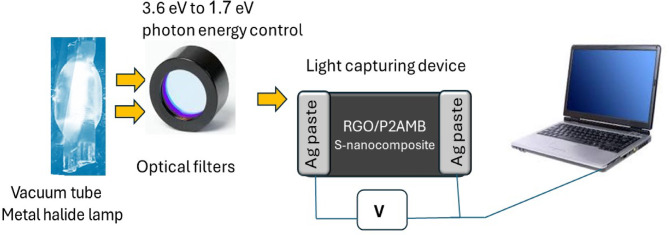
Fig. 1
Fig. 1
Illustrates the electrical configuration of the assembled vdW (rGO/P2AMB S-nanocomposite) thin-film apparatus engineered for light detection. A metal halide lamp is the illumination source, and Optical filters are employed to choose the desired light wavelength. The vdW (rGO/P2AMB) acts as the specimen under investigation in these experiments—silver paste forms electrical contacts on either side of the vdW heterostructure.
Fig. 2
Fig. 2
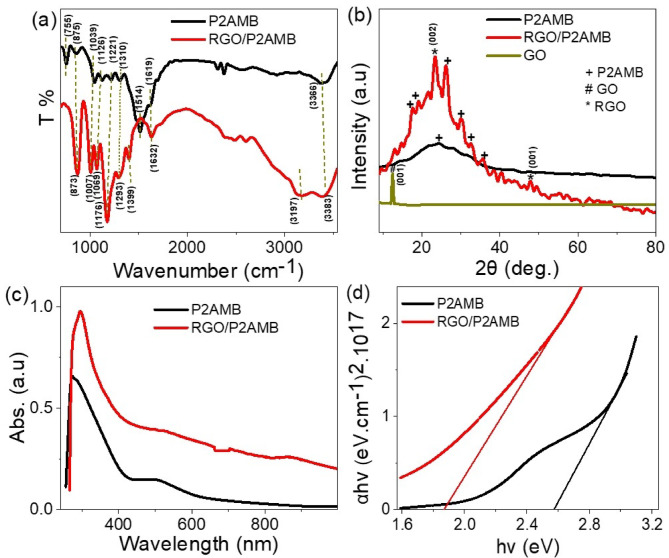
The chemical analysis of the synthesized rGO/P2AMB S-nanocomposite compared to both rGO and P2AMB: (a) FTIR, (b) XRD, (c) optical absorbance, and (d) bandgap estimated using the Tauc equation.
Fig. 3
Fig. 3
Morphological examination of the engineered vdW composite: rGO/P2AMB S-nanocomposite. (a-b) SEM images at different scales show well-arranged rGO layers interspersed with P2AMB droplets. (c-d) TEM imagery at varied magnifications, coupled with (e) estimated roughness and cross-sectional analysis. In contrast, (f) displays the SEM of the unmodified P2AMB.
Fig. 4
Fig. 4
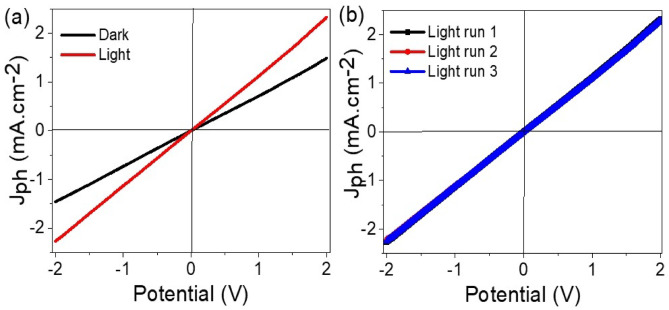
Illustrates the electrical evaluation of the vdW (rGO/P2AMB-nanocomposite) thin film for optoelectronic photon detection, displaying (a) the photogenerated current Jph, which exhibits Ohmic behavior like that observed in dark conditions and (b) a panel confirming consistent performance across multiple illumination tests.
Fig. 5
Fig. 5
Presents (a) the electrical linear sweep voltammetry results, spanning from − 2.0 to 2.0 V of the fabricated vdW (rGO/P2AMB-nanocomposite thin film) optoelectronic device with photon energies varying between 2.3 and 3.6 eV, and (b) the calculated Jph at a potential of -2.0 V.
Fig. 6
Fig. 6
provides detailed characteristics of the fabricated vdW (rGO/P2AMB S-nanocomposite) thin film optoelectronic device under different photon energies. Specifically, panel (a) illustrates the photo-responsivity, R, while panel (b) demonstrates the detectivity, D. The photon energies assessed range from 3.6 eV to 1.6 eV.
Fig. 7
Fig. 7
Schematic illustration of the vdW heterostructure of the rGO/P2AMB nanocomposite. The layered architecture consists of reduced graphene oxide (gray spheres) intercalated with P2AMB molecules (orange spheres), forming a stable and efficient optoelectronic material, (this schematic is designed using the open-access tools: Avogadro (Version 1.95) for molecular modeling and export of 3D atomic structures (https://avogadro.cc))

References

    1. Alkallas, F. H., Rabia, M., Kusmartsev, F. V. & Trabelsi, A. B. G. A thin film optoelectronic photodetector of spherical and linear resonators via one-pot synthesis of Bi(III) oxide/polypyrrole nanocomposite. Sci. Rep.15, 1–11 (2025). - PMC - PubMed
    1. Li, G. et al. Interface-engineered non-volatile visible-blind photodetector for in-sensor computing. Nat. Commun.16, 1–10 (2025). - PMC - PubMed
    1. Kwon, J. H. & Choi, K. C. Highly reliable and stretchable OLEDs based on facile patterning method: toward stretchable organic optoelectronic devices. Npj Flex. Electron.8, 17 (2024).
    1. Ma, D. et al. Pushing the thinness limit of silver Fi Lms for Fl exible optoelectronic devices via ion-beam thinning-back process. Nat. Commun.15, 2248 (2024). - PMC - PubMed
    1. Patel, A. B. et al. Transferrable thin film of ultrasonically exfoliated MoSe2 nanocrystals for efficient visible-light photodetector. Phys. E: Low-dimensional Syst. Nanostruct.119, 114019 (2020).

LinkOut - more resources