


The impact of two-year community-wide pharmacy interventions on the public's knowledge, attitudes, beliefs and behaviors about pharmacists as immunizers
- PMID: 41351147
- PMCID: PMC12681092
- DOI: 10.1186/s12889-025-24906-3
The impact of two-year community-wide pharmacy interventions on the public's knowledge, attitudes, beliefs and behaviors about pharmacists as immunizers
Abstract
Background: Immunization rates for vaccine-preventable diseases remain well below targets worldwide, leading to unnecessary morbidity and mortality, and heavy economic burdens to healthcare systems and workforces. One promising avenue to improve vaccine coverage is through the public's acceptance and use of pharmacists as immunizers; yet, at present, pharmacists remain underutilized for vaccine uptake by the public. Further study is needed on how to improve the perceptions and use of pharmacists as immunizers.
Methods: Between 2017 and 2019, pharmacy interventions were conducted in communities in Nova Scotia and New Brunswick, Canada, with 23 intervention pharmacies and 21 non-intervention pharmacies. Interventions focused on seven vaccines, and included activities such as pharmacists providing counsel to patients (registered patients and walk-ins), online messaging, and pharmacy posters. Following the interventions, online surveys were conducted among adult residents in the communities (n = 992) to assess the public's knowledge, attitudes, beliefs, and behaviors (KABB) regarding pharmacists as immunizers. Data were analyzed using Fisher's exact tests, multiple regressions, and Spearman's ranked correlations.
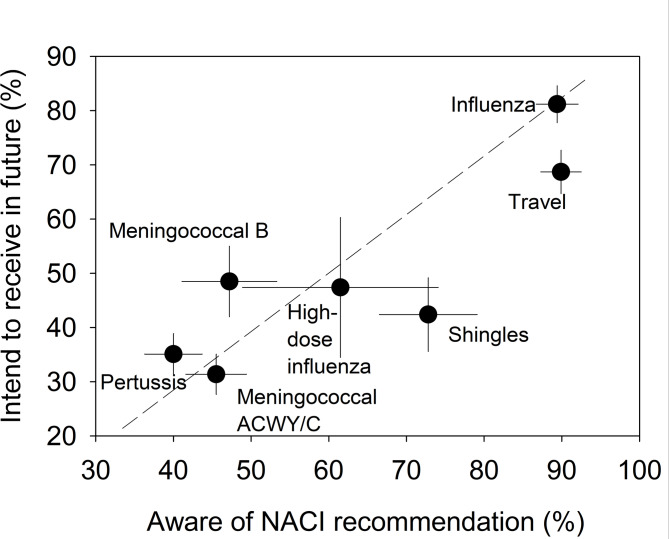
Results: As compared to non-intervention communities, respondents in intervention communities had improved awareness of their vaccination status and increased self-reported uptake for meningococcal ACWY/C and travel vaccines, and reduced uptake of the shingles vaccine (P < 0.05). From combined analysis of non-intervention and intervention communities, willingness to receive a vaccine was strongly associated with being offered that vaccine in the past (R = 1.0, P < 10⁻⁷) and with awareness of recommendations from the National Advisory Committee on Immunization (NACI) (R = 0.79, P < 10⁻⁷). Less than 13% of respondents were aware that pharmacists provide the pertussis vaccine, while 90.7% reported they would receive all studied vaccines if free of charge. Respondents without access to a family physician had three-times higher odds of using the internet for vaccine information compared to those with a physician.
Conclusions: The KABB of respondents in intervention and non-intervention communities provided insights into improving the public's use of pharmacists as immunizers. Future strategies may include pharmacists proactively offering vaccines and counsel on Public Health vaccine guidelines to patients, increasing the public's awareness about vaccines provided by pharmacists (through healthcare providers and social media), and expanding public funding for vaccines with low uptake.
Keywords: Behaviors; Immunizers; Interventions; Knowledge; Pharmacist; Public; Uptake; Vaccines.
© 2025. The Author(s).
Conflict of interest statement
Declarations. Ethics approval and consent to participate: Ethics approval: This study was approved by the Nova Scotia Health Research Ethics Board (#1021559), Horizon Health Network Research Ethics Board (#10111), and St. Francis Xavier University Research Ethics Board (#22895). Consent to participate: The study adhered to the Declaration of Helsinki. Informed consent was obtained from all study participants prior to starting the online survey. Consent for publication: Not applicable. Competing interests: The authors declare no competing interests.
Figures



References
-
- PHAC. Highlights from the 2022–2023 Seasonal Influenza (Flu) Vaccination Coverage Survey. 2024; https://www.canada.ca/en/public-health/services/immunization-vaccines/va...
MeSH terms
LinkOut - more resources
Full Text Sources
Research Materials
Miscellaneous
