


Exploring the mental health issues of left-behind children based on propensity score matching: the parallel mediating role of psychological abuse and neglect
- PMID: 41366806
- PMCID: PMC12690925
- DOI: 10.1186/s13034-025-00992-4
Exploring the mental health issues of left-behind children based on propensity score matching: the parallel mediating role of psychological abuse and neglect
Abstract
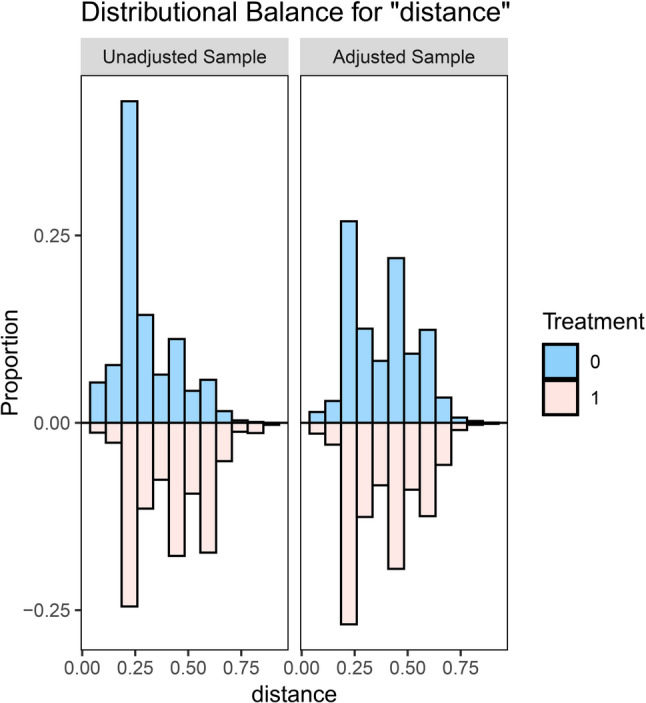
Introduction: The underdeveloped western region of China, where most of the country’s migrant workers originate, has many children who remain at home while their parents work elsewhere. These left-behind children often suffer from significant psychological issues, including depression, anxiety, stress, and sleep quality problems. The pathways through which being left behind leads to these mental health challenges are not well understood. This study employs Propensity Score Matching (PSM) to adjust for confounders and investigate the mediating effects of psychological abuse and neglect on these mental health issues.
Methods: The study surveyed 17 middle schools in western China using convenience cluster sampling. It gathered data on demographics, the Child Psychological Abuse and Neglect Scale (CPANS), the Depression Anxiety Stress Scale (DASS-21), and the Pittsburgh Sleep Quality Index (PSQI). PSM was used to compare left-behind children with their peers. Statistical tests included Pearson’s chi-squared and bivariate correlation analysis, and mediation was assessed.
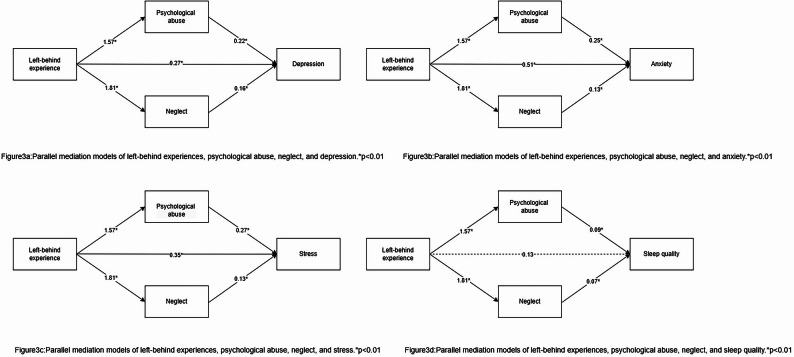
Results: A cohort of 12,192 adolescents (mean age = 15.1 ± 1.41 years) was enrolled in this study. Participants with left-behind experiences displayed significantly higher prevalence rates of psychological abuse, neglect, and mental health relative to their non-left-behind counterparts (p < 0.05). Following PSM to balance potential confounders, 3,741 matched pairs were successfully yielded. Within these matched cohorts, adolescents with left-behind experiences also demonstrated significantly elevated rates across all measured adverse outcomes (p < 0.05). Correlation analysis showed strong associations between left-behind experiences and psychological issues. Mediation analysis revealed that psychological abuse and neglect are significant mediators in the relationship between left-behind experiences and mental health outcomes.
Conclusion: The study suggests that left-behind experiences negatively impact adolescent mental health, acting through mechanisms of psychological abuse and neglect.
Keywords: Neglect; Parallel mediation model; Psychological abuse; Psychological health issue.
Conflict of interest statement
Declarations. Ethics approval and consent to participate: This research protocol received approval from the Ethics Committee of North Sichuan Medical College. The project, designated as NSMC[2021]53, has been approved by the China Clinical Trial Registration Center and assigned the registration number ChiCTR2200058160. Informed consent to participate and for publication was obtained. Competing interests: The authors declare no competing interests.
Figures

References
-
- Cheng-rong D, et al. Survival and development of Left-behind children in rural china: based on the analysis of sixth census data. Popul J. 2012;35(199):37–49.
-
- Rongyi Z, Jiaojiao W, Bingxiang M. The mental and psychological problems in left-behind children in China. Pediatr Res. 2019;87(5):802–3. - PubMed
-
- Wang X, et al. Self-concept of left-behind children in China: a systematic review of the literature. Child Care Health Dev. 2014;41(3):346–55. - PubMed
-
- Wei W, et al. Meta-analysis of the mental health status of left‐behind children in China. J Paediatr Child Health. 2019;55(3):260–70. - PubMed
Grants and funding
- SWFZ24-Z-04/Primary Health Care Research Center of Sichuan province
- SWFZ24-Z-04/Primary Health Care Research Center of Sichuan province
- SWFZ24-Z-04/Primary Health Care Research Center of Sichuan province
- SWFZ24-Z-04/Primary Health Care Research Center of Sichuan province
- SWFZ24-Z-04/Primary Health Care Research Center of Sichuan province
- SWFZ24-Z-04/Primary Health Care Research Center of Sichuan province
- SWFZ24-Z-04/Primary Health Care Research Center of Sichuan province
- SWFZ24-Z-04/Primary Health Care Research Center of Sichuan province
- SWFZ24-Z-04/Primary Health Care Research Center of Sichuan province
- SWFZ24-Z-04/Primary Health Care Research Center of Sichuan province
- SWFZ24-Z-04/Primary Health Care Research Center of Sichuan province
- No. NC24A016/the Project of the Fourteenth Five-Year Plan for Social Science Research of Nanchong City in 2024
- No. NC24A016/the Project of the Fourteenth Five-Year Plan for Social Science Research of Nanchong City in 2024
- No. NC24A016/the Project of the Fourteenth Five-Year Plan for Social Science Research of Nanchong City in 2024
- No. NC24A016/the Project of the Fourteenth Five-Year Plan for Social Science Research of Nanchong City in 2024
- No. NC24A016/the Project of the Fourteenth Five-Year Plan for Social Science Research of Nanchong City in 2024
- No. NC24A016/the Project of the Fourteenth Five-Year Plan for Social Science Research of Nanchong City in 2024
- No. NC24A016/the Project of the Fourteenth Five-Year Plan for Social Science Research of Nanchong City in 2024
- No. NC24A016/the Project of the Fourteenth Five-Year Plan for Social Science Research of Nanchong City in 2024
- No. NC24A016/the Project of the Fourteenth Five-Year Plan for Social Science Research of Nanchong City in 2024
- No. NC24A016/the Project of the Fourteenth Five-Year Plan for Social Science Research of Nanchong City in 2024
- No. NC24A016/the Project of the Fourteenth Five-Year Plan for Social Science Research of Nanchong City in 2024
LinkOut - more resources
Full Text Sources
Miscellaneous
