. 2025 Dec;648(8093):306-311.
doi: 10.1038/s41586-025-09775-5. Epub 2025 Dec 10.

Observation of deuteron and antideuteron formation from resonance-decay nucleons

Collaborators

Observation of deuteron and antideuteron formation from resonance-decay nucleons

ALICE Collaboration. Nature. 2025 Dec.

Abstract

High-energy hadronic collisions generate environments characterized by temperatures above 100 MeV (refs. 1,2), about 100,000 times hotter than the centre of the Sun. At present, it is therefore unclear how light (anti)nuclei with mass number A of a few units, such as the deuteron, 3He or 4He, each bound by only a few MeV, can emerge from these collisions3,4. Here, the ALICE Collaboration reports that deuteron-pion momentum correlations in proton-proton (pp) collisions provide model-independent evidence that about 90% of the observed (anti)deuterons are produced in nuclear reactions5 following the decay of short-lived resonances, such as the Δ(1232). These findings, obtained by the ALICE Collaboration at the Large Hadron Collider, resolve a gap in our understanding of nucleosynthesis in ultrarelativistic hadronic collisions. Apart from offering insights on how (anti)nuclei are formed in hadronic collisions, the results can be used in the modelling of the production of light and heavy nuclei in cosmic rays6 and dark-matter decays7,8.


Conflict of interest statement

Competing interests: The authors declare no competing interests.

Figures

Fig. 1
Fig. 1. (Anti)deuteron production scenarios.
Illustration of three scenarios for deuteron production and interaction with pions (left) and the resulting π±–d correlation functions (right). All scenarios include Coulomb attraction between π–d (green curves) and Coulomb repulsion between the π+–d (red curves). The dashed lines always show the correlation function using Coulomb interaction. a,b, Thermally produced deuterons with only Coulomb (a) and Coulomb + elastic + inelastic (b) interactions, respectively. c, Deuteron formation by nuclear binding following Δ-resonance decays. All the simulations include the charge conjugates (π+dπ+dπd¯ and πdπdπ+d¯). The bandwidths corresponds to the statistical uncertainties of the models.
Fig. 2
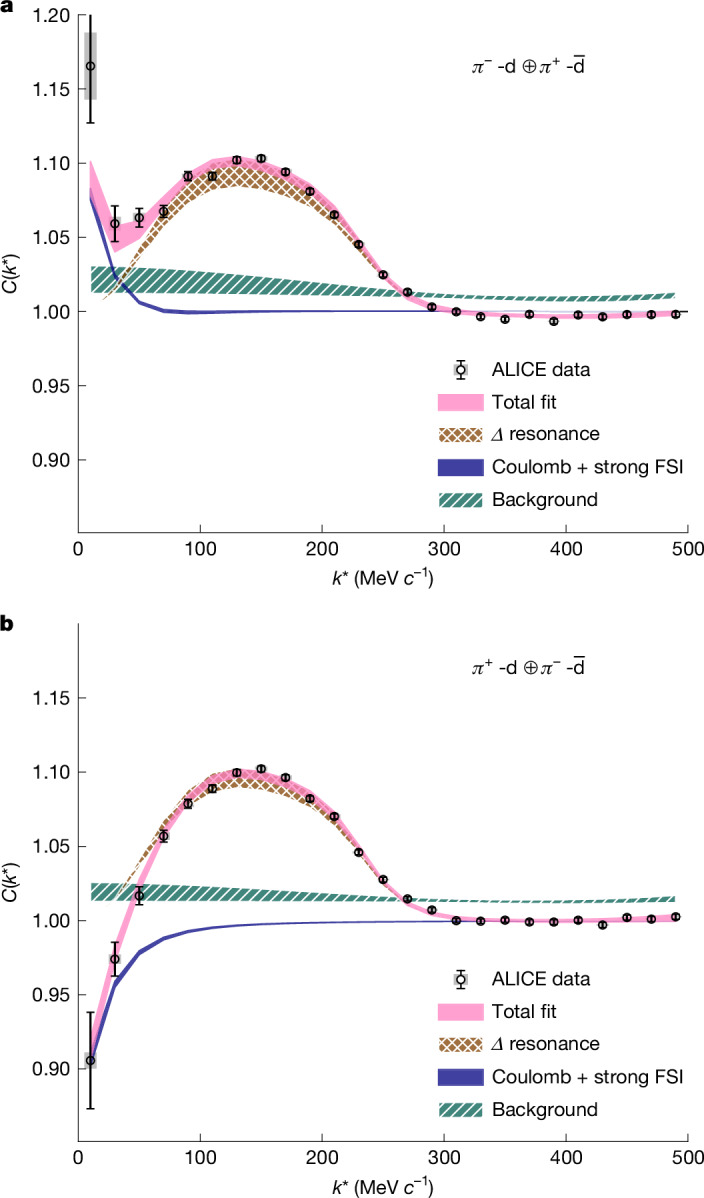
Fig. 2. Experimental π–d and π+–d correlation functions.
The data are obtained from high-multiplicity pp collisions at √s = 13 TeV. a, The measured π–d correlation function together with the corresponding fit function (magenta). The brown cross-hatched band represents contributions from the Δ resonance, the blue band denotes the Coulomb and strong FSI interactions, and the teal diagonally hatched band corresponds to the residual background. The widths of the bands indicate the fit uncertainty. b, In the same representation, the π+–d correlation function. However, the strong FSI interaction is neglected for this system. The χ2 per degree of freedom is 14/15 for both correlations.
Extended Data Fig. 1
Extended Data Fig. 1. Extracted Δ spectral temperature.
The Δ spectral temperature is derived from π±–p and π±−d correlation functions measured in high-multiplicity pp collisions at s = 13 TeV. The bands correspond to the uncertainties obtained by fits to the correlation functions, incorporating systematic uncertainties on the measured data, as well as those arising from variations in the source size and the λ parameter for the genuine interaction.

References

    1. ALICE Collaboration. The ALICE experiment: a journey through QCD. Eur. Phys. J. C84, 813 (2024).
    1. ALICE Collaboration. Multiplicity dependence of π, K, and p production in pp collisions at √s = 13 TeV. Eur. Phys. J. C80, 693 (2020).
    1. Butler, S. T., & Pearson, C. A. Deuterons from high-energy proton bombardment of matter. Phys. Rev.129, 836–842 (1963).
    1. Kapusta, J. I. Mechanisms for deuteron production in relativistic nuclear collisions. Phys. Rev. C21, 1301–1310 (1980).
    1. Sun, K.-J., Wang, R., Ko, C. M., Ma, Y.-G. & Shen, C. Unveiling the dynamics of little-bang nucleosynthesis. Nat. Commun.15, 1074 (2024). - PMC - PubMed

LinkOut - more resources