


The safety and efficacy of gamma frequency auditory and visual stimulation in the treatment of alzheimer's disease: a systematic review and meta-analysis
- PMID: 41381439
- PMCID: PMC12700959
- DOI: 10.1038/s41398-025-03788-4
The safety and efficacy of gamma frequency auditory and visual stimulation in the treatment of alzheimer's disease: a systematic review and meta-analysis
Abstract
Background: Alzheimer's disease (AD) is a progressive neurodegenerative disorder associated with cognitive decline and significant global health burden. Current treatments offer limited benefits, highlighting the need for novel therapies. Gamma-frequency auditory and visual stimulation (GFAVS), utilizing 40 Hz neuromodulation, has gained attention as a non-invasive treatment for cognitive deficits and underlying pathophysiology in AD.
Objective: This systematic review and meta-analysis aimed to assess the safety and efficacy of GFAVS in treating Alzheimer's disease (AD) and mild cognitive impairment (MCI).
Methods: A comprehensive literature search across multiple databases (PubMed, Cochrane Library, MEDLINE, Web of Science, and Embase) was performed up to November 2025. Controlled trials involving adults (≥50 years) with AD or MCI, using GFAVS, were included. Meta-analyses assessed adverse events, cognitive function, and brain changes.
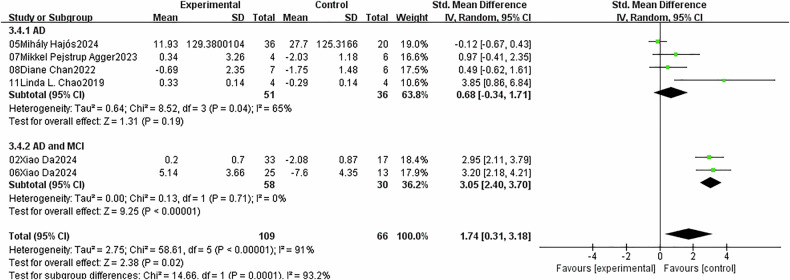
Results: Eleven studies (341 participants) were included. GFAVS was safe, with no significant increase in overall adverse events (RR = 0.99, P = 0.93; RD = -0.01, P = 0.93). However, GFAVS significantly increased the risk of tinnitus (RR = 6.46, P = 0.08; RD = 0.16, P = 0.01). GFAVS significantly improved structural brain changes (SMD = 1.74, P = 0.02), especially in mixed AD and MCI populations (SMD = 3.05, P < 0.00001). Nevertheless, no significant improvements were observed in cognitive function (SMD = 0.16, 95% CI [-0.36 to 0.68], P = 0.55) or activities of daily living (SMD = 0.53, 95% CI [-1.26 to 2.33], P = 0.56), despite the observed structural brain changes. High heterogeneity was observed.
Conclusion: GFAVS appears to be well tolerated and may induce structural brain alterations in individuals with Alzheimer's disease or mild cognitive impairment; however, its impact on cognition or daily functioning remains to be established. Large-scale, rigorously designed trials are required to clarify optimal protocols and address the observed heterogeneity.
© 2025. The Author(s).
Conflict of interest statement
Competing interests: The authors declare no competing interests.
Figures




References
-
- World-Alzheimer-Report-2024.pdf.
-
- Vaz M, Silvestre S Alzheimer’s disease: recent treatment strategies. Eur J Pharmacol 2020;887. - PubMed
-
- Karran E, Mercken M, De Strooper B. The amyloid cascade hypothesis for alzheimer’s disease: an appraisal for the development of therapeutics. Nat Rev Drug Discov. 2011;10:698–712. - PubMed
Publication types
MeSH terms
Grants and funding
LinkOut - more resources
Full Text Sources
Medical
Miscellaneous
