Review
. 1974 Dec;6(4 Suppl 1):129-39.

Progress in and deterrents to orthotopic liver transplantation, with special reference to survival, resistance to hyperacute rejection, and biliary duct reconstruction

Review

Progress in and deterrents to orthotopic liver transplantation, with special reference to survival, resistance to hyperacute rejection, and biliary duct reconstruction

T E Starzl et al. Transplant Proc. 1974 Dec.

Abstract

Before I begin, I want to add my own personal reminiscence. I knew Dave Hume for almost 14 years, slightly for the first 4 and well for the last 10. I first talked to him at an elevator entrance at the Greenbrier Hotel in West Virginia, in April, 1959, and for the last time in April, 1973, in the lower lobby of the Century Plaza Hotel in Los Angeles. In May, 1973, I was in the railroad station in Albuquerque, New Mexico, when I learned from my grief-stricken youngest son that Dave was dead. It is strange how the exact details of these and some other memories in between, of the time I spent with Dave Hume, stand out with the same clarity as what I was doing when I learned of the bombing of Pearl Harbor, the assassination of John Kennedy, but very few other things. The most eloquent tribute to Dave Hume I have heard was the briefest, coming from a non-medical friend who told me sadly, “He really was a dynamite guy!”


Figures
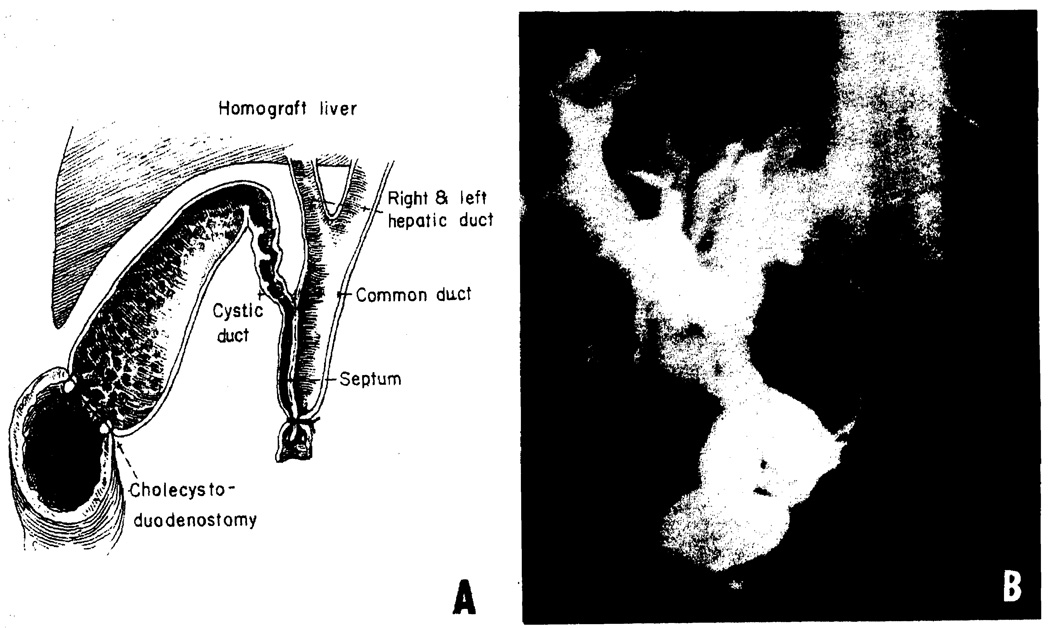
Fig. 1
Fig. 1
Two kinds of biliary duct obstruction after cholecystoduodenostomy. (A) The anatomic basis for a technical error that cost the life of 3 patients. Distal ligation of the double-barreled extrahepatic duct system resulted in total biliary obstruction. This recurrent accident has caused us to perform cholangiography on all liver homografts before transplantation. (B) The kind of biliary obstruction caused by stenosis of the cystic duct. Martineau reported that cytomegalovirus infection of the duct could be responsible for this development.
Fig. 2
Fig. 2
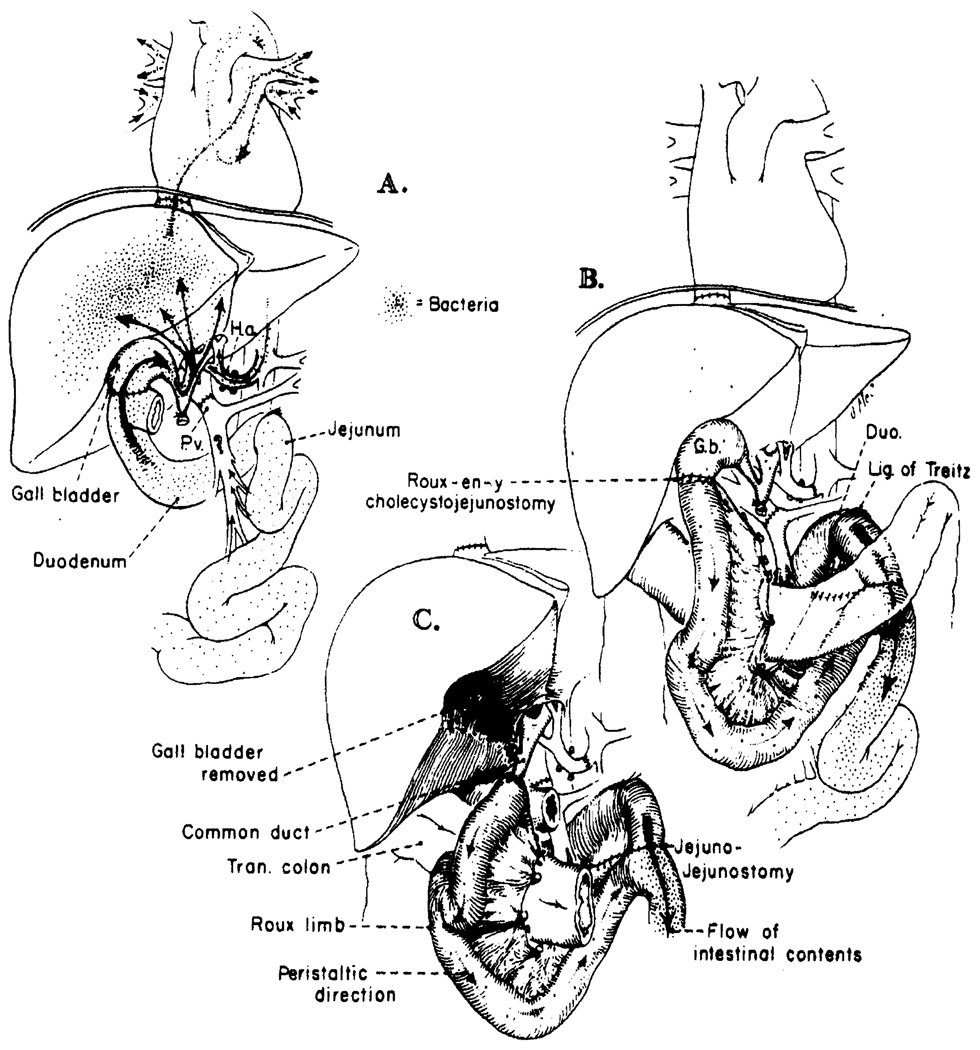
Schematic representation of the bacterial contamination or lack thereof in three different kinds of biliary reconstruction. (A) cholecystoduodenostomy. This extremely simple operation probably carries the greatest risk of graft infection. (B) Roux-en-Y cholecystojejunostomy. This operation protects from hepatic sepsis by placing the new liver outside the main gastrointestinal stream. The isoperistaltic limb is made at least 18 in. long. (C) Roux-en-Y choledochojejunostomy. The end-to-end duct-to-bowel anastomosis is simple if the duct is dilated, as would be the case if a conversion became necessary from B to C.
Fig. 3
Fig. 3
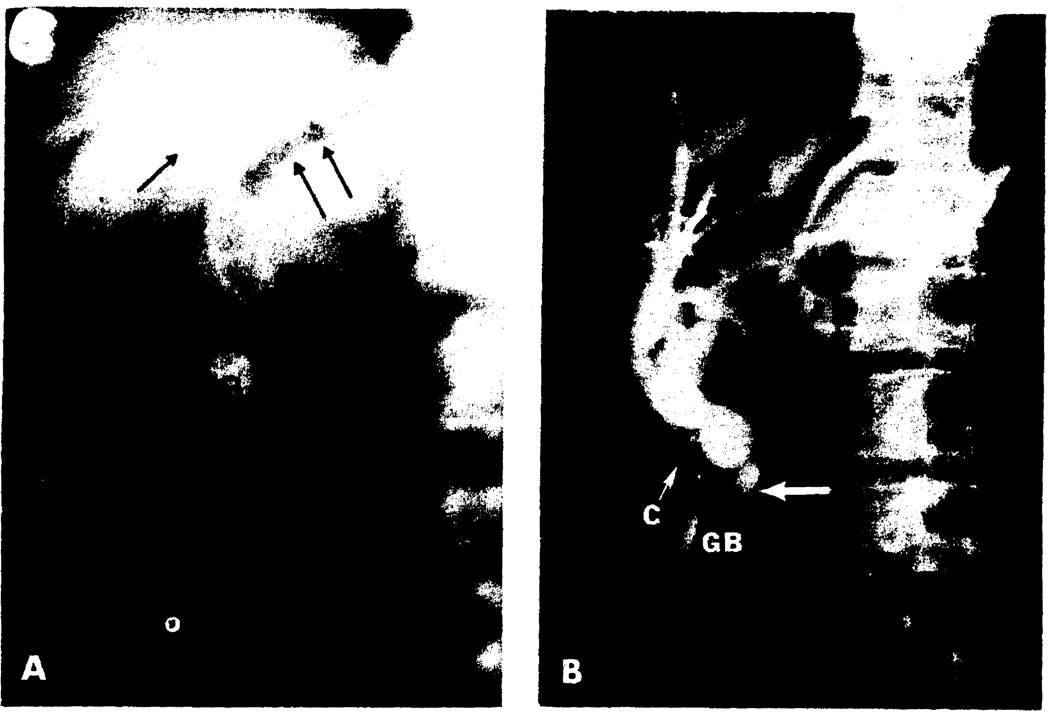
Post-transplantation cholangiographic studies. (A) Intravenous cholangiogram in a 47-year-old recipient of a hepatic homograft, the biliary drainage for which was with Roux-en-Y cholecystojejunostomy (Fig. 2B). The patient’s liver function studies were normal at the time of the examination. However, the findings of a very slightly dilated common duct and air in the biliary system (arrows) are suspicious for low-grade obstruction. (B) A percutaneous transhepatic cholangiogram performed 4 weeks post-transplantation because of persistent elevations of the serum bilirubin (8–10 mg/100 ml). At the time of transplantation, biliary drainage had been established with a Roux-en-Y cholecystojejunostomy (Fig. 2B). After obtaining this study, the patient was re-explored, the gallbladder removed, and the Roux limb anastomosed to the dilated common duct (large arrow), as shown in Fig. 2C. The patient’s jaundice rapidly cleared, and he now has normal liver function 3 months post-transplantation. GB, gallbladder; CD, common bile duct; C, cystic duct.

References

    1. Starzl TE, Putnam CW. Experience in Hepatic Transplantation. Philadelphia: W. B. Saunders; 1969. (For those interested in Hume’s life and work, his personal reports of these cases are on pages 279 and 502.)
    1. Groth CG. personal communication.
    1. Starzl TE, Porter KA, Schroter G, et al. N Engl J Med. 1973;289:82. - PMC - PubMed
    1. Martineau G, Porter KA, Corman J, et al. Surgery. 1972;72:604. - PMC - PubMed
    1. Brettschneider L, Tong JL, Boose DS, et al. Arch Surg. 1968;97:313. - PMC - PubMed

LinkOut - more resources