Exclusion of the mentally ill. Reflection on an old problem in a new context
- PMID: 4711130
- PMCID: PMC7561026
- DOI: 10.1001/archpsyc.1973.04200010095016
Exclusion of the mentally ill. Reflection on an old problem in a new context
Abstract
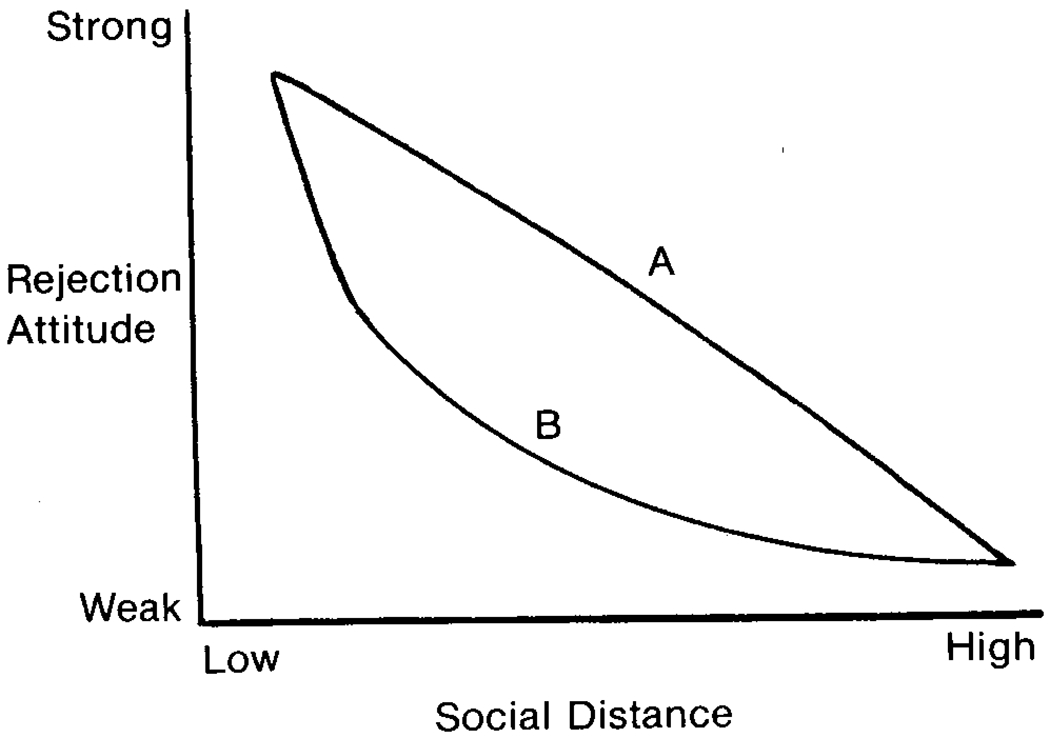
Are those individuals who were formerly placed on the back wards of the state mental hospital drifting to the back alleys of the community? There is some evidence to suggest that the erosion of the state hospitals system has led communities to develop new methods of excluding their mentally ill. Viewing inclusion and exclusion efforts as a function of social distance, we have reviewed empirical data on the nature of attitudinal response to the mentally ill.
Implications of public attitudinal response to this group are considered with respect to providing the necessary incentives for inclusion. Taking California as an example, we also attempt to conceptualize and classify actual community response patterns in the light of what appears to be the development of new formal and informal mechanisms of exclusion.
Figures
References
-
- Phillips D: Rejection: A possible consequence of seeking help for mental disorders. Am Sociolog Rev 28:963–972, 1963.
-
- Phillips D: Rejection of the mentally ill: The influence of behavior and sex. Am Sociolog Rev 29:679–687, 1964.
-
- Scheff T: Being Mentally Ill: A Sociological Theory. Chicago, Aldine: Publishing Co, 1966.
-
- Lemkau PV, Crocetti GM: On rejection of the mentally ill. Am Sociolog Rev 30:579–580, 1965. - PubMed
-
- Cumming E, Cumming JC: Closed Rand: An Experiment in Mental Health Education. Cambridge, Mass, Harvard University Press, 1957.