Case Reports
doi: 10.1001/archsurg.1966.01320190073016.
Changes in blood coagulation
- PMID: 5322193
- PMCID: PMC3035840
- DOI: 10.1001/archsurg.1966.01320190073016
Item in Clipboard
Case Reports
Changes in blood coagulation
Arch Surg.
1966 Jan.
No abstract available
Figures
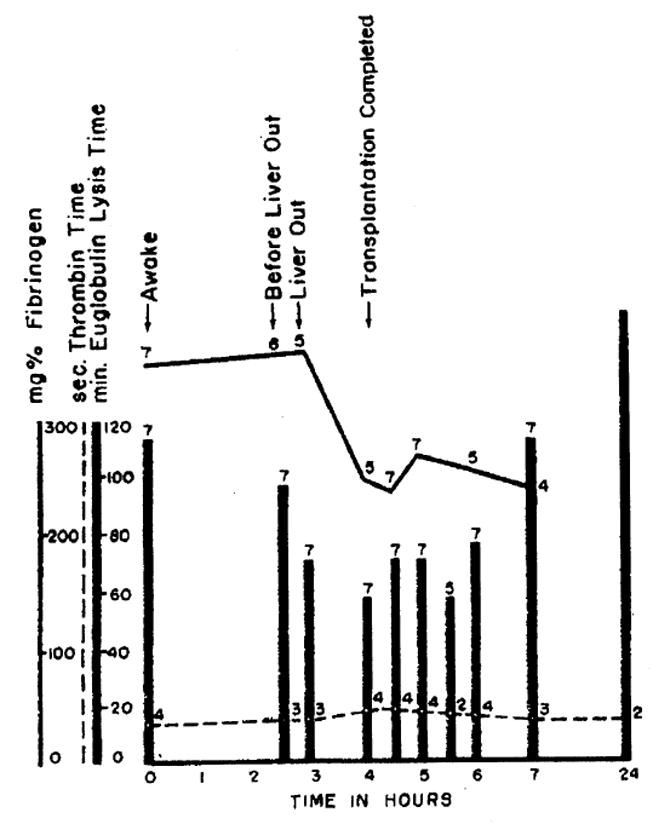
Trend of euglobulin lysis time and plasma fibrinogen concentration before, during, and after canine orthotopic liver homotransplantation (average values). Number of animals used to obtain average values is indicated. Note drop of ELT at time of liver removal followed by return to normal within five hours after placement of the homograft. The maximum decrease in ELT did not occur at same time; degree of fibrinolytic activity at some time during individual experiments was, therefore, generally greater than depicted by mean values.
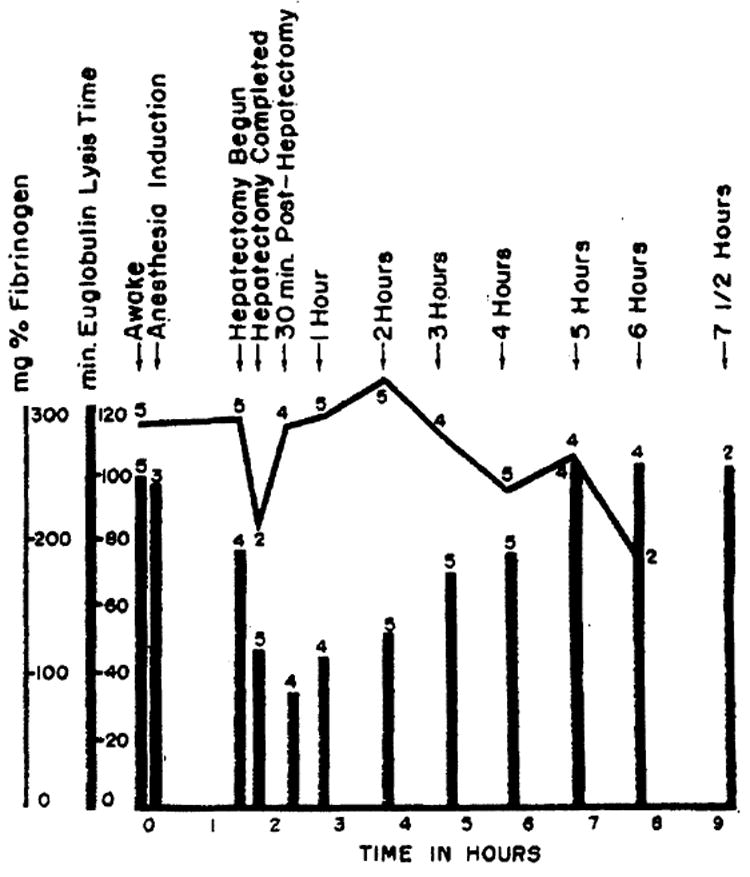
Trend of average euglobulin lysis time and plasma fibrinogen concentration before, during, and after canine hepatectomy. Number of animals used to obtain mean values is indicated. Note drop of ELT at time of liver removal followed by return to normal within five to six hours.
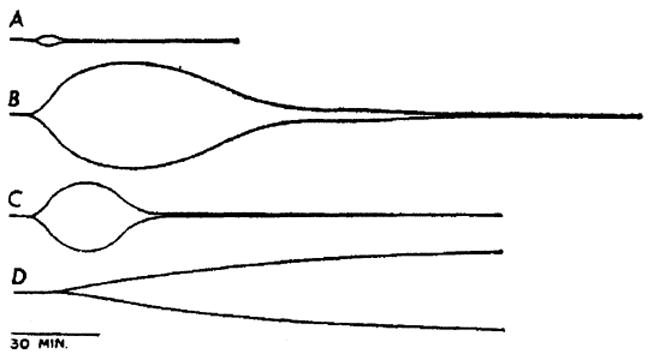
Thromboelastograms of recalcified citrated plasma obtained two hours after revascularization of orthotopic liver homograft in patient 1 of clinical series. (A) Untreated plasma. Clot dissolves as fast as it is formed. (B and C) 50% and 20%, respectively, of normal fresh plasma have been added to specimen of patient’s plasma. Fibrinolysis is slowed but not prevented. (D) after patient had been given intravenously EACA (0.1 gm/kg). Fibrinolytic reaction is abolished but there is poor clot due to low fibrinogen.
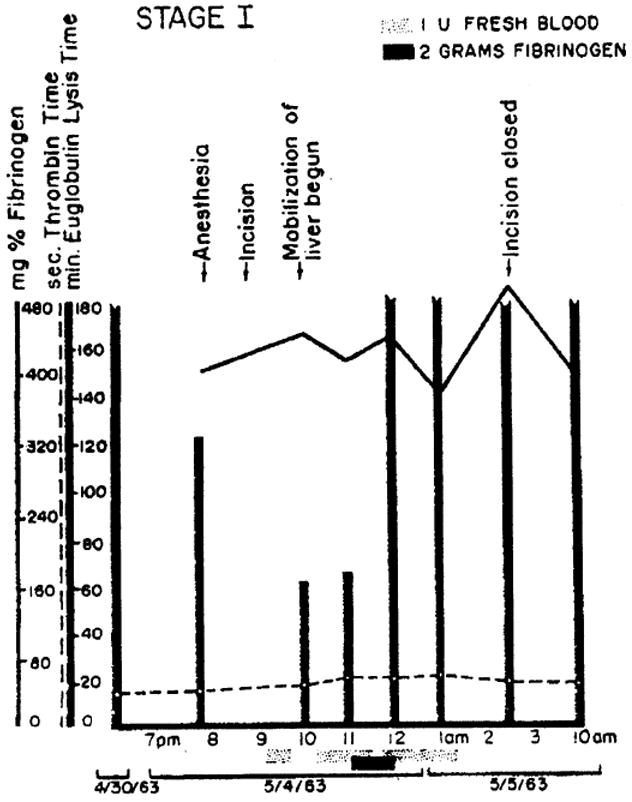
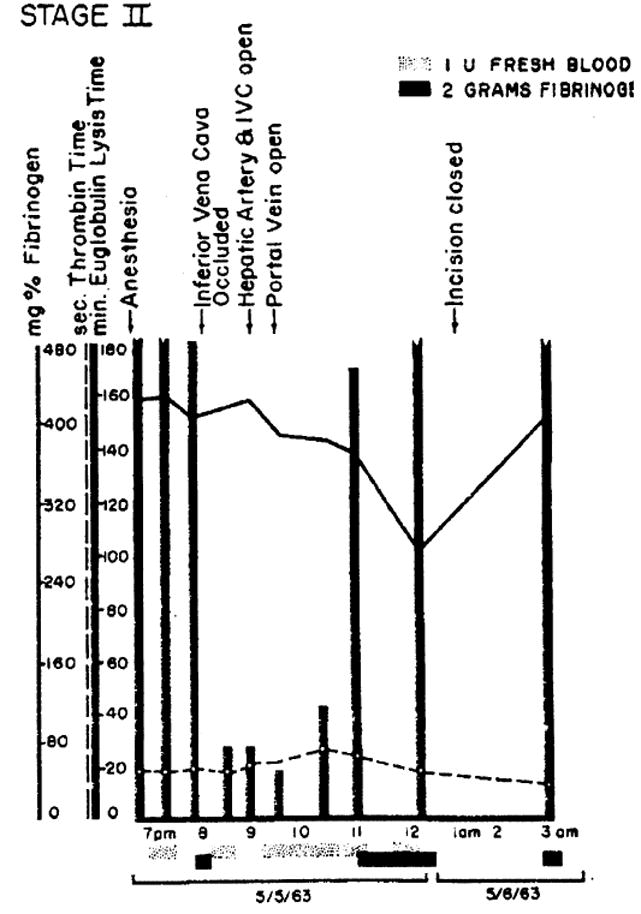
Changes in euglobulin lysis time, fibrinogen concentration, and thrombin time during stage 1 mobilization of liver in patient 2. Note decrease of euglobulin lysis time during manipulation of liver.
Changes in euglobulin lysis time, fibrinogen concentration, and thrombin time during actual liver transplantation in patient 2. Note extreme shortening of ELT during transplantation mg/kg) was given, I.V at 8:47 ™ with no influence on ELT by 9 ™; nevertheless EACA (0.1 thromboelastogram was restored to normal at this time. (See Fig 6).
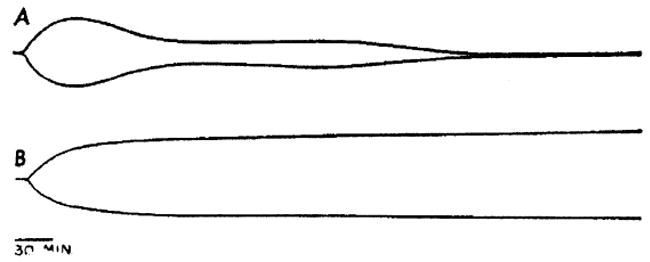
Thromboelastograms in patient 2. (A) Rapid clot dissolution during unhepatic state (ELT 28 min). (B) Thrombelastogram obtained few minutes later after intravenous EACA. Despite ELT of 18 minutes, clot lysis is controlled.
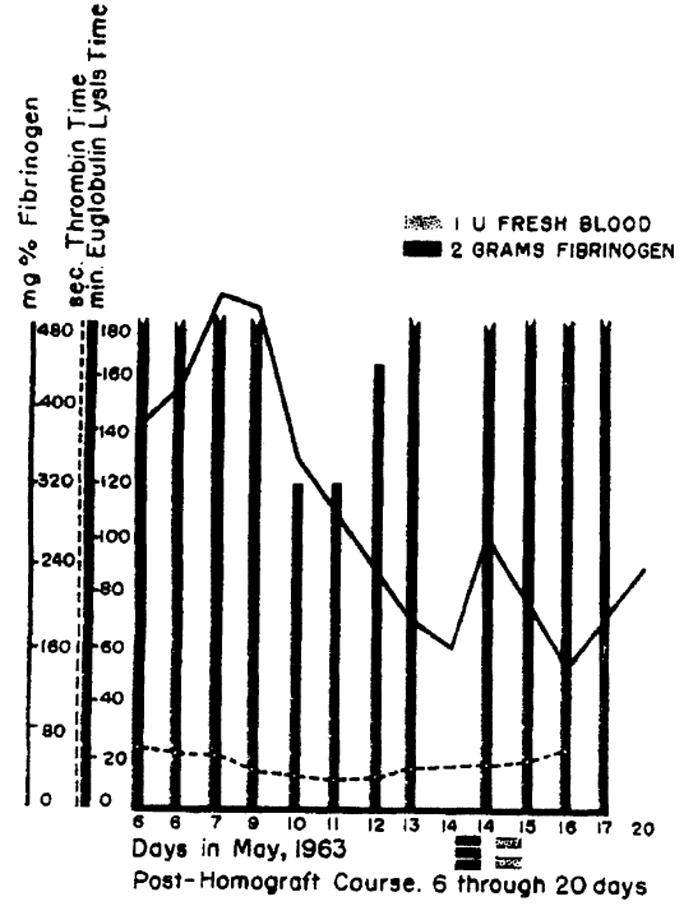
Euglobulin lysis time, fibrinogen concentration, and thrombin time during postoperative period of patient 2. Note progressive decrease of fibrinogen level in absence of any increase of spontaneous fibrinolytic activity.
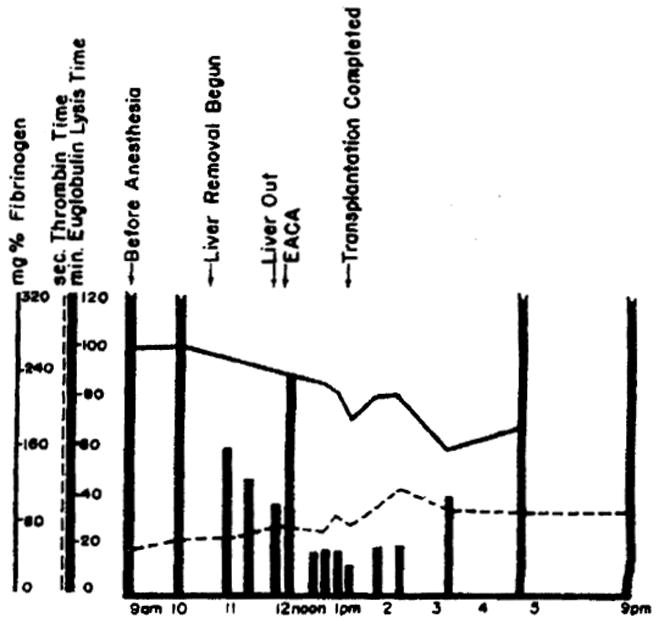
Euglobulin lysis time, fibrinogen concentration, and thrombin time in patient 3. Note temporary shortening of ELT during and after transplantation, but with subsequent return to normal or prolonged values.
References
-
- von Kaulla KN, Schultz RL. Methods for Evaluation of Human Fibrinolysis: Studies With Two Combined Techniques. Amer J Clin Path. 1958;29:104. - PubMed
-
- Rahn B, von Kaulla KN. Pharmacological Induction of Fibrinolytic Activity in the Dog. Proc Soc Exp Biol Med. 1964;115:359. - PubMed
-
- Alkjaersig N, Fletcher AP, Sherry S. E-Aminocaproic Acid, an Inhibitor of Plasminogen Activation. J Biol Chem. 1959;234:832. - PubMed
-
- von Kaulla KN. Continuous Automatic Recording of Fibrin Formation and Fibrinolysis. J Lab Clin Med. 1957;49:304. - PubMed
-
- Ratnoff OD, Menzie C. New Method for Determination of Fibrinogen in Small Samples of Plasma. J Lab Clin Med. 1951;37:316. - PubMed
Publication types
MeSH terms
Grants and funding
LinkOut - more resources
Full Text Sources