


Resolving 20 years of inconsistent interactions between lexical familiarity and orthography, concreteness, and polysemy
- PMID: 6242753
- PMCID: PMC4311894
- DOI: 10.1037//0096-3445.113.2.256
Resolving 20 years of inconsistent interactions between lexical familiarity and orthography, concreteness, and polysemy
Abstract
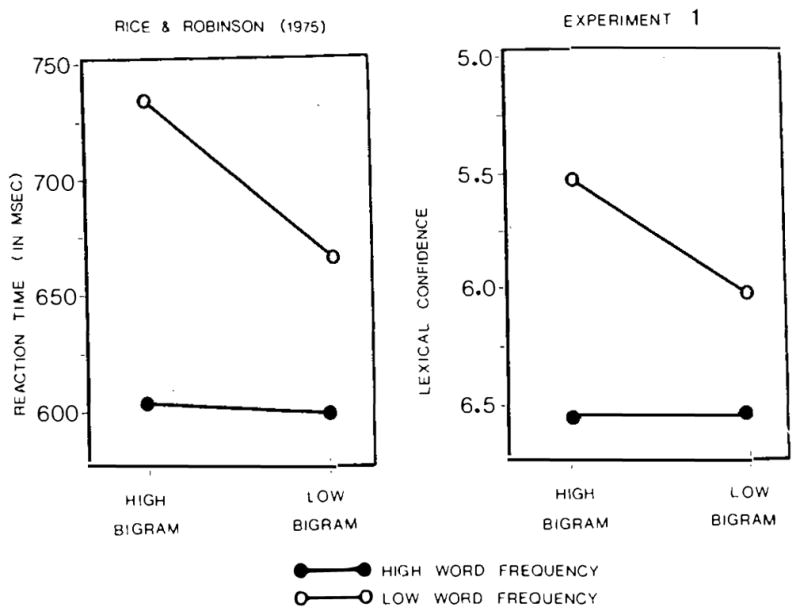
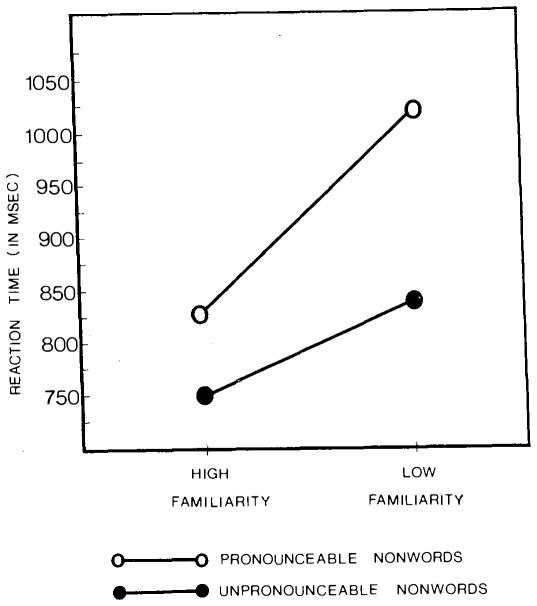
Numerous word recognition studies conducted over the past 2 decades are examined. These studies manipulated lexical familiarity by presenting words of high versus low printed frequency and most reported an interaction between printed frequency and one of several second variables, namely, orthographic regularity, semantic concreteness, or polysemy. However, the direction of these interactions was inconsistent from study to study. Six new experiments clarify these discordant results. The first two demonstrate that words of the same low printed frequency are not always equally familiar to subjects. Instead, subjects' ratings of "experimental familiarity" suggest that many of the low-printed-frequency words used in prior studies varied along this dimension. Four lexical decision experiments reexamine the prior findings by orthogonally manipulating lexical familiarity, as assessed by experiential familiarity ratings, with bigram frequency, semantic concreteness, and number of meanings. The results suggest that of these variables, only experiential familiarity reliably affects word recognition latencies. This in turn suggests that previous inconsistent findings are due to confounding experiential familiarity with a second variable.
Figures
References
-
- Adams MJ. Models of word recognition. Cognitive Psychology. 1979;11:133–176.
-
- Attneave F. Psychological probability as a function of experienced frequency. Journal of Experimental Psychology. 1953;46:81–86. - PubMed
-
- Biederman GB. The recognition of tachistoscopically presented five-letter words as a function of digram frequency. Journal of Verbal Learning and Verbal Behavior. 1966;5:208–209.
-
- Broadbent DE. Word-frequency effect and response bias. Psychological Review. 1967;74:1–15. - PubMed
-
- Broadbent DE, Gregory M. Visual perception of words differing in letter digram frequency. Journal of Verbal Learning and Verbal Behavior. 1968;7:569–571.
Publication types
MeSH terms
Grants and funding
LinkOut - more resources
Full Text Sources
Medical
Miscellaneous