. 1980 Jan 31;283(5746):499-501.
doi: 10.1038/283499a0.

Translation of globin messenger RNA by the mouse ovum

Translation of globin messenger RNA by the mouse ovum

R L Brinster et al. Nature. .

Abstract

It has been demonstrated that the Xenopus oocyte can translate rabbit haemoglobin messenger RNA (mRNA) following microinjection of the message into the cell. The Xenopus oocyte has since been shown to be capable of translating a variety of messenger RNAs from different species. This system has proved useful in un-erstanding the mechanism of message translation and has also provided information about the translation capability of the Xenopus oocyte. Several other cell types, including HeLa cells and fibroblasts, can also translate exogenous message injected into the cell. However, there have been no reports of injection of mRNA into oocytes or fertilised one-cell ova of mammalian species. Nevertheless, the latter system could be of considerable use in studying the processing of exogenous messages in a mammalian system undergoing development, as well as providing insight into the way the early embryo processes injected messages and the protein products of such messages. We report here the results of injecting message into the fertilised one-cell mouse ovum and show that both mouse and rabbit globin mRNA are translated in this system.


Figures
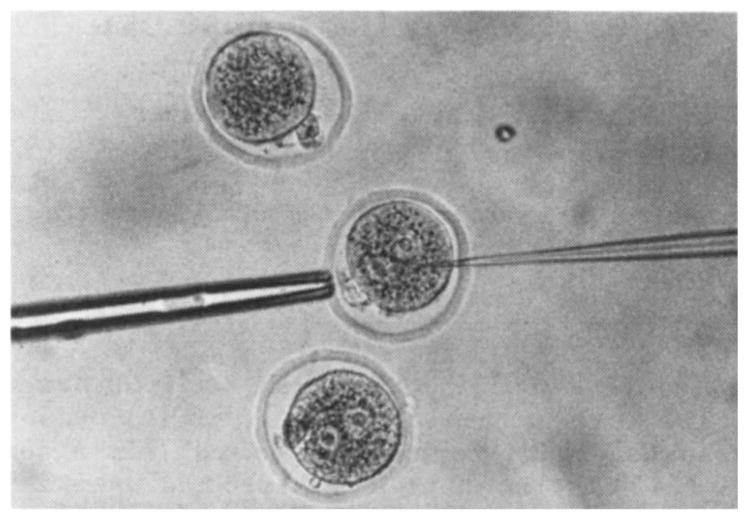
Fig. 1
Fig. 1
Injection of one-cell mouse ovum with mRNA. The ovum was held with a blunt suction pipette (5 μm i.d., 20 μm o.d.). The o.d. of the injector pipette was 2–3 μm, and the tip was sharpened either by chipping or grinding. The ova were maintained on a depression slide in culture medium under silicone oil. The injection solution drop, from which the injector pipette was filled, was adjacent to the medium containing the ova. The technique was similar to that used for injecting cells into blastocysts.
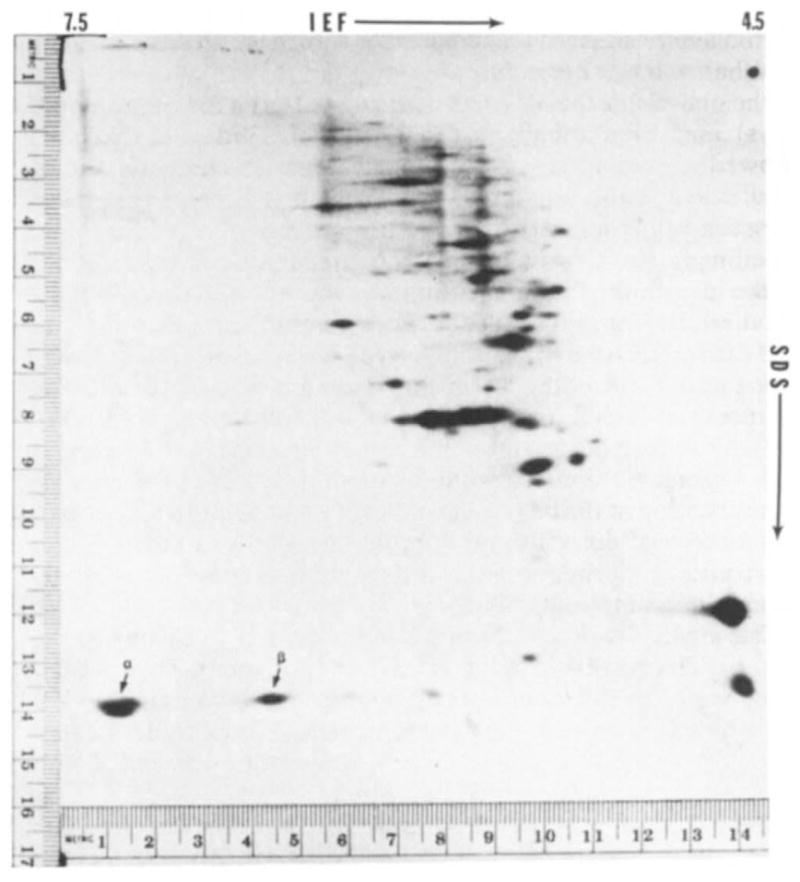
Fig. 2
Fig. 2
Fluorograph of two-dimensional electrophoretic separation of proteins from 20 one-cell fertilised mouse ova injected with mouse globin mRNA and incubated in 3H-labelled amino acids. Isoelectric focusing (IEF) was from left (pH 7.5) to right (pH 4.5) and SDS-polyacrylamide electrophoresis was from top to bottom. The technique used was basically that of O’Farrell, as previously described,. The IEF was carried out with pH 3–10 ampholines. Marker proteins on the right margin are lactoglobulin (top, MW = 18,400) and methaemoglobin (bottom, MW= 16,000). The two radioactive spots indicated by the arrows coincide with the position of the non-radioactive globin marker protein prepared from mouse blood. α and β indicate the positions of α- and β-chains of globin.
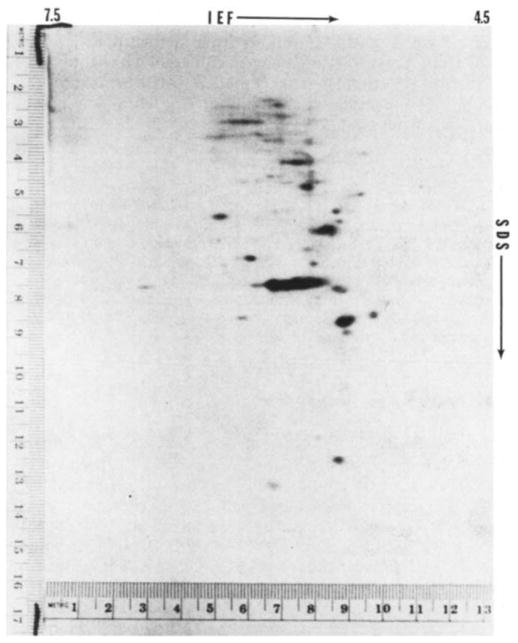
Fig. 3
Fig. 3
Fluorograph of two-dimensional electrophoretic separation of proteins from 20 one-cell fertilised mouse ova injected with water. Techniques used were similar to those for Fig. 2. No radioactivity appears in the area of globin migration.
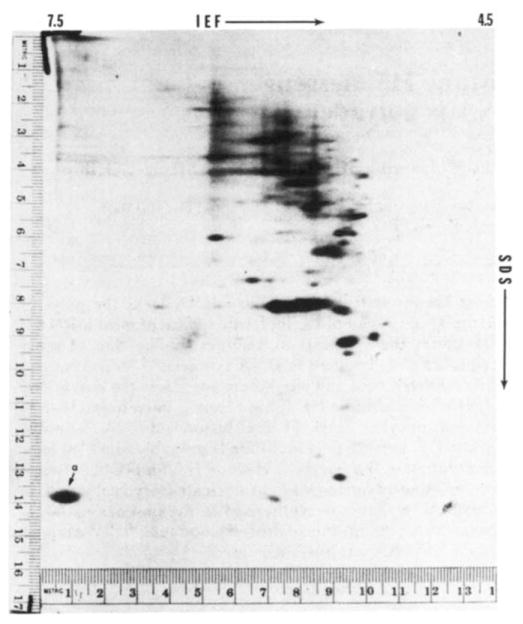
Fig. 4
Fig. 4
Fluorograph of two-dimensional electrophoretic separation of proteins from 20 one-cell fertilised mouse ova injected with rabbit globin mRNA. Techniques used were similar to those for Fig. 2. The single radioactive spot indicated by the arrow coincides with the position of the non-radioactive globin marker protein prepared from rabbit blood. α Indicates the position of the α-chain of globin. No β-chain was detected on the fluorograph.

References

    1. Gurdon JB, Lane CD, Woodland HR, Marbaix G. Nature. 1971;233:177–182. - PubMed
    1. Gurdon JB. 6th Karolinska Symp on Research Methods in Reproductive. Endocrinology. 1973:225–243.
    1. Colman A, Morser J. Cell. 1979;17:517–526. - PubMed
    1. Mous J, Peeters B, Van Bellegem H, Rombauts W. Eur J Biochem. 1979;94:393–400. - PubMed
    1. Laskey RA, Mills AD, Gurdon JB, Partington GA. Cell. 1977;11:345–351. - PubMed

Publication types