. 1980 Feb 1;207(4430):553-5.
doi: 10.1126/science.7352269.

Auditory and vocal nuclei in the frog brain concentrate sex hormones

Auditory and vocal nuclei in the frog brain concentrate sex hormones

D B Kelley. Science. .

Abstract

Mate calling by South African clawed frogs, Xenopus laevis, is under the control of androgens. Autoradiographic studies demonstrate androgen-concentrating neurons in a motor nucleus that controls mate calling and a midbrain nucleus that is stimulated by sound. Hormone concentration by laryngeal motor neurons suggests that steroids regulate the final common path for vocal behavior. Modulation of auditory sensitivity by hormones could explain seasonal variations in behavioral responsiveness to conspecific vocalizations.


Figures
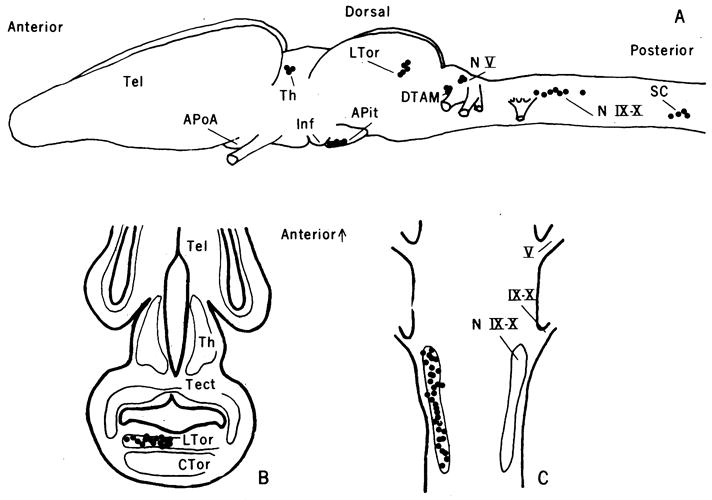
Fig. 1
Fig. 1
(A) A lateral view of the brain and anterior spinal chord of X. laevis. Locations of DHT-concentrating cells (●) are indicated schematically. (B) A representative horizontal section through the torus semicircularis. Locations of labeled cells (●) are shown on the left side; major brain nuclei are identified on the right. The figure represents all labeled cells from one 10-μm autoradiogram projected onto a standard reference section. (C) A representative horizontal section through the nucleus of cranial nerves IX and X. Abbreviations: APit, anterior pituitary; ApoA, anterior preoptic area; CTor, caudal nucleus of the torus semicircularis; DTAM, dorsal tegmental area of the medulla; Inf, infundibulum; LTor, laminar nucleus of the torus semicircularis; NV, sensory nucleus of the fifth cranial nerve; N IX-X, motor nucleus of the ninth and tenth cranial nerves; SC, ventral horn of the anterior spinal cord; Tect, optic tectum; Tel, telencephalon; Th, thalamus; V, fifth cranial nerve; and IX-X, ninth and tenth cranial nerves.
Fig. 2
Fig. 2
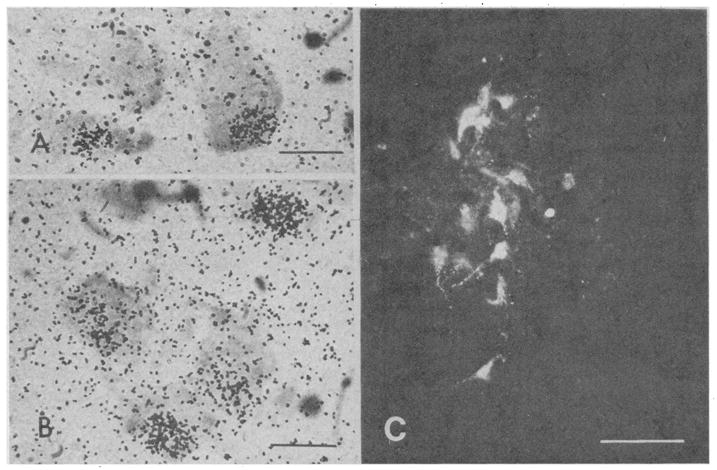
(A and B) Photomicrographs of autoradiograms illustrating DHT-concentrating cells in N IX-X of X. laevis after 6 weeks exposure. Cells are lightly stained with cresyl violet acetate. Calibration bar, 20 μm. (C) Dark-field photomicrograph of HRP-labeled cells in N IX-X after insertion of enzyme into the ipsilateral bipennate muscles of the larnyx. Intracellular HRP was visualized by reaction with tetramethylbenzidine and hydrogen peroxide. Calibration bar; 50 μm.
Fig. 3
Fig. 3
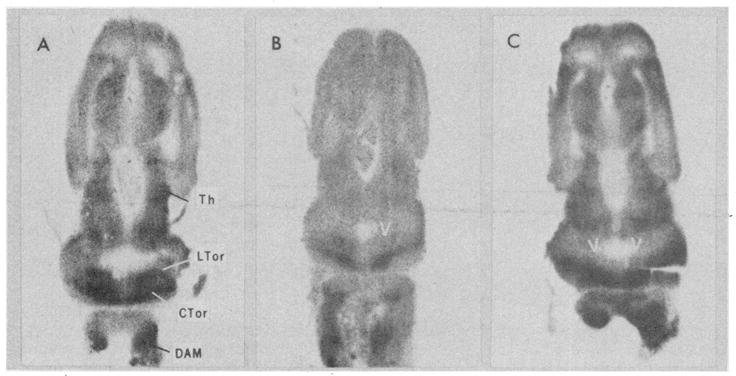
Autoradiograms of horizontal sections through the torus semicircularis of frogs exposed to 14C-labeled 2DG. (A) Intact male frog stimulated with a 2-hour tape of conspecific vocalizations. Regions of heavy accumulation of radioactivity include the dorsal acoustic medulla (DAM), the caudal nucleus of the torus semicircularis (CTor), the laminar nucleus of the torus semicircularis (LTor), and anterior and posterior thalamus (Th). (B) Male frog deafened on one side and stimulated with a 2-hour tape of conspecific vocalizations. Arrow, reduction of label in the contralateral LTor. (C) Bilaterally deafened, male frog exposed only to ambient noise. While CTor and Th are clearly visible, LTor cannot be distinguished (arrows).

References

    1. Kelley D, Pfaff D. In: Biological Determinants of Sexual Behavior. Hutchison J, editor. Wiley-Interscience; New York: 1978. pp. 225–254.
    2. Morrell J, Kelley D, Pfaff D. In: Proceedings of the Second Brain-Endocrine Interaction Symposium. Knigge K, Scott D, Kobayashi M, Ishii S, editors. Karger; Basel: 1975. pp. 230–256.
    1. Examples of testosterone-concentrating motor neurons include the nucleus of cranial nerves IX and X in frogs (3), hypoglossal neurons in zebra finches (4), and motor neurons in the ventral horn in rats [ Sar M, Stumpf WE. Science. 1977;197:77.].

    1. Kelley D, Morrell J, Pfaff D. J Comp Neurol. 1975;164:47. - PubMed
    2. Morrell J, Kelley D, Pfaff D. :63. ibid.
    1. As has also been described for CNS control of song in birds [ Arnold A, Nottebohm F, Pfaff D. 1976;165:487. ibid.

    1. For example, dorsal horn cells in the spinal cord concentrate estradiol [ Keefer DA, Stumpf WE. Proc Soc Exp Biol Med. 1973;143:414.

Substances

LinkOut - more resources