Review
doi: 10.1146/annurev.ne.18.030195.001021.
Dynamic regulation of receptive fields and maps in the adult sensory cortex
Affiliations
- PMID: 7605058
- PMCID: PMC3621971
- DOI: 10.1146/annurev.ne.18.030195.001021
Item in Clipboard
Review
Dynamic regulation of receptive fields and maps in the adult sensory cortex
Annu Rev Neurosci.
1995.
No abstract available
Figures
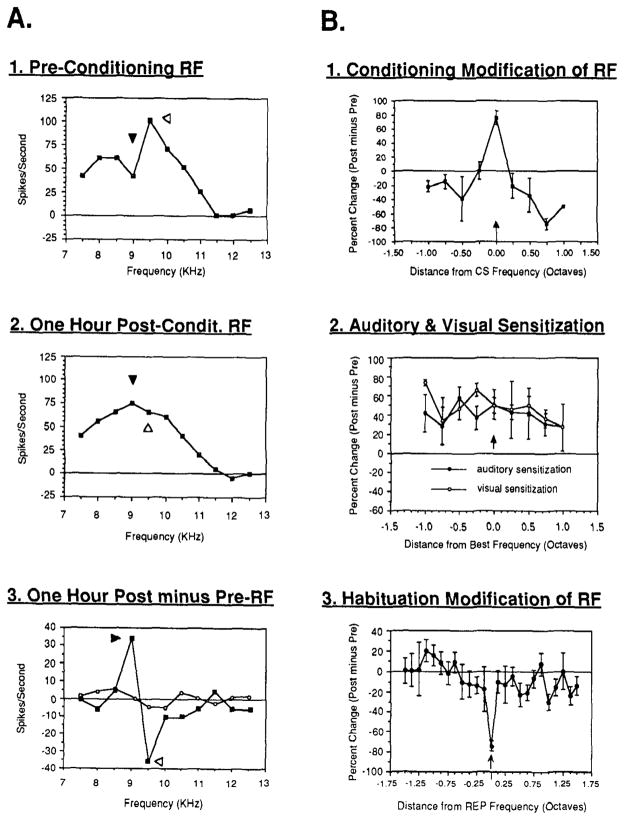
The effects of learning upon receptive fields in the primary auditory cortex of the waking guinea pig. (A) An example of CS-specific receptive field modification produced by classical conditioning. The illustrated case is one in which the CS frequency became the best frequency. 1. Preconditioning the best frequency was 9.5 kHz (open arrowhead) and the CS was selected to be 9.0 kHz (closed arrowhead) for conditioning, which produced behavioral conditioned responses to this frequency (not shown). 2. One hour postconditioning, the CS frequency became the best frequency because of increased response to this frequency and decreased response to the preconditioning best frequency and other frequencies. 3. The receptive field difference function (post-minus pre-RFs) shows that conditioning produces the maximal increase at the CS frequency and maximal decrease at the pretraining best frequency. Open circles show no systematic effect on spontaneous activity. (B) Group receptive field mean (± s.e.) difference functions (treatment minus control) for three types of training. 1. Conditioning produces increased response at the frequency of the conditioned stimulus and decreases at most other frequencies starting at 0.25 octaves from the CS frequency (side-band suppression). 2. Sensitization training produces a broad, nonspecific increase in response across the auditory receptive field, both for auditory and visual sensitization training. 3. Habituation produces a frequency-specific decrease for a frequency which developed a decrement in response due to repeated presentation alone. Note the high degree of specificity; frequencies 0.125 octaves from the repeated frequency were little affected. From Weinberger 1994.

Resprentative responses of barrel D2 cells in rats with differing sensory experience. Whisker deflection in each PSTH was at 0 ms. Cell P5U3 (left) was recorded in a rat (WP17) with all whiskers intact. Note the vigorous response to the CRF whisker and the symmetry in the response to whiskers D 1 and D3 and whiskers C2 and E2. This is in contrast to cell P6U2 (right), which was recorded in a rat (WP21) with whiskers D2 and D3 paired during the preceding 64 h. Here, movement of whisker D3 yielded a stronger response (arrow) than did the SRF whiskers that had been cut. From Diamond et al 1993.

Cortical representation of characteristic frequency (CF) in A 1 of four adult owl monkeys. Thin lines define boundaries of cortical locations with CFs within one octave. Stippled regions encircle cortical locations where neurons were recorded with CFs in the frequency range used in the 2.5 kHz task; solid regions represent frequencies used in the 5 kHz task; and hatched regions represent the frequency range used in the 8 kHz task. The cortical areas representing a given frequency range were approximated by connecting the 50% distance values to the neighboring recording sites with CFs outside the given frequency range. Pluses denote recording sites with neuronal response not consistent with properties of A1 neurons. A is from a representative normal owl monkey (N2); B is from a monkey trained at 2.5 kHz (OM3); C shows the monkey passively stimulated with the frequencies used in the 5 kHz task (CM2); and D shows the representation the monkey trained at the 5 kHz task (OM4). From Recanzone et al 1993.
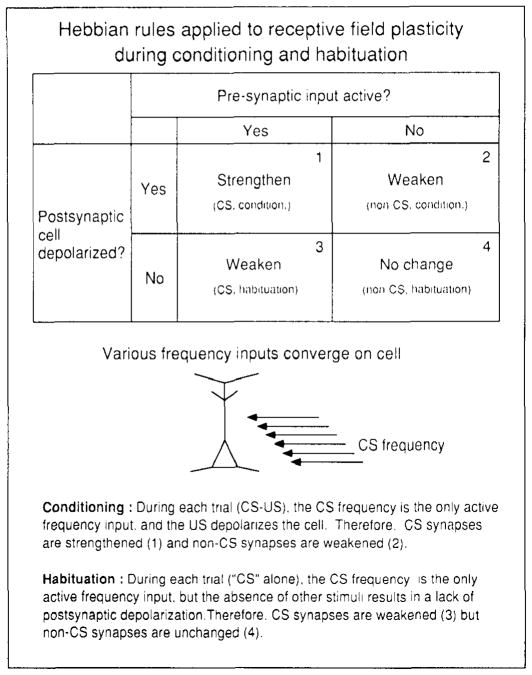
Application of extended Hebbian rules to receptive field plasticity for classical conditioning and habituation. Simple combinations of pre- and postsynaptic elements, each of which can be in an active or nonactive state, might account for the effects of conditioning on CS and non-CS synaptic strengths and for the effects of habituation on the repeated and nonrepeated stimuli. From Weinberger 1993.

A subjective estimate of the extent of research in developmental sensory plasticity and adult sensory cortical plasticity. The relative sizes of the dots indicate the relative estimates of research; the dots should be interpreted as occuring on a greatly expanded nonlinear scale.
References
-
- Allard T, Clark SA, Jenkins WM, Merzenich MM. Reorganization of somatosensory area 3b representations in adult owl monkeys after digital syndactyly. J Neurophysiol. 1991;66:1048–58. - PubMed
-
- Ahissar E, Vaadia E, Ahissar M, Bergman H, Arieli A, Abeles M. Dependence of cortical plasticity on correlated activity of single neurons and on behavioral context. Science. 1992;257:1412–15. - PubMed
-
- Armstrong-James M, George MJ. Influence of anesthesia on spontaneous activity and receptive field size of single units in rat Sm1 neocortex. Exp Neurol. 1988;99:369–87. - PubMed
-
- Ashe JH, McKenna TM, Weinberger NM. Cholinergic modulation of frequency receptive fields in auditory cortex: II. Frequency-specific effects of anticholinesterases provide evidence for a modulatory action of endogenous ACh. Synapse. 1989;4:44–54. - PubMed
-
- Bakin JS, Lepan B, Weinberger NM. Sensitization induced receptive field plasticity in the auditory cortex is independent of CS-modality. Brain Res. 1992;577:226–35. - PubMed
Publication types
MeSH terms
Grants and funding
LinkOut - more resources
Full Text Sources