


Glial cytokines in Alzheimer's disease: review and pathogenic implications
- PMID: 7635444
- PMCID: PMC3903413
- DOI: 10.1016/0046-8177(95)90001-2
Glial cytokines in Alzheimer's disease: review and pathogenic implications
Abstract
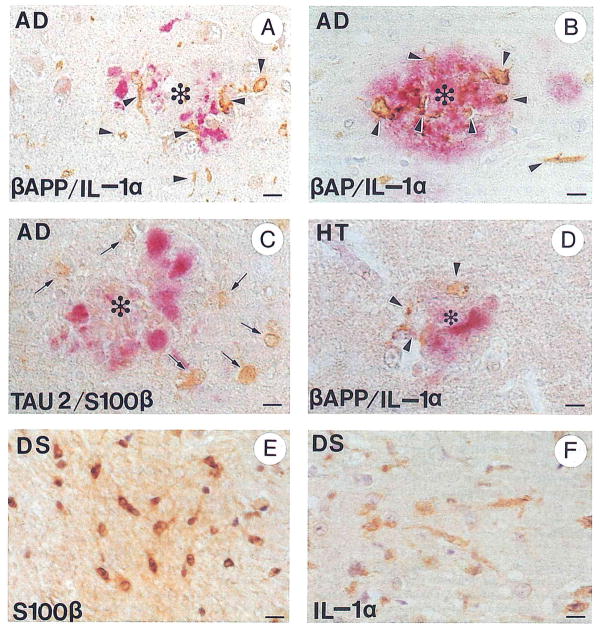
The roles of activated glia and of glial cytokines in the pathogenesis of Alzheimer's disease are reviewed. Interleukin-1 (IL-1), a microglia-derived acute phase cytokine, activates astrocytes and induces expression of the astrocyte-derived cytokine, S100 beta, which stimulates neurite growth (and thus has been implicated in neuritic plaque formation) and increases intracellular free calcium levels. Interleukin-1 also upregulates expression and processing of beta-amyloid precursor proteins (beta-APPs) (thus favoring beta-amyloid deposition) and induces expression of alpha 1-antichymotrypsin, thromboplastin, the complement protein C3, and apolipoprotein E, all of which are present in neuritic plaques. These cytokines, and the molecular and cellular events that they engender, form a complex of interactions that may be capable of self-propagation, leading to chronic overexpression of glial cytokines with neurodegenerative consequences. Self-propagation may be facilitated by means of several reinforcing feedback loops. beta-Amyloid, for instance, directly activates microglia, thus inducing further IL-1 production, and activates the complement system, which also leads to microglial activation with IL-1 expression. Self-propagation also could result when S100 beta-induced increases in intraneuronal free calcium levels lead to neuronal injury and death with consequent microglial activation. Such chronic, self-propagating, cytokine-mediated molecular and cellular reactions would explain the progressive neurodegeneration and dementia of Alzheimer's disease.
Figures

References
-
- Selkoe DJ. Alzheimer’s disease: A central role for amyloid. J Neuropathol Exp Neurol. 1994;53:438–447. - PubMed
-
- Davies CA, Mann DMA, Sumpter PQ, et al. A quantitative morphometric analysis of the neuronal and synaptic content of the frontal and temporal cortex in patients with Alzheimer’s disease. J Neurol Sci. 1987;78:151–164. - PubMed
-
- Terry RD, Masliah E, Salmon DP, et al. Physical basis of cognitive alterations in Alzheimer’s disease: Synapse loss is the major correlate of cognitive impairment. Ann Neurol. 1991;30:572–580. - PubMed
-
- DeKosky ST, Scheff SW. Synapse loss in frontal cortex biopsies in Alzheimer’s disease: Correlation with cognitive severity. Ann Neurol. 1990;27:457–464. - PubMed
Publication types
MeSH terms
Substances
Grants and funding
LinkOut - more resources
Full Text Sources
Other Literature Sources
Medical
Miscellaneous
