. 1995 Jun 23;268(5218):1763-6.
doi: 10.1126/science.7792602.

Aggressive behavior and altered amounts of brain serotonin and norepinephrine in mice lacking MAOA

Affiliations

Aggressive behavior and altered amounts of brain serotonin and norepinephrine in mice lacking MAOA

O Cases et al. Science. .

Abstract

Deficiency in monoamine oxidase A (MAOA), an enzyme that degrades serotonin and norepinephrine, has recently been shown to be associated with aggressive behavior in men of a Dutch family. A line of transgenic mice was isolated in which transgene integration caused a deletion in the gene encoding MAOA, providing an animal model of MAOA deficiency. In pup brains, serotonin concentrations were increased up to ninefold, and serotonin-like immunoreactivity was present in catecholaminergic neurons. In pup and adult brains, norepinephrine concentrations were increased up to twofold, and cytoarchitectural changes were observed in the somatosensory cortex. Pup behavioral alterations, including trembling, difficulty in righting, and fearfulness were reversed by the serotonin synthesis inhibitor parachlorophenylalanine. Adults manifested a distinct behavioral syndrome, including enhanced aggression in males.


Figures

Fig. 1
Fig. 1
MAOA RNA of Tg8 mice (A) Representation of the Tg8 gene encoding MAOA between exons 1 and 8 (the gene for MAOA probably has 15 exons) and structure of the four species of MAOA RNA detected by RT-PCR. The species containing IFN-β sequences (an exon of 199 bp) results from splicing events between legitimate MAOA splice sites and cryptic IFN-β splice sites (SA and SD, acceptor and donor sites present in antisense IFN-β RNA). (B) Sequence of SA and SD, and sequence of MAOA exon 2 acceptor splice site. The MAOA exon 2 acceptor has a strong putative branch site sequence (TGTTAAC), as opposed to the cryptic acceptor SA. (C) C3H MAOA sequences obtained by RT-PCR between exons and 8. The Tg8 RNA splice between exons 1 and 4 causes a reading frame shift, and the IFN-β exon of the hybrid RNA species does not restore the normal reading frame. Internal initiation of translation may occur at ACAATG within exon 4.
Fig. 2
Fig. 2
Behavioral alterations of Tg8 mice. (A) Righting responses. Pups were separated from their dam, isolated in a bare cage at 20°C for 3 min to wake them up, and placed on their backs. The graph gives the mean time for the pups to turn over with an upper limit of 1 min (means of the mean of five consecutive time points for each pup ± SEM). Tg8 pups turned over with forceful movements and excitation, whereas C3H pups acted calmly. (B) Aggression between Tg8 male cage mates. The plot represents a 1-day survey of skin wounds in 2- to 7-month-old males housed in groups form the time of weaning (12 cages; in the one cage of unwounded 4-month-old mice, two individuals were wounded 2 week later). In the control survey, no wounded individuals were found among 2- to 8-month-old C3H males housed in groups from the time of weaning (173 males in 22 cages). Skin wounds were not present in Tg8 and C3H female groups. (C) Latency to the first appearance of biting attack in resident-intruder tests after a long period of breeding. Each 6-month-old resident was given a single 10-min encounter in his home cage with a 2-month-old C3H intruder. The 30 Tg8 residents and 30 C3H residents were housed with a female from the age of 2 months and reared several litters. The 60 intruders were housed in groups of 10 from the time of weaning; attack latency (mean ± SEM) of Tg8 and C3H residents was 74 ± 10s and 237 ± 18 s, respectively (t test; t(58) = 7.90, P < 0.0001). (D) Latency to the first appearance of biting attack in resident-intruder tests after a period of isolation. Tg8 and C3H males were individually housed for 5 weeks beginning at weaning and were given single 3-min encounters (a short time to allow further testing) in their home cages with 2-month-old C3H intruders. Attack latency of Tg8 and C3H residents was 110 ± 12 s and 172 ± 4 s, respectively (P < 0.0001). One month later, the residents were given single 10-min encounters in their home cages with 2-month-old BALB/cJ intruders: Attack latency of Tg8 and C3H residents was 27 ± 6 s and 252 ± 35 s, respectively (P < 0.0001).
Fig. 3
Fig. 3
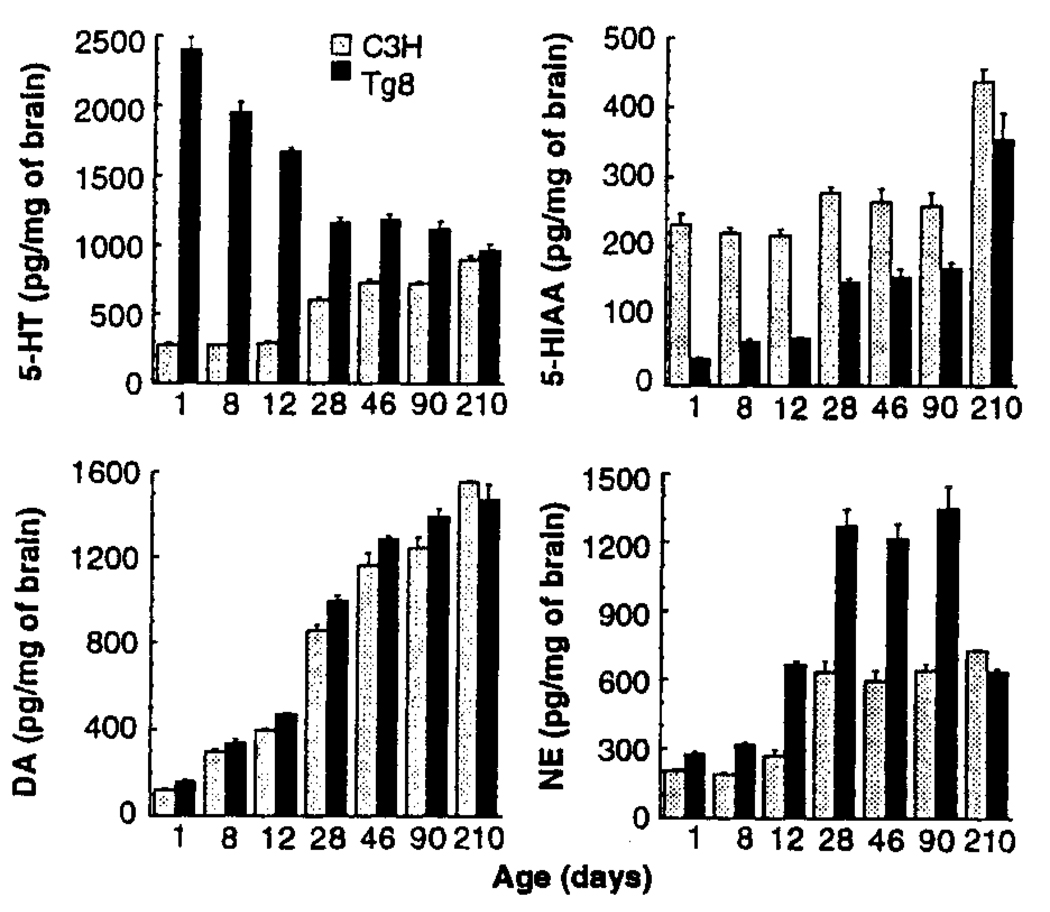
Amounts of 5-HT, 5-HIAA, DA, and NE in whole brains from Tg8 and C3H mice. Values from HPLC assays (24) are expressed in picogram per milligram of wet brain and represent the mean ± SEM (n = 4, 5, 7, 8, 4, 4, and 2). Mice were of both sexes and various ages (except for the 3-month-old mice, which were males only) and were housed in groups according to sex beginning at weaning (except for the 7-month-old mice, which were breeding pairs).
Fig. 4
Fig. 4
Abnormal 5-HT immunostaining in 7-day-old Tg8 brains. (A through C) Coronal sections of C3H brain. (D through F) Corresponding sections of Tg8 brain. 5-HT polyclonal antibody was used at a dilution of 1:15,000 and was revealed by a streptavidin-biotin-peroxidase complex and by diaminobenzidine. In the locus coeruleus (Ic) [(A) and (D)], substantia nigra (sn), and ventral tegmental area (vta) [(B) and (E)], 5-HT-like immunoreactivity is present in terminal fibers and medial forebrain bundle (mfb) in C3H and Tg8 mice but is abnormally present in cell bodies in Tg8 mice [arrows in (D) and (E)]. Four different 5-HT antisera (three polyclonal and one monoclonal) revealed the same staining pattern. Double immunofluorescent staining for 5-HT and the catecholamine synthesizing enzyme tyrosine hydroxylase showed that these 5-HT-like immunoreactive cell bodies were catecholaminergic. In the somatosensory cortex [(C) and (F)], clusters of 5-HT-immunoreactive fibers delineate barrels in layer IV in C3H mice (C), whereas they form a continuous band in layer IV in Tg8 mice (F). Scale bar, 225 µm.

Comment in

References

    1. Mann CC. Science. 1994;264:1686. - PubMed
    2. Barinaga M. ibid. :1690.
    3. Saudou F, et al. ibid. 1994;265:1875. - PubMed
    4. Chen C, Rainnie DG, Greene RW, Tonegawa S. ibid. 1994;266:291. - PubMed
    1. Bach AWJ, et al. Proc. Natl. Acad. Sci. U.S.A. 1988;85:4934. - PubMed
    2. Chen Z-Y, Powell JF, Hsu Y-PP, Breakefield XO, Craig IW. Genomics. 1992;14:75. - PubMed
    1. Collins FA, et al. Am. J. Med. Genet. 1992;42:127. - PubMed
    1. Brunner HG, Nelen M, Breakefield XO, Ropers HH, van Oost BA. Science. 1993;262:578. - PubMed
    1. The IFN-β minigene is a 1588-bp Acc I-Apa I fragment derived from plasmid pKb-IFN-β [ Seif I, De Maeyer E, Rivière I, De Maeyer-Guignard J. J. Virol. 1991;65:664. ]. The Tg8 transgene is identical to the minigene, except for a 64-bp terminal deletion in the herpes virus thymidine kinase (TK) region and a 148-bp deletion in the promoter region from the major histocompatibility gene H-2Kb (H2).

Publication types