


A virus-like particle enzyme-linked immunosorbent assay detects serum antibodies in a majority of women infected with human papillomavirus type 16
- PMID: 8133532
- PMCID: PMC3935441
- DOI: 10.1093/jnci/86.7.494
A virus-like particle enzyme-linked immunosorbent assay detects serum antibodies in a majority of women infected with human papillomavirus type 16
Abstract
Background: Previous studies have demonstrated that genital infection with high-risk types of human papillomavirus (HPV), most often HPV16, is the most significant risk factor for the development of cervical cancer. However, serologic assays that have been developed to identify high-risk HPV infection have either failed to associate serum reactivity with other indicators of HPV infection or have identified only a minority of HPV-infected individuals.
Purpose: Our purpose was to determine whether a specifically developed enzyme-linked immunosorbent assay (ELISA) could detect IgG anti-HPV16 virion antibodies in the sera of women who had tested positive for genital HPV16 infection by DNA-based methods.
Methods: An ELISA was developed using newly developed HPV16 virus-like particles as antigens to detect anti-HPV16 virion IgG antibodies. These particles are comprised of HPV16 structural proteins that are self-assembled in insect cells after expression by recombinant baculoviruses. The sera of 122 women, whose HPV status had been previously evaluated by nucleic acid-based methods, were tested by this ELISA.
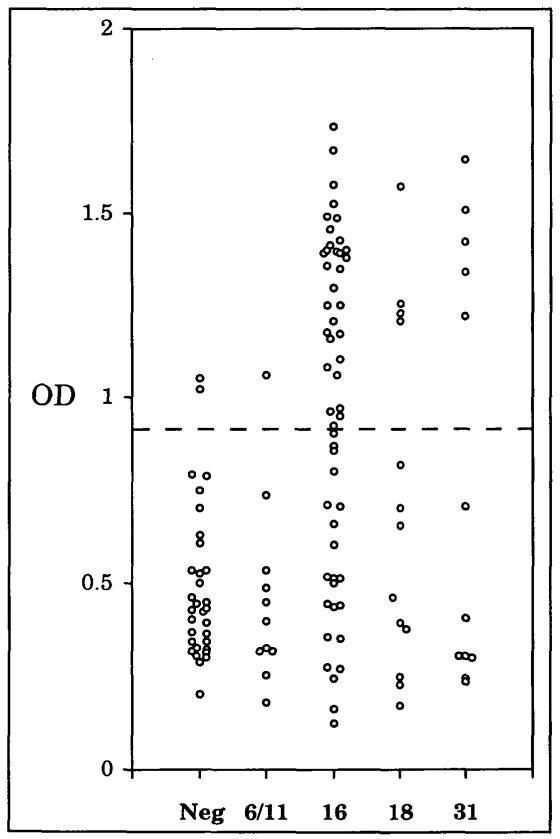
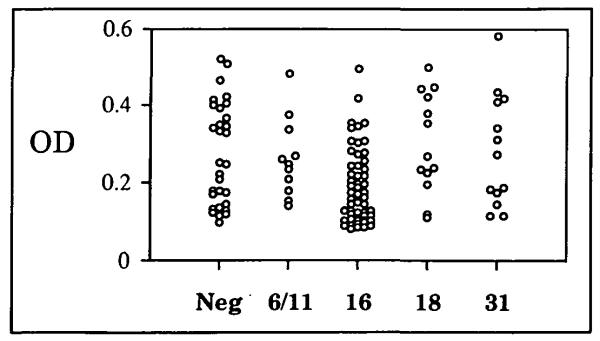
Results: The sera of 59% of women (32 of 54) positive for genital HPV16 DNA by polymerase chain reaction (PCR) were positive in the ELISA assay compared with sera from women who had tested negative for HPV DNA (P < .0005). In contrast, 6% of HPV DNA-negative women (two of 31) and 9% of women positive for low-risk HPV6/11 DNA (one of 11) were ELISA positive by this criterion. The sera of women who were DNA positive for two additional high-risk HPV types were evaluated; the sera of 31% of HPV18-positive (four of 13) and 38% of HPV31-positive women (five of 13) were positive in the HPV16 particle ELISA. The sera of 75% of HPV16 DNA-positive women with severe dysplasias (12 of 16) gave positive ELISA results. The sera of 67% of women (28 of 42) who tested positive for HPV16 DNA by both PCR and the less sensitive ViraType assay tested positive in the ELISA compared with 33% of women (four of 12) who were positive by PCR but negative by ViraType (P < .05).
Conclusion: The majority of women with cervical HPV16 infection generate an IgG antibody response to conformationally dependent epitopes of HPV16 L1 that can be detected by ELISA.
Implication: This particular ELISA, or a similar one incorporating virus-like particles of additional HPV types, may be useful in determining the natural history of high-risk HPV infection and perhaps help to identify women at risk for developing cervical cancer.
Figures
Comment in
-
Papillomavirus capsids: a new approach to identify serological markers of HPV infection.J Natl Cancer Inst. 1994 Apr 6;86(7):474-5. doi: 10.1093/jnci/86.7.474. J Natl Cancer Inst. 1994. PMID: 8133525 No abstract available.
References
-
- Koutsky LA, Holmes KK, Critchlow CW, et al. A cohort study of the risk of cervical intraepithelial neoplasia grade 2 or 3 in relation to papillomavirus infection. N Engl J Med. 1992;327:1272–1278. - PubMed
-
- Lorincz AT, Reid R, Jenson AB, et al. Human papillomavirus infection of the cervix: relative risk associations of 15 common anogenital types. Obstet Gynecol. 1992;79:328–337. - PubMed
-
- Schiffman MH, Bauer HM, Hoover RN, et al. Epidemiologic evidence showing that human papillomavirus infection causes most cervical intraepithelial neoplasia. J Natl Cancer Inst. 1993;85:958–964. - PubMed
-
- Koss LG. The Papanicolaou test for cervical cancer detection. A triumph and a tragedy. JAMA. 1989;261:737–743. - PubMed
-
- Schiffman MH. Validation of hybridization assays: correlation of filter in situ, dot blot and PCR with Southern blot. In: Muñoz N, Bosch FX, Shah KV, et al., editors. The Epidemiology of Cervical Cancer and Human Papillomavirus. International Agency for Research on Cancer; Lyon: 1992. pp. 169–179. (Scientific Publication No. 119). - PubMed
Publication types
MeSH terms
Substances
Grants and funding
LinkOut - more resources
Full Text Sources
Other Literature Sources
Medical
