


Cloning and manipulation of the Schizosaccharomyces pombe his7+ gene as a new selectable marker for molecular genetic studies
- PMID: 8299169
- PMCID: PMC4417482
- DOI: 10.1007/BF00351711
Cloning and manipulation of the Schizosaccharomyces pombe his7+ gene as a new selectable marker for molecular genetic studies
Abstract
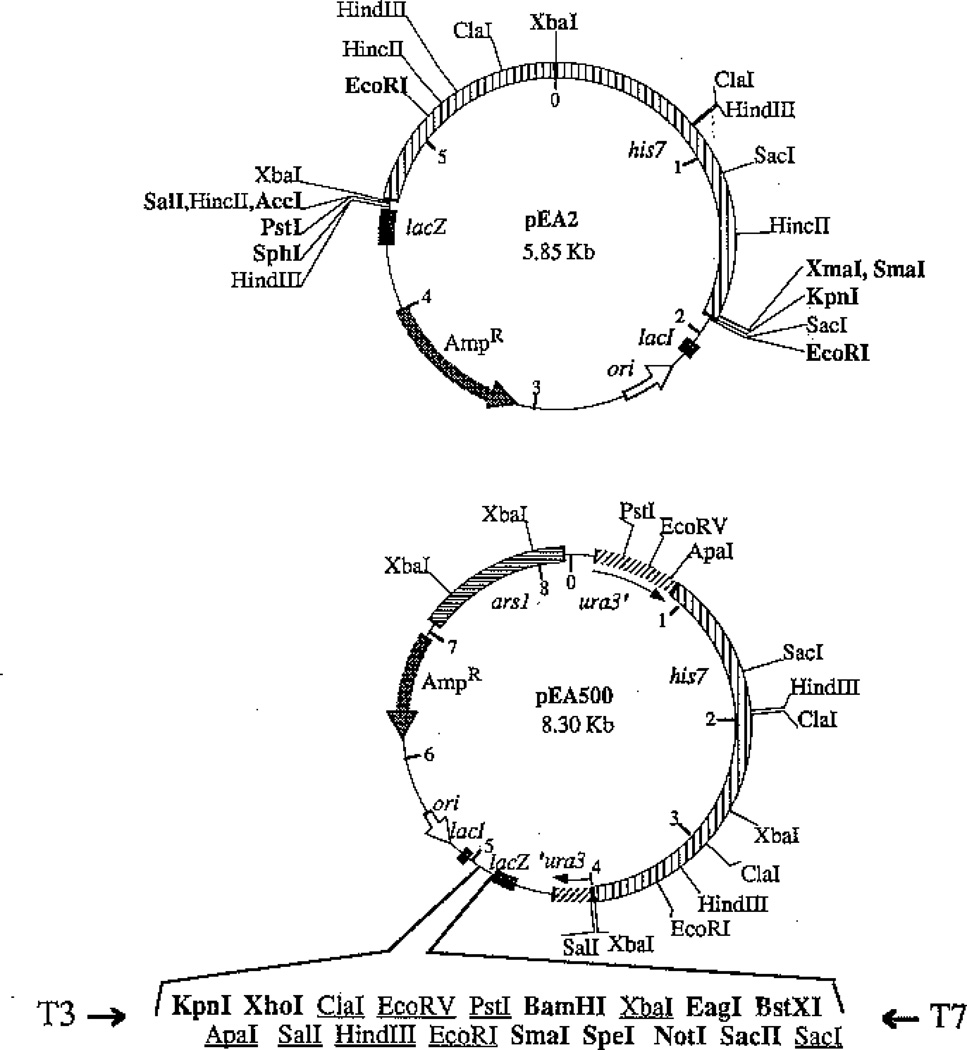
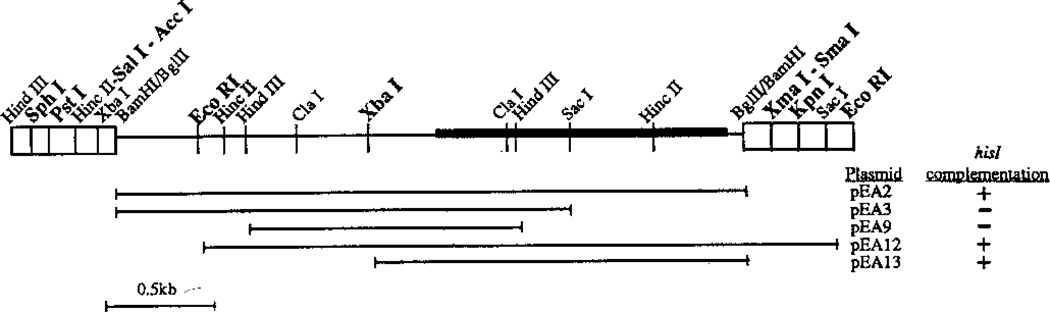
We have cloned the his7+ gene of the fission yeast Schizosaccharomyces pombe by complementation of the recessive mutant allele his7-366. The his7+ gene is able to complement a mutation of the Escherichia coli hisI gene, suggesting that his7+ encodes a phosphoribosyl-AMP cyclohydrase. Subcloning experiments localize the gene to a 1.9-kb XbaI-BglII fragment. We describe the construction of plasmids to facilitate the use of his7+ as a selectable marker in S. pombe studies. Plasmid pEA2 carries his7+ cloned into the pUC18 polylinker. From either pEA2 or the original his7+ clone, pMN1, fragments carrying his7+ can be isolated using a variety of restriction enzymes for the construction of gene disruptions. Plasmid pEA500 is a cloning vector that carries his7+ and ars1, yet retains the ability to use the blue/white color screen to identify recombinants.
Figures
References
-
- Ausubel F, Brent R, Kingston R, Moore D, Smith J, Scidman J, Struhl K, editors. Current protocols in molecular biology. New York: Wiley; 1987.
-
- Bach ML. Curr Genet. 1987;12:527–534. - PubMed
-
- Beach D, Nurse P. Nature. 1981;290:140–142. - PubMed
-
- Beach D, Rogers L, Gould J. Curr Genet. 1985;10:297–311. - PubMed
Publication types
MeSH terms
Substances
Grants and funding
LinkOut - more resources
Full Text Sources
Molecular Biology Databases
