


Optical measurements of pH using fluorescence lifetimes and phase-modulation fluorometry
- PMID: 8368522
- PMCID: PMC6816262
- DOI: 10.1021/ac00061a007
Optical measurements of pH using fluorescence lifetimes and phase-modulation fluorometry
Abstract
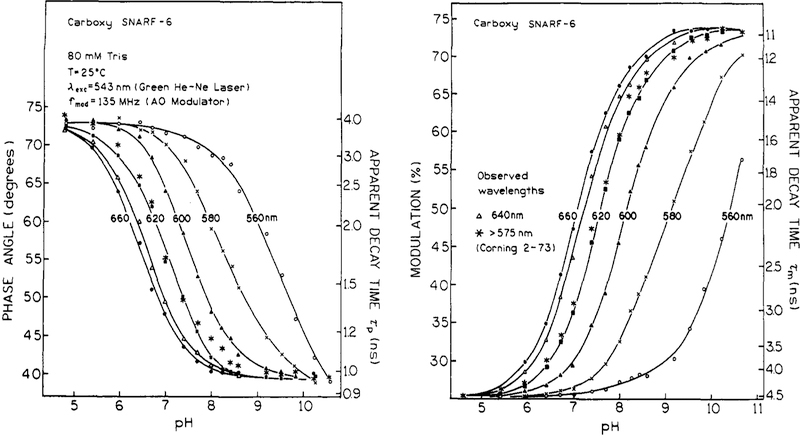
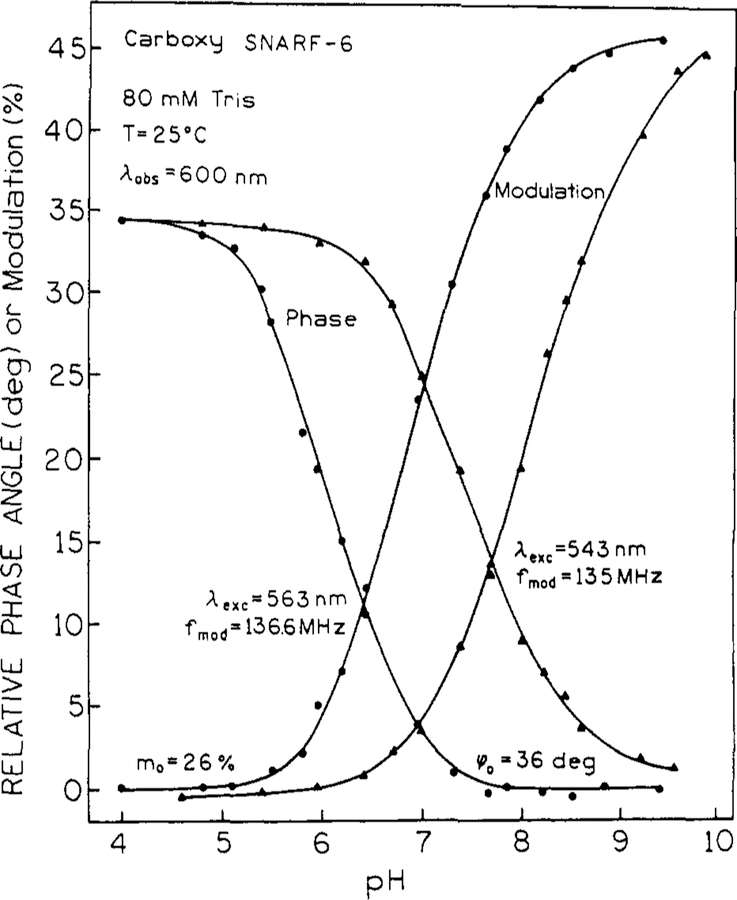
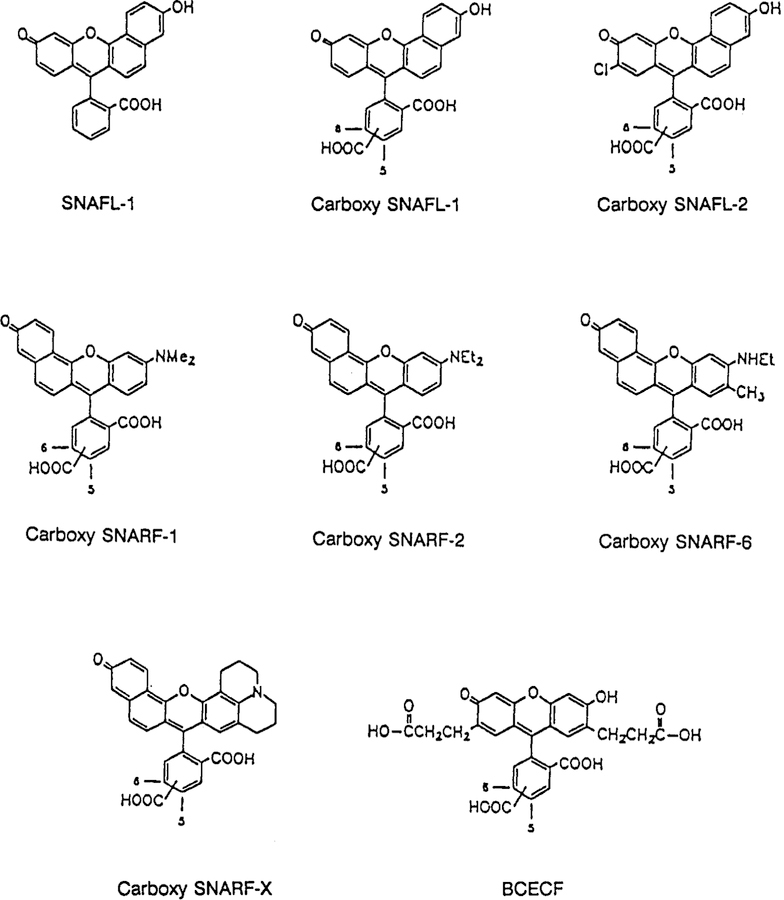
We measured the pH-dependent fluorescence decay times of the seminaphthofluoresceins (SNA-FL), seminaphthorhodafluors (SNARF), and BCE-CF using phase-modulation fluorometry. The phase and modulation values were found to be strongly pH-dependent in the physiological pH range, over the easily accessible range of light modulation frequencies from 10 to 300 MHz, making these probes useful as lifetime-based pH sensors. The phase and modulation values are dependent on excitation and emission wavelength as well as pH. This dependence allows the range of pH sensitivity to be chosen by selection of the wavelength(s) and enables increased precision of the pH measurements by use of phase and/or modulation measurements at several wavelengths. These probes can be excited using a a green He-Ne laser at 543 nm, which allows their use in low cost instrumentation. Phase and modulation measurements are especially suitable for sensing applications because they are insensitive to the changes in signal intensity that result from photobleaching, probe washout, and/or light losses.
Figures



References
-
- Wolfbeis OS, Ed. Fiber-Optic Chemical Sensors and Biosensors; CRC Press: Boca Raton, FL, 1991; Vols. I and II.
-
- Saari LA; Seitz WR Anal. Chem 1982, 54,823–824.
-
- Offenbacher H; Wolfbeis OS; Furlinger E (1986) Sens. Actuators 1986, 9, 73–84.
-
- Wolfbeis OS;Baustert JH J.Heterocycl. Chem 1985, 22, 1215–1218.
-
- Fuh M-RS; Burgess LW; Hirschfeld T; Christian GD Analyst 1987, 112, 1159–1163.
Publication types
MeSH terms
Substances
Grants and funding
LinkOut - more resources
Full Text Sources
Other Literature Sources
Research Materials