


Review
doi: 10.1016/0167-5699(93)90054-o.
Donor cell chimerism permitted by immunosuppressive drugs: a new view of organ transplantation
Affiliations
- PMID: 8397774
- PMCID: PMC2979321
- DOI: 10.1016/0167-5699(93)90054-o
Item in Clipboard
Review
Donor cell chimerism permitted by immunosuppressive drugs: a new view of organ transplantation
Immunol Today.
1993 Jun.
Erratum in
- Immunol Today. 2008 Apr;29(4):149
Abstract
One line of thought in organ transplantation feels that immunosuppressive drugs can lead to tolerance induction by allowing a previously unrecognized common mechanism of cell migration and microchimerism to occur, persist, and in some cases, become drug independent. It has been recognized that there is a spectrum of susceptibility of different organs to cellular rejection and that the variable ability of these organs to induce donor-specific nonreactivity reflects their comparative content of migratory leukocytes. Here, Thomas Starzl and colleagues discuss how many of the enigmas of transplantation immunology can be explained by this chimerism.
Figures
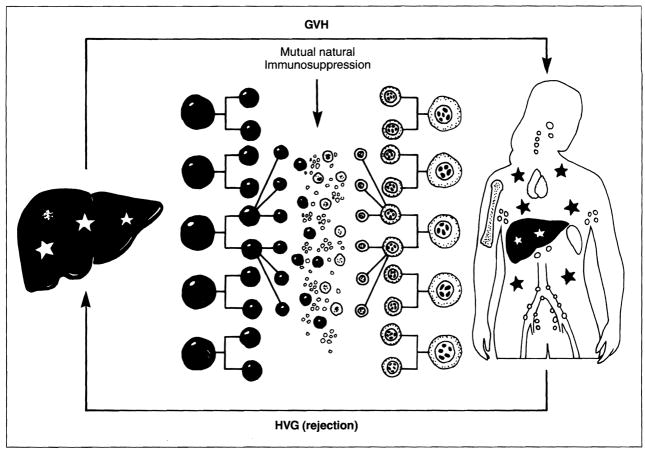
The mutual engagement of migratory immunocytes from the graft and the recipient following organ transplantation under potent pharmacological immunosuppression. GVH: graft versus host; HVG: host versus graft.
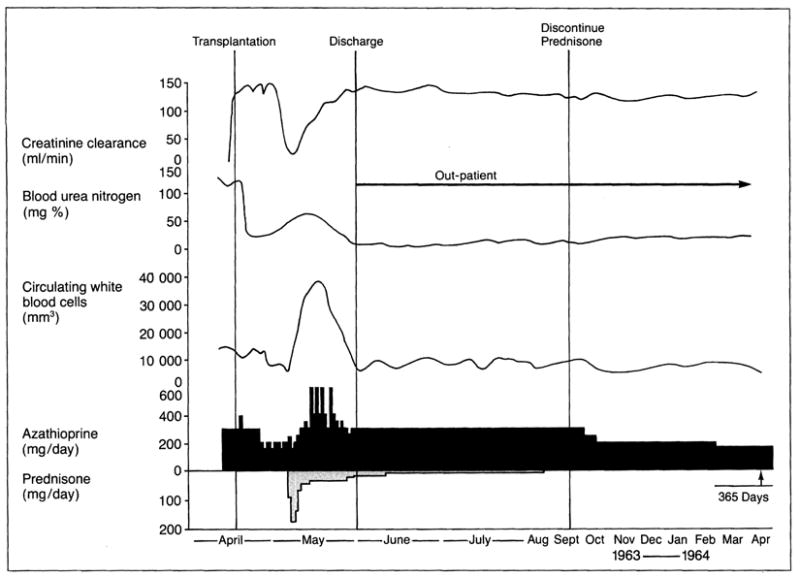
The characteristic cycle of immunological confrontation and recovery after organ transplantation (in this case kidney) that has dictated the use of immunosuppressive drugs for the last 30 years. Following a period of good postoperative renal function, rejection 2-1/2 weeks after transplantation (Tx) was correlated with a fall in creatinine clearance (Ccr), a rise in blood urea nitrogen (BUN) and an increase in circulating white blood cells (WBC). The adverse findings were reversed with prednisone, which was later discontinued along with a reduction of maintenance azathioprine. The kidney allograft in this 23 year old man functioned continuously from April 1963 until death from a myocardial infarction in 1990. (Adapted from Starzl, T.E., Experience In Renal Transplantation, W.B. Saunders Company, Philadelphia, PA, 1964, p. 167.)
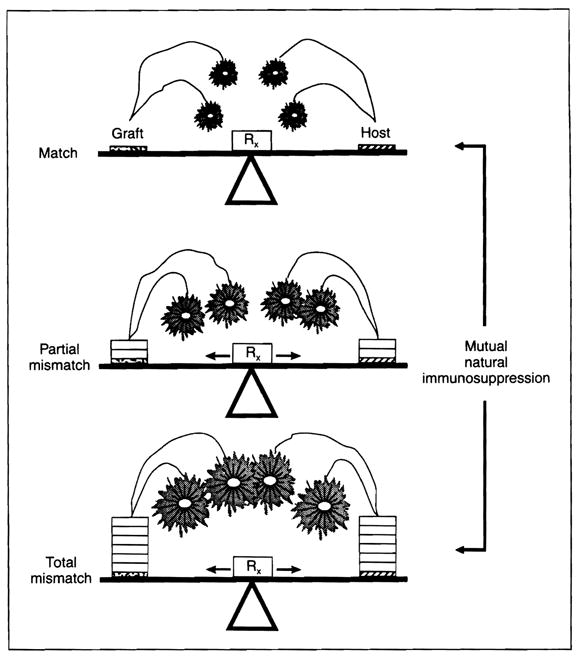
The donor–recipient leukocyte interaction shown in Fig. 1 is a buffer against rejection on one hand and GVHD on the other. Veto and suppressor cells are postulated to be the result of the interaction. Rx: iatrogenic immunosuppression.
References
-
- Sigal NH, Dumont FJ. Annu Rev Immunol. 1992;10:519–560. - PubMed
-
- Thomson AW, Starzl TE, editors. Immunosuppressive Drugs: Developments in Anti-Rejection Therapy. Edward Arnold; London: (in press)
Publication types
MeSH terms
Substances
Grants and funding
LinkOut - more resources
Full Text Sources
Other Literature Sources
Medical
