


Granulocyte/macrophage colony-stimulating factor-stimulated hepatic dendritic cell progenitors prolong pancreatic islet allograft survival
- PMID: 8525540
- PMCID: PMC2966312
Granulocyte/macrophage colony-stimulating factor-stimulated hepatic dendritic cell progenitors prolong pancreatic islet allograft survival
Abstract
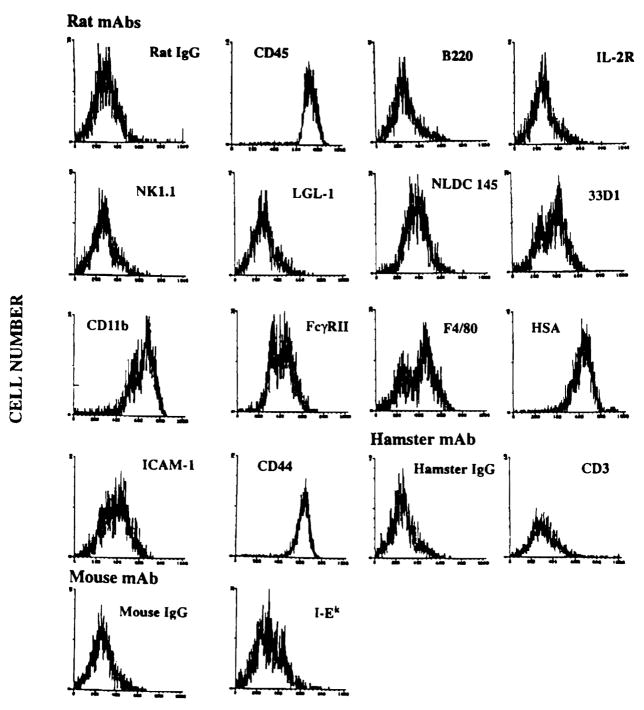
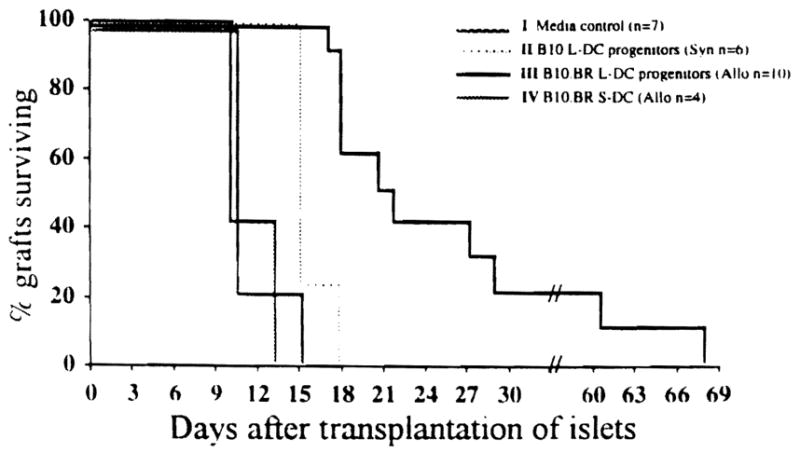
Liver-derived dendritic cell (DC) progenitors propagated in liquid culture in granulocyte/macrophage colony-stimulating factor exhibit low levels both of cell surface MHC class II antigens and of counter-receptors for CTLA-4/CD28. They fail to stimulate allogeneic T cells in mixed leukocyte cultures. To evaluate their in vivo functional significance, we determined their influence on survival of pancreatic islet allografts. Cultured B10.BR (H2k;I-E+) mouse liver-derived DC progenitors were injected (2 x 10(6) i.v.) into streptozotocin-diabetic B10 (H2b; I-E-) recipients 7 days before transplantation of pancreatic islets (700 IEq/mouse) from the same donor strain. No immunosuppressive agents were administered. Mean islet allograft survival time was prolonged from 15.3 days (in animals pretreated with syngeneic cells) to 30.3 days (P < 0.001) in mice pretreated with the donor-derived liver cells. In 20% of these animals, islet allograft survival exceeded 60 days. These data suggest that liver-derived DC progenitors may contribute both to the inherent tolerogenicity of the mouse liver and to its capacity to protect other allografts of the same donor strain from rejection.
Figures
References
-
- Zimmerman FA, Butcher GW, Davies HS, Brons G, Kamada N, Turel O. Techniques for orthotopic liver transplantation in the rat and some studies of the immunologic responses to fully allogeneic liver grafts. Transplant Proc. 1979;11:571. - PubMed
-
- Calne RY, Sells RA, Pena JR, et al. Induction of immunological tolerance by porcine liver allografts. Nature. 1969;233:472. - PubMed
-
- Kamada N, Davies HS, Roser BJ. Reversal of transplantation immunity by liver grafting. Nature. 1981;292:840. - PubMed
Publication types
MeSH terms
Substances
Grants and funding
LinkOut - more resources
Full Text Sources
Other Literature Sources
Medical
Research Materials