


Ultrastructural immunocytochemical localization of mu-opioid receptors in rat nucleus accumbens: extrasynaptic plasmalemmal distribution and association with Leu5-enkephalin
- PMID: 8753878
- PMCID: PMC6579005
- DOI: 10.1523/JNEUROSCI.16-13-04162.1996
Ultrastructural immunocytochemical localization of mu-opioid receptors in rat nucleus accumbens: extrasynaptic plasmalemmal distribution and association with Leu5-enkephalin
Abstract
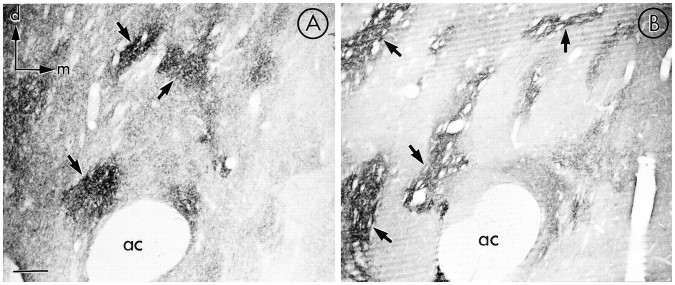
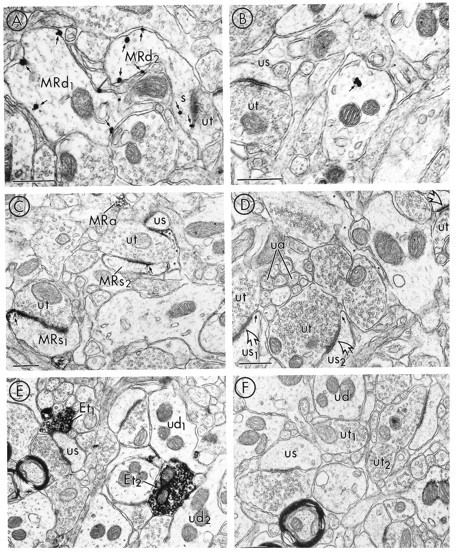
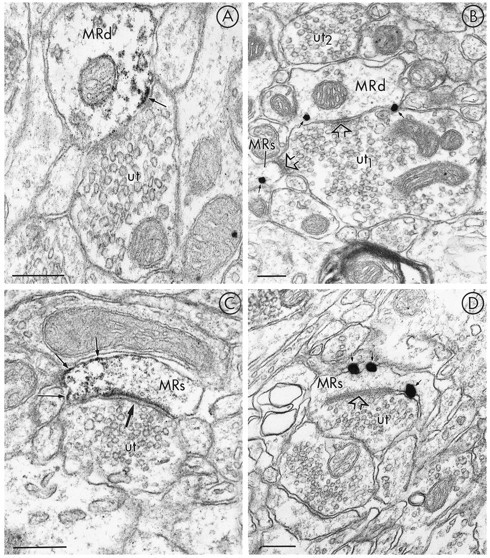
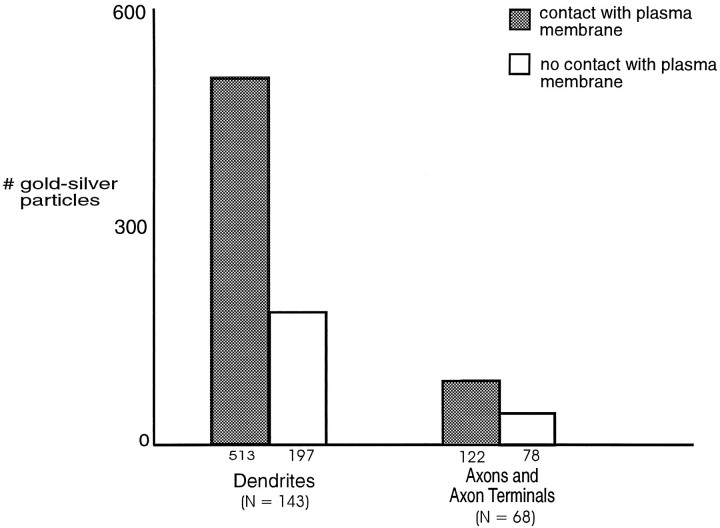
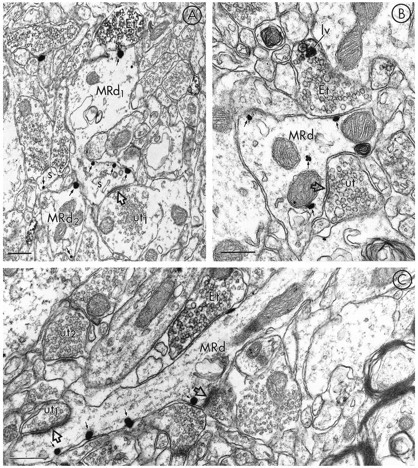
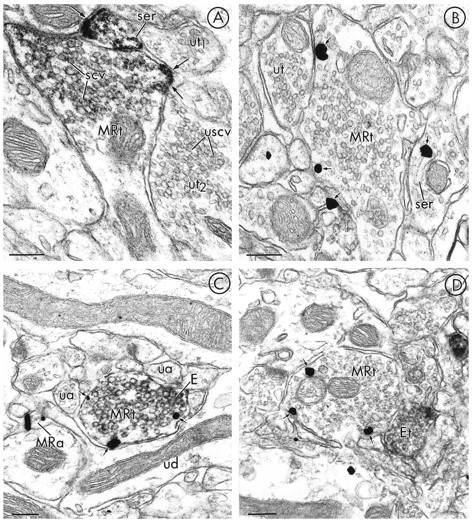
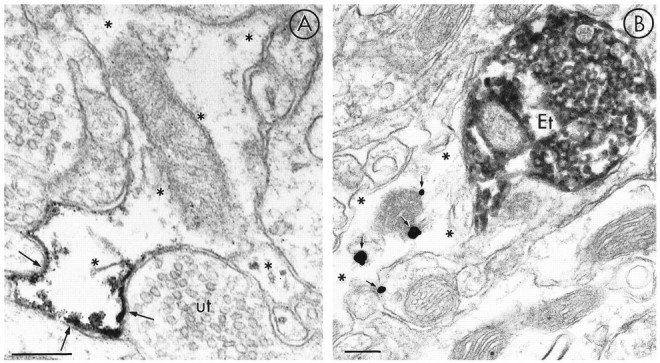
mu-Opioid receptors and their endogenous ligands, including Leu5-enkephalin (LE), are distributed abundantly in the nucleus accumbens (NAC), a region implicated in mechanisms of opiate reinforcement. We used immunoperoxidase and/or immunogold-silver methods to define ultrastructural sites for functions ascribed to mu-opioid receptors and potential sites for activation by LE in the NAC. An antipeptide antibody raised against an 18 amino acid sequence of the cloned mu-opioid receptor (MOR) C terminus showed that MOR-like immunoreactivity (MOR-LI) was localized predominantly to extrasynaptic sites along neuronal plasma membranes. The majority of neuronal profiles containing MOR-LI were dendrites and dendritic spines. The dendritic plasma membranes immunolabeled for MOR were near sites of synaptic input from LE-labeled terminals and other unlabeled terminals forming either inhibitory or excitatory type synapses. Unmyelinated axons and axon terminals were also intensely but less frequently immunoreactive for MOR. Observed sites for potential axonal associations with LE included coexistence of MOR and LE within the same terminal, as well as close appositions between differentially labeled axons. Astrocytic processes rarely contained detectable MOR-LI, but also were sometimes observed in apposition to LE-labeled terminals. We conclude that in the rat NAC, MOR is localized prominently to extrasynaptic neuronal and more rarely to glial plasma membranes that are readily accessible to released LE and possibly other opioid peptides and opiate drugs. The close affiliation of MOR with spines receiving excitatory synapses and dendrites receiving inhibitory synapses provides the first direct morphological evidence that MOR selectively modulates postsynaptic responses to cortical and other afferents.
Figures
References
-
- Aoki C, Pickel VM. C-Terminal tail of β-adrenergic receptors: immunocytochemical localization within astrocytes and their relation to catecholaminergic neurons in N. tractus solitarii and area postrema. Brain Res. 1992;571:35–49. - PubMed
-
- Beauvillain JC, Moyse E, Dutreiz I, Mitchell V, Poulain P, Mazzuca M. Localization of mu opioid receptors on the membranes of nerve endings and tanycytes in the guinea-pig median eminence by electron microscopic radioautography. Neuroscience. 1992;49:925–936. - PubMed
-
- Broadwell RD, Cataldo AM. The neuronal endoplasmic reticulum: its cytochemistry and contribution to the endomembrane system. J Histochem Cytochem. 1983;31:1077–1088. - PubMed
-
- Browning ET, Ruina M. Glial fibrillary acidic protein: norepinephrine stimulated phosphorylation in intact C-6 glioma cells. J Neurochem. 1984;42:718–726. - PubMed
Publication types
MeSH terms
Substances
Grants and funding
LinkOut - more resources
Full Text Sources
Molecular Biology Databases
Research Materials
