


Trace eyeblink conditioning increases CA1 excitability in a transient and learning-specific manner
- PMID: 8757265
- PMCID: PMC6578886
- DOI: 10.1523/JNEUROSCI.16-17-05536.1996
Trace eyeblink conditioning increases CA1 excitability in a transient and learning-specific manner
Abstract
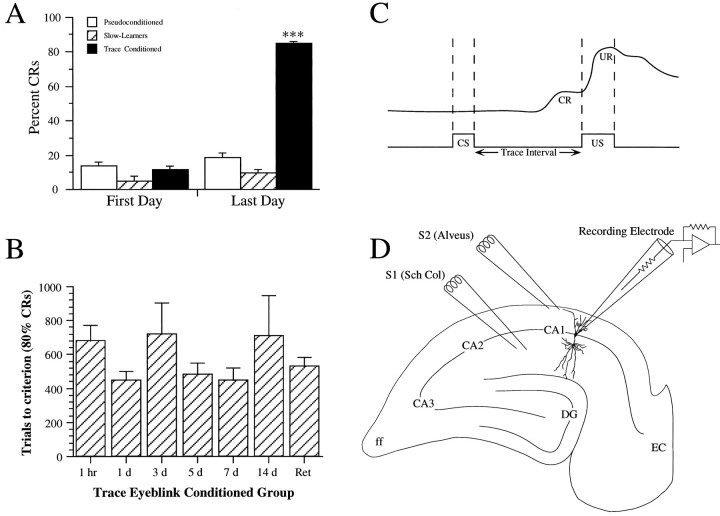
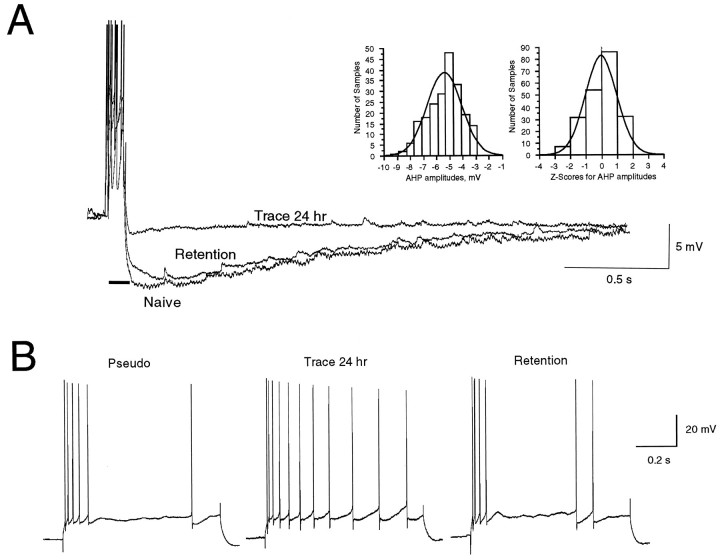
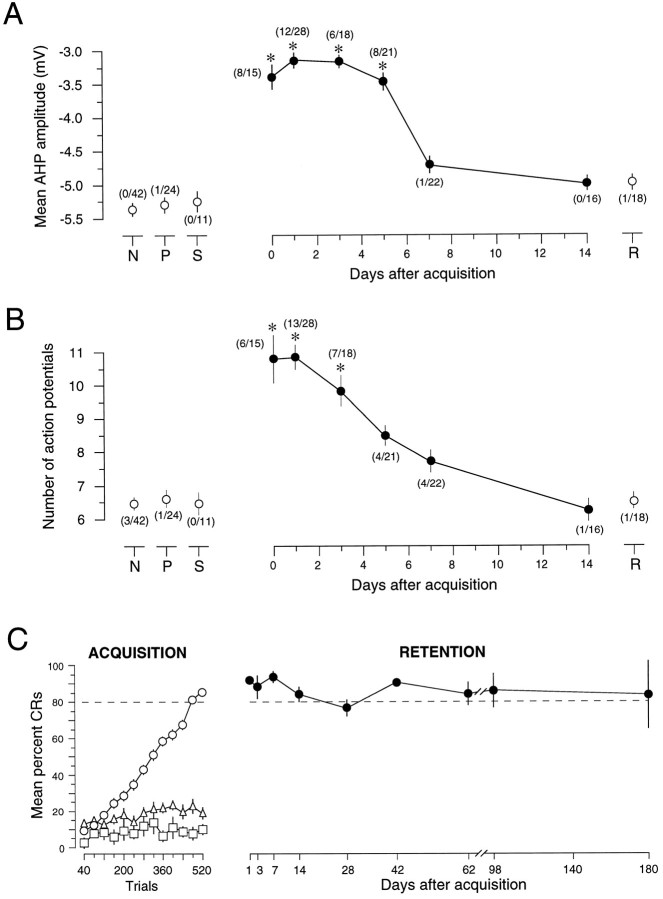
Time-dependent, learning-related changes in hippocampal excitability were evaluated by recording from rabbit CA1 pyramidal neurons in slices prepared at various times after acquisition of trace eyeblink conditioning. Increased excitability (reduced postburst afterhyperpolarizations and reduced spike-frequency adaptation) was seen as early as 1 hr after acquisition to behavioral criterion, was maximal in neurons studied 24 hr later, and returned to baseline within 7 d, whereas behavioral performance remained asymptotic for months. Neurons were held at -67 mV to equate voltage-dependent effects. No learning-related effects were observed on input resistance, action-potential amplitude or duration, or resting membrane potential. The excitability changes were learning-specific, because they were not seen in neurons from very slow learning (exhibited < 30% conditioned responses after 15 training sessions) or from pseudoconditioned control rabbits. Neurons from rabbits that displayed asymptotic behavioral performance after long-term retention testing (an additional training session 14 d after learning) were also indistinguishable from control neurons. Thus, the increased excitability of CA1 neurons was not performance- or memory-dependent. Rather, the time course of increased excitability may represent a critical window during which learning-specific alterations in postsynaptic excitability of hippocampal neurons are important for consolidation of the learned association elsewhere in the brain.
Figures
References
-
- Aghajanian GK, Rasmussen K. Intracellular studies in the facial nucleus illustrating a simple new method for obtaining viable motoneurons in adult rat brain slices. Synapse. 1989;3:331–338. - PubMed
-
- Akase E, Alkon DL, Disterhoft JF. Hippocampal lesions impair memory of short-delay conditioned eyeblink in rabbits. Behav Neurosci. 1989;103:935–943. - PubMed
-
- Akase E, Thompson LT, Disterhoft JF. A system for quantitative analysis of associative learning. II. Real-time software for MS-DOS microcomputers. J Neurosci Methods. 1994;54:119–130. - PubMed
-
- Alkon DL. Calcium-mediated reduction of ionic currents: a biophysical memory trace. Science. 1984;226:1037–1045. - PubMed
Publication types
MeSH terms
Grants and funding
LinkOut - more resources
Full Text Sources
Other Literature Sources
Miscellaneous
