Case Reports
. 1996 Oct 16;65(2):137-41.
doi: 10.1002/(SICI)1096-8628(19961016)65:2<137::AID-AJMG11>3.0.CO;2-R.

A 5-year-old white girl with Prader-Willi syndrome and a submicroscopic deletion of chromosome 15q11q13

Affiliations
Case Reports

A 5-year-old white girl with Prader-Willi syndrome and a submicroscopic deletion of chromosome 15q11q13

M G Butler et al. Am J Med Genet. .

Abstract

We report on a 5-year-old white girl with Prader-Willi syndrome (PWS) and a submicroscopic deletion of 15q11q13 of approximately 100-200 kb in size. High resolution chromosome analysis was normal but fluorescence in situ hybridization (FISH), Southern hybridization, and microsatellite data from the 15q11q13 region demonstrated that the deletion was paternal in origin and included the SNRPN, PAR-5, and PAR-7 genes from the proximal to distal boundaries of the deletion segment. SNRPN and PW71B methylation studies showed an abnormal pattern consistent with the diagnosis of PWS and supported the presence of a paternal deletion of 15q11q13 or an imprinting mutation. Biparental (normal) inheritance of PW71B (D15S63 locus) and a deletion of the SNRPN gene were observed by microsatellite, quantitative Southern hybridization, and/or FISH analyses. Our patient met the diagnostic criteria for PWS, but has no reported behavior problems, hyperphagia, or hypopigmentation. Our patient further supports SNRPN and possibly other genomic sequences which are deleted as the cause of the phenotype recognized in PWS patients.


Figures
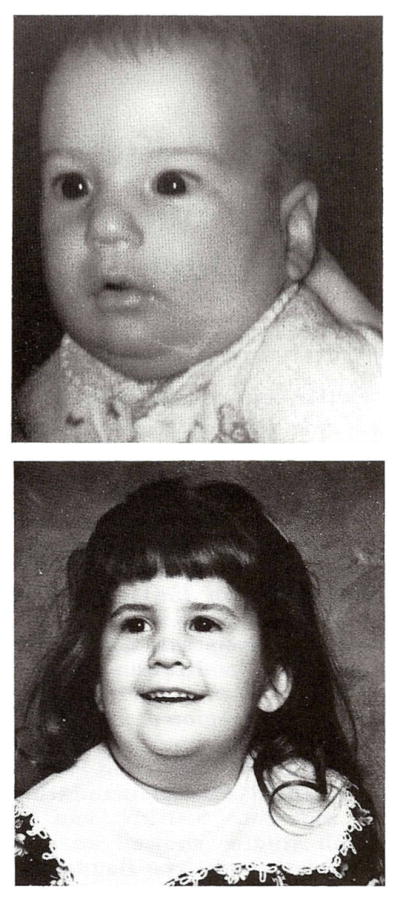
Fig. 1
Fig. 1
Frontal photographs of patient EE with a submicroscopic deletion of proximal 15q at age 3 months and 5 years.
Fig. 2
Fig. 2
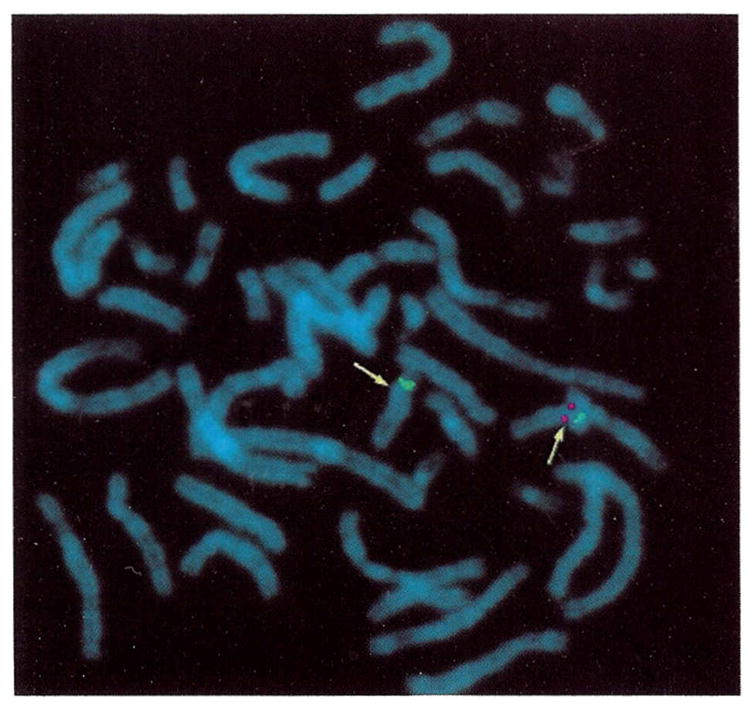
Fluorescence in situ hybridization (FISH) using cosmid 102, containing most of the SNRPN gene, from the proximal 15q11q13 region (red signal; yellow arrow) and a chromosome 15 alpha satellite control probe (green) from patient EE. Only one chromosome 15 (normal) shows both the alpha satellite and cosmid 102 hybridization signals, while the other chromosome 15 (deleted) shows only the control alpha satellite hybridization signal and no cosmid 102 signal.
Fig. 3
Fig. 3
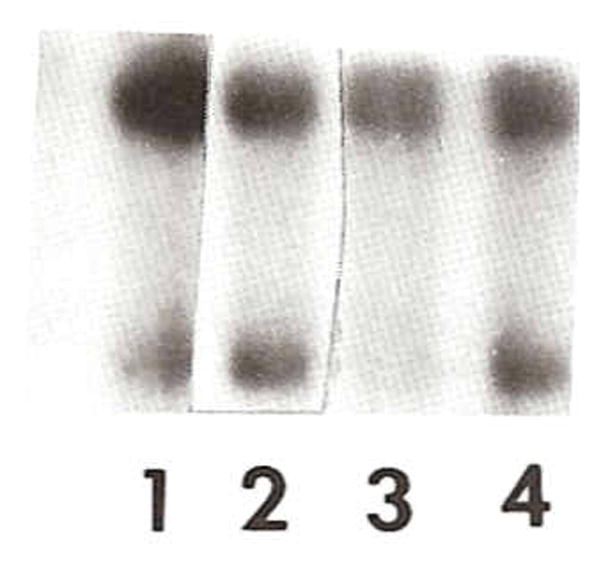
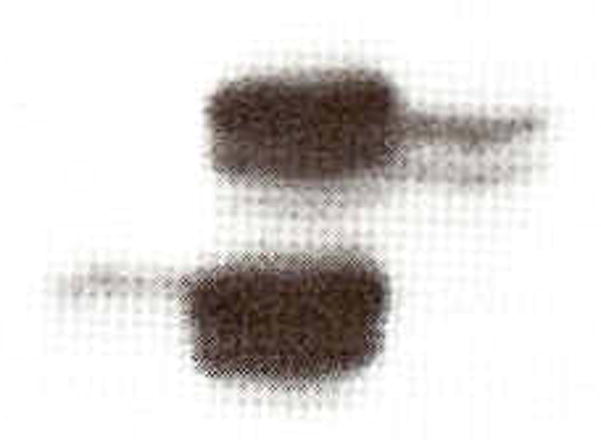
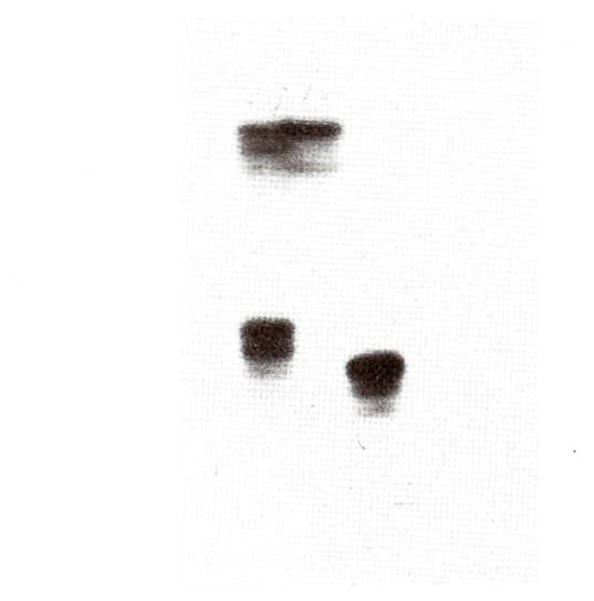
Quantitative hybridization using a radio-labeled PCR product generated using primers of exons 4 and 6 of the SNRPN gene [Ozcelik et al., 1992] with genomic DNA digested with Bgl II. The 7.5 kb (upper band) fragment represents a pseudogene (used as control) from chromosome 6 and the 5.8 kb (lower band) fragment represents the SNRPN gene from 15q11q13 region. Lanes 1 and 3 are from patient EE and show a submicroscopic deletion (e.g., calculated copy number of 0.7 or a deletion for SNRPN) of 15q11q13 and confirmed by FISH analysis. Lanes 2 and 4 are a normal control female.
Fig. 4
Fig. 4
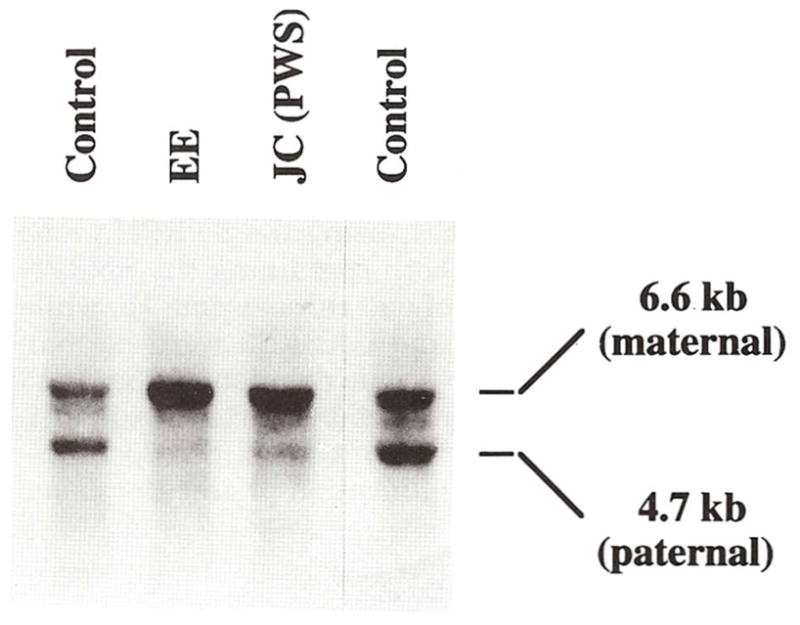
Southern hybridization using a radio-labeled PW71B probe (recognizing D15S63, a differentially methylated locus) hybridized to 5 μg of genomic DNA isolated from peripheral blood and digested with Hind III/Hpa II enzymes which produces two different size fragments (upper 6.6 kb band from maternal chromosome 15 and a lower 4.7 kb band from the paternal chromosome 15). Four individuals were studied. Our patient (EE) and a PWS patient (JC) both show only the upper band (maternal) indicating the PWS diagnosis or absence of a lower band (paternal) while the two controls have both upper and lower bands.
Fig. 5
Fig. 5
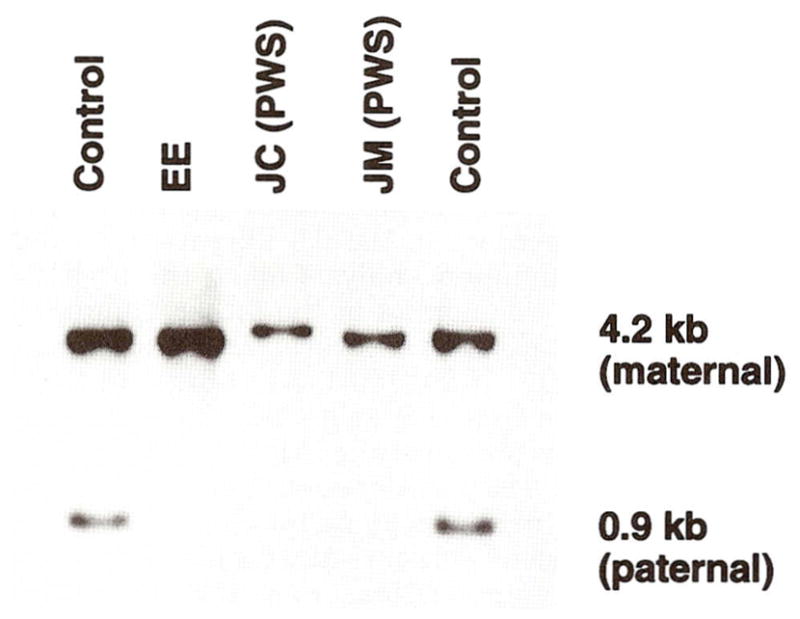
Southern hybridization using radio-labeled SNRPN CpG island probe (0.9 kb) [Sutcliffe et al., 1994] hybridized to 5 μg genomic DNA isolated from peripheral blood and digested with Xba I and Not I enzymes, produces two different size fragments (upper 4.2 kb band from the maternal chromosome 15 and lower 0.9 kb band from the paternal chromosome 15). Five individuals were studied. Our patient (EE) and two PWS patients (JC and JM) showed only the upper band (maternal) indicating the PWS diagnosis or absence of the lower band (paternal) while the two controls have both the upper and lower bands.
Fig. 6
Fig. 6
PCR amplification with radio-labeled primers from D15S63 locus from PWS patient EE (middle lane), her mother (right lane), and her father (left lane) generating two fragment sizes [167 bp (bottom band) and 171 bp (upper band)]. PCR amplification of D15S63 produces 38% heterozygosity. Biparental (normal) inheritance of D15S63 was seen for patient EE.
Fig. 7
Fig. 7
PCR amplification with radio-labeled primers from MN1 locus (identified in the 3′ UTR region of the PAR-7 gene) from patient EE (middle lane), her mother (left lane) and her father (right lane). The mother showed two alleles (heterozygous) and the father showed one allele (homozygous) but for a different size allele. Patient EE shows only one allele from the mother and no allele from the father, thus a paternal deletion of the MN1 locus.

References

    1. Buiting K, Saitoh S, Gross S, Dittrich B, Schwartz S, Nicholls RD, Horsthemke B. Inherited microdeletions in the Angelman and Prader-Willi syndromes define an imprinting centre on human chromosome 15. Nat Genet. 1995;9:395–400. - PubMed
    1. Butler MG. Hypopigmentation: A common feature of Prader-Willi syndrome. Am J Hum Genet. 1989;45:140–146. - PMC - PubMed
    1. Butler MG. Prader-Willi syndrome: Current understanding of cause and diagnosis. Am J Med Genet. 1990;35:319–332. - PMC - PubMed
    1. Butler MG, Dahir GA, Schwartz HS. Molecular analysis of transforming growth factor beta in giant cell tumor of bone. Cancer Genet Cytogenet. 1993;66:108–112. - PMC - PubMed
    1. Butler MG, Forrest KB, Miller LK. Cytogenetic and molecular characterization of 57 individuals with the Prader-Willi syndrome. Am J Hum Genet. 1994;55:A100.

Publication types

MeSH terms

Substances