. 1996 Nov 12;93(23):12834-9.
doi: 10.1073/pnas.93.23.12834.

A zinc finger directory for high-affinity DNA recognition

Affiliations

A zinc finger directory for high-affinity DNA recognition

A C Jamieson et al. Proc Natl Acad Sci U S A. .

Abstract

We have used two monovalent phage display libraries containing variants of the Zif268 DNA-binding domain to obtain families of zinc fingers that bind to alterations in the last 4 bp of the DNA sequence of the Zif268 consensus operator, GCG TGGGCG. Affinity selection was performed by altering the Zif268 operator three base pairs at a time, and simultaneously selecting for sets of 16 related DNA sequences. In this way, only four experiments were required to select for all possible 64 combinations of DNA triplet sequences. The results show that (i) for high-affinity DNA binding in the range observed for the Zif268 wild-type complex (Kd = 0.5-5 nM), finger 1 specifically requires the arginine at the carboxy terminus of its recognition helix that forms a bidentate hydrogen-bond with the guanine base (G) in the crystal structure of Zif268 complexed to its DNA operator sequence GCG TGG GCG; (ii) when the guanine base (G) is replaced by A, C, or T, a lower-affinity family (Kd > or = 50 nM) can be detected that shows an overall tendency to bind G-rich DNA; (iii) the residues at position 2 on the finger 2 recognition helix do not appear to interact strongly with the complementary 5' base in the finger 1 binding site; and (iv) unexpected substitutions at the amino terminus of finger 1 can occasionally result in specificity for the 3' base in the finger 1 binding site. A DNA recognition directory was constructed for high-affinity zinc fingers that recognize all three bases in a DNA triplet for seven sequences of the type GNN. Similar approaches may be applied to other zinc fingers to broaden the scope of the directory.


Figures
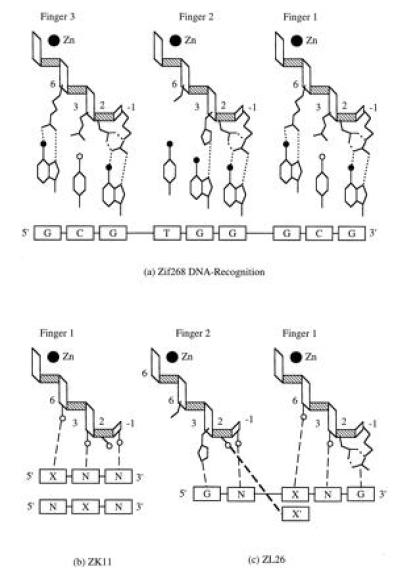
Figure 1
Figure 1
(a) Zif268 DNA recognition (1). Each of the three zinc finger recognition helices is shown in relation to its 3 base pair binding site. Hydrogen bonds (dotted lines) are formed when side-chains at positions −1, 2, 3, and 6 contact bases in the DNA major groove. Each helix is oriented such that position −1 on the helix amino terminus interacts at the 3′ end of the binding site. Fingers 1 and 3 contain the side-chains Arg-1, Asp-2, Glu-3, and Arg-6. Finger 2 contains Arg-1, Asp-2, His-3, and Thr-6. The DNA bases are differentiated according to filled circles (carbonyl groups) and open circles (amide groups exposed in the DNA major groove). (b) The ZK11 phage display library. The library contains amino acid substitutions at positions −1, 2, 3, and 6 (shown as open circles) on finger 1 and are shown in relation to two sets of DNA base replacements, XNN and NXN. X is fixed as A, C, G, or T, and N stands for a mixture of four bases. Dashed lines represent the expected interactions between side-chains and DNA bases according to the Zif268 crystal structure (1). (c) The ZL26 library. The library substitutions are located at positions −1 and 2 on finger 2 and at positions 3 and 6 on finger 1 (shown as four open circles). The thick dashed line represents the potential interaction (1, 2) between the side-chain at position 2 (finger 2) and the complementary 5′ base in the finger 1 binding site.
Figure 2
Figure 2
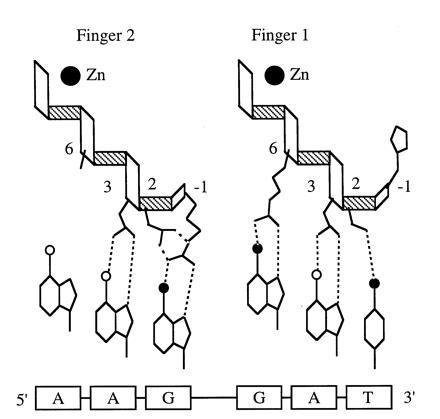
Tramtrack DNA recognition (2). Interactions between the side-chains on each of the recognition helices and the DNA bases are presented according to the scheme in Fig. 1. The finger 1 helix contains His-1, Ser-2, Asn-3, and Arg-6, and the finger 2 helix contains Arg-1, Asp-2, Asn-3, and Ala-6.
Figure 3
Figure 3
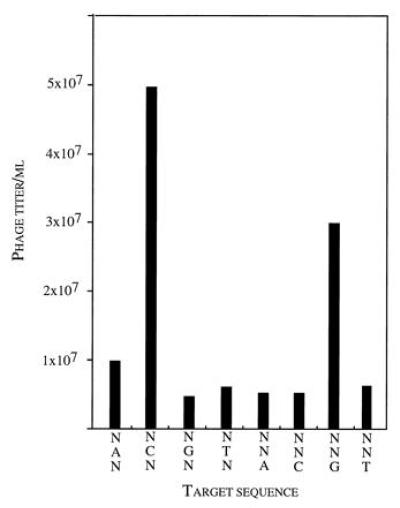
Partial binding signature of zinc finger 1 variant Gly-1 Trp-2 Glu-3 Arg-6 (GWER). Phagemids propagated from the clone were bound in affinity wells containing fixed bases at set positions in the finger 1 binding site (NAN, NCN, etc.). The resulting titers after infecting E. coli F+ cells show that GWER specifically recognizes (G)CG.
Figure 4
Figure 4
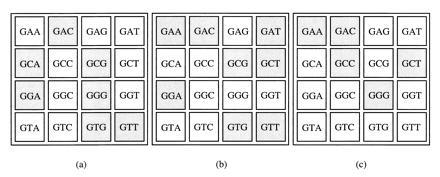
Zinc fingerprints. DNA triplets recognized by either Zif268 finger 1 (a), Zif268 finger 2 (b) (9), and a three-finger consensus sequence framework (c) (26) are represented as shaded boxes. The data include only those sequences for which zinc fingers were altered to recognize all three bases in the DNA base triplet.

References

    1. Pavletich N, Pabo C O. Science. 1991;252:809–817. - PubMed
    1. Fairall L, Schwabe J W R, Chapman L, Finch J T, Rhodes D. Nature (London) 1993;366:483–487. - PubMed
    1. Nardelli J, Gibson T, Charnay P. Nucleic Acids Res. 1992;20:4137–4144. - PMC - PubMed
    1. Desjarlais J R, Berg J M. Proc Natl Acad Sci USA. 1992;89:7345–7349. - PMC - PubMed
    1. Desjarlais J R, Berg J M. Proc Natl Acad Sci USA. 1993;90:2256–2260. - PMC - PubMed

Publication types

LinkOut - more resources