


Repair of thalassemic human beta-globin mRNA in mammalian cells by antisense oligonucleotides
- PMID: 8917506
- PMCID: PMC24007
- DOI: 10.1073/pnas.93.23.12840
Repair of thalassemic human beta-globin mRNA in mammalian cells by antisense oligonucleotides
Abstract
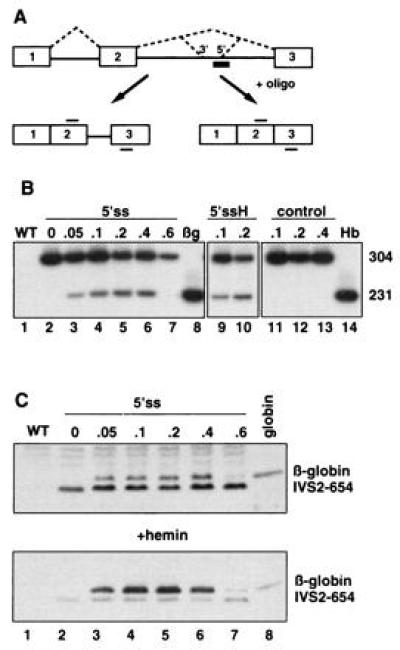
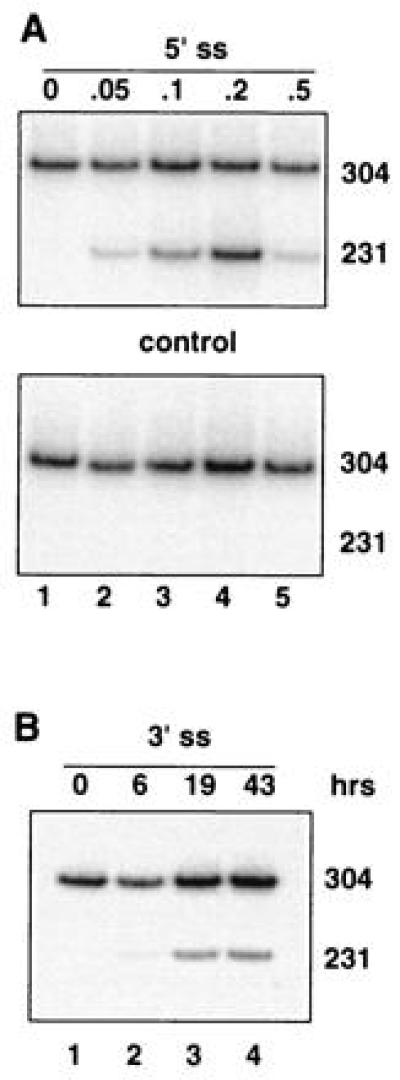
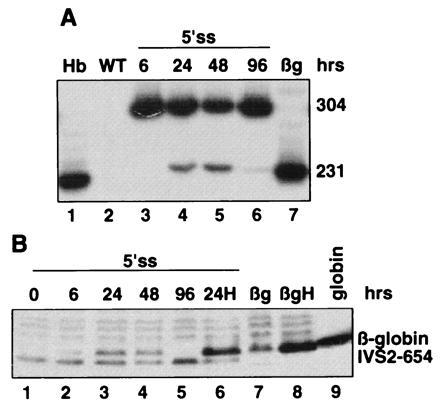
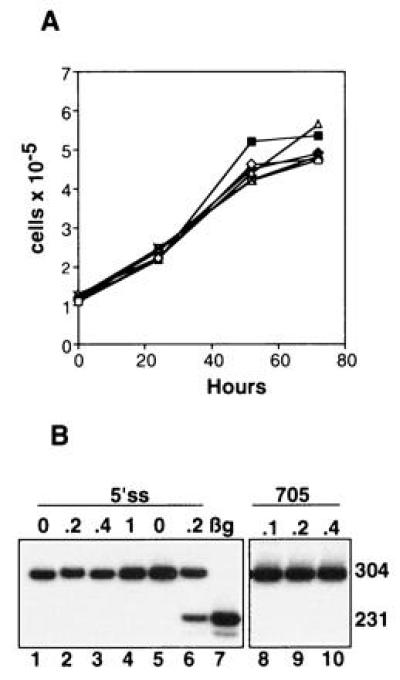
In one form of beta-thalassemia, a genetic blood disorder, a mutation in intron 2 of the beta-globin gene (IVS2-654) causes aberrant splicing of beta-globin pre-mRNA and, consequently, beta-globin deficiency. Treatment of mammalian cells stably expressing the IVS2-654 human beta-globin gene with antisense oligonucleotides targeted at the aberrant splice sites restored correct splicing in a dose-dependent fashion, generating correct human beta-globin mRNA and polypeptide. Both products persisted for up to 72 hr posttreatment. The oligonucleotides modified splicing by a true antisense mechanism without overt unspecific effects on cell growth and splicing of other pre-mRNAs. This novel approach in which antisense oligonucleotides are used to restore rather than to down-regulate the activity of the target gene is applicable to other splicing mutants and is of potential clinical interest.
Figures
References
-
- Schwartz E, Benz E J. In: Hematology, Basic Principles and Practice. Hoffman R, Benz E J, Shattil S J, Furie B, Cohen H J, editors. New York: Churchill Livingstone; 1995. pp. 586–610.
-
- Huisman T H J. Br J Haematol. 1990;75:454–457. - PubMed
-
- Huang S-Z, Zeng F-Y, Ren Z-R, Lu Z-H, Rodgers G P, Schechter A N, Zeng Y-T. Br J Haematol. 1994;88:541–546. - PubMed
-
- Busslinger M N, Moschonas N, Flavell R A. Cell. 1981;27:289–296. - PubMed
Publication types
MeSH terms
Substances
LinkOut - more resources
Full Text Sources
Other Literature Sources
