Review
. 1996 Nov 26;93(24):13438-44.
doi: 10.1073/pnas.93.24.13438.

Memory systems in the brain and localization of a memory

Affiliations
Review

Memory systems in the brain and localization of a memory

R F Thompson et al. Proc Natl Acad Sci U S A. .

Abstract

It is now clear that there are a number of different forms or aspects of learning and memory that involve different brain systems. Broadly, memory phenomena have been categorized as explicit or implicit. Thus, explicit memories for experience involve the hippocampus-medial temporal lobe system and implicit basic associative learning and memory involves the cerebellum, amygdala, and other systems. Under normal conditions, however, many of these brain-memory systems are engaged to some degree in learning situations. But each of these brain systems is learning something different about the situation. The cerebellum is necessary for classical conditioning of discrete behavioral responses (eyeblink, limb flexion) under all conditions; however, in the "trace" procedure where a period of no stimuli intervenes between the conditioned stimulus and the unconditioned stimulus the hippocampus plays a critical role. Trace conditioning appears to provide a simple model of explicit memory where analysis of brain substrates is feasible. Analysis of the role of the cerebellum in basic delay conditioning (stimuli overlap) indicates that the memories are formed and stored in the cerebellum. The phenomenon of cerebellar long-term depression is considered as a putative mechanism of memory storage.


Figures
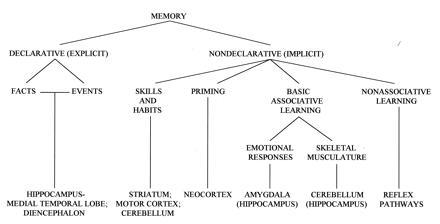
Figure 1
Figure 1
A tentative taxonomy of long-term memory and associated brain structures (adapted from ref. 1).
Figure 2
Figure 2
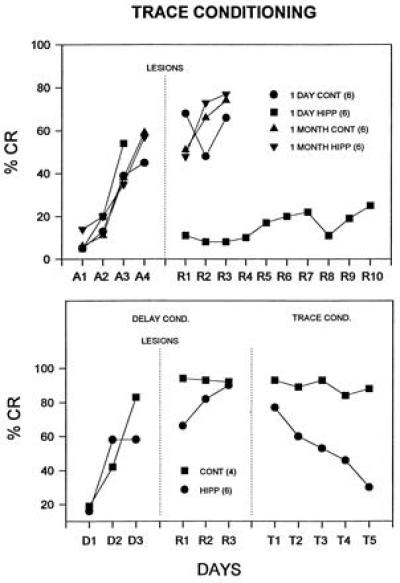
Effects of hippocampal lesions on retention of trace and delay CRs. Shown are the mean percentage of CRs during initial training and following postoperative training. (Upper) Trace procedure: 1 day cont, controls given cortical or sham lesions 1 day after training; 1 month cont, controls given lesions 1 month after training; 1 day hipp, bilateral hippocampal lesions made 1 day after training; 1 month hipp, hippocampal lesions made 1 month after training. Only the hippocampal lesions made immediately after training abolished the trace CR. (Lower) Animals initially trained on the delay procedure and lesioned 1 day after training (control lesions and hippocampal lesions). The hippocampal lesion had little effect on immediate retention of the delay CR. Animals were then shifted to the trace procedure. Control animals transferred, continuing to show asymptotic CRs, but the hippocampal lesioned animals actually showed extinction of the CR (from ref. ; reprinted with permission from the American Psychological Association, Washington, DC).
Figure 3
Figure 3
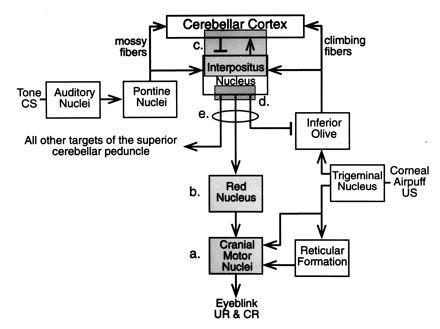
Simplified schematic of the essential brain circuitry involved in classical conditioning of discrete responses—e.g., eyeblink response. Shadowed boxes represent areas that have been reversibly inactivated during training. (a) Inactivation of motor nuclei including facial (7th) and accessory 6th. (b) Inactivation of magnocellular red nucleus. (c) Inactivation of dorsal aspect of the anterior interpositus nucleus and overlying cerebellar cortex. (d) Inactivation of ventral anterior interpositus nucleus and associated white matter. (e) Complete inactivation of the superior cerebellar peduncle (scp), essentially all output from the cerebellar hemisphere. See text for details. (Reprinted with permission from ref. , Annual Reviews, Inc., Palo Alto, CA.)

References

    1. Squire L R, Knowlton B J. In: The Cognitive Neurosciences. Gazzaniga M, editor. Cambridge, MA: MIT Press; 1994. pp. 825–837.
    1. Rescorla R A. Annu Rev Neurosci. 1988;11:329–352. - PubMed
    1. Dudai Y. The Neurobiology Memory: Concepts, Findings, Trends. New York: Oxford Univ. Press; 1989.
    1. Scoville W B, Milner B. J Neurol Neurosurg Psychiatry. 1957;20:11–21. - PMC - PubMed
    1. Mishkin M. Nature (London) 1978;273:297–298. - PubMed

Publication types