. 1996 Nov 26;93(24):13555-60.
doi: 10.1073/pnas.93.24.13555.

Light-directed synthesis of high-density oligonucleotide arrays using semiconductor photoresists

Affiliations

Light-directed synthesis of high-density oligonucleotide arrays using semiconductor photoresists

G McGall et al. Proc Natl Acad Sci U S A. .

Abstract

High-density arrays of oligonucleotide probes are proving to be powerful new tools for large-scale DNA and RNA sequence analysis. A method for constructing these arrays, using light-directed DNA synthesis with photo-activatable monomers, can currently achieve densities on the order of 10(6) sequences/cm2. One of the challenges facing this technology is to further increase the volume, complexity, and density of sequence information encoded in these arrays. Here we demonstrate a new approach for synthesizing DNA probe arrays that combines standard solid-phase oligonucleotide synthesis with polymeric photoresist films serving as the photoimageable component. This opens the way to exploiting high-resolution imaging materials and processes from the microelectronics industry for the fabrication of DNA probe arrays with substantially higher densities than are currently available.


Figures
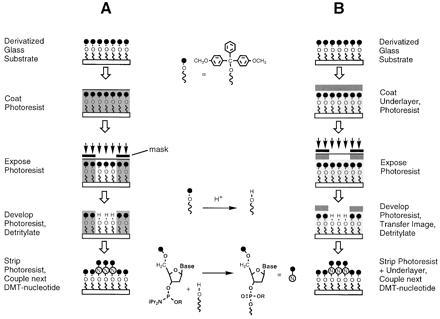
Figure 1
Figure 1
Oligonucleotide array fabrication processes using polymeric photoresists. (A) Single-layer resist process. (B) “Bilayer” process using an inert polymer underlayer to protect surface oligonucleotide chemistry.
Figure 2
Figure 2
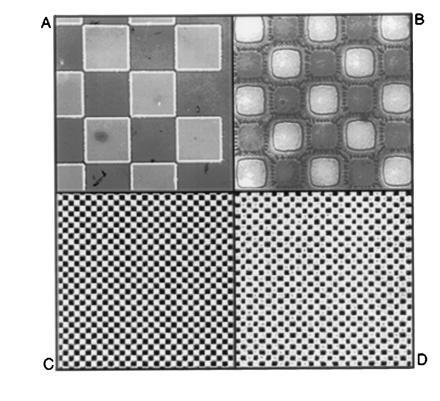
Imaging with the bilayer process. Substrates were prederivatized with a single 5′-DMT-thymidine-3′-cyanoethylphosphate monomer covalently coupled to a hexaethyleneglycol spacer before applying the patterned bilayer. (A and B) Optical micrographs of patterned bilayer film with 50- and 10-μm features, respectively. (C and D) Corresponding surface fluorescence images obtained after transferring the patterns to the substrate with dichloroacetic acid in cyclohexanone, removing the polymers, and staining with fluorescein phosphoramidite.
Figure 3
Figure 3
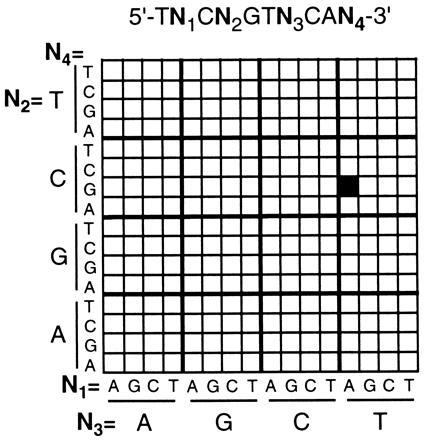
Arrangement of oligonucleotide probes in the 256-decanucleotide arrays prepared in this work. The site containing the complementary sequence 5′-TACCGTTCAG is highlighted for reference.
Figure 4
Figure 4
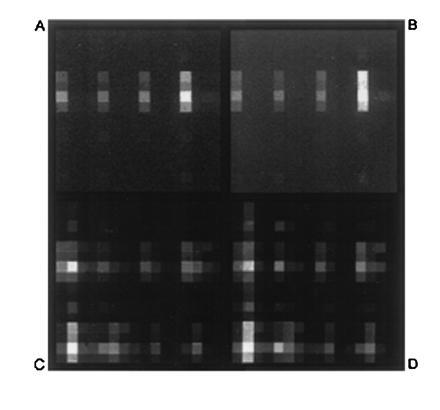
Hybridization of fluorescein-labeled oligonucleotides to the 256-decanucleotide arrays outlined in Fig. 3. Individual features are 100 μm on a side. The observed brightness at any particular location is proportional to the amount of labeled target hybridized to the probe at that site. Upper images (A and B) were acquired after hybridization of the 10-mer target 5′-fluorescein-CTGAACGGTA; and lower images (C and D) after hybridization of the 22-mer target 5′-fluorescein-ACTGGACTGAACGGTAATGCAC-3′. Images on the left (A and C) correspond to the array fabricated by the resist bilayer process with DMT-protected monomers; and images on the right (B and D), correspond to the same array fabricated with photoactivatible 5′-O-9α-methyl-6-nitropiperonyloxycarbonyl-protected monomers as described (19).
Figure 5
Figure 5
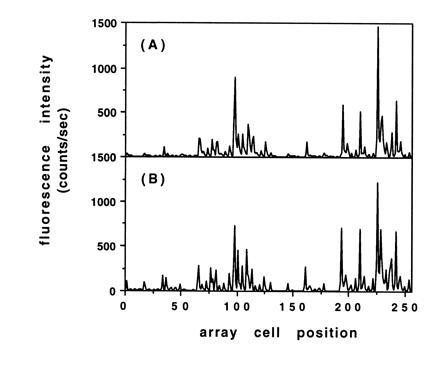
Comparison of histogram plots of the observed fluorescence intensity due to hybridization for the test arrays shown in Fig. 4 C and D. (A) Array fabricated with the resist bilayer process. (B) Array fabricated with photoactivatible monomers.

References

    1. Hunkapillar T, Kaiser R J, Koop B F, Hood L. Science. 1991;254:59–67. - PubMed
    1. Lipshutz R J, Fodor S P A. Curr Opin Struct Biol. 1994;4:376–80.
    1. Bains W, Smith G C. J Theor Biol. 1988;135:303–307. - PubMed
    1. Lysov Y P, Florentiev V L, Khorlyn A A, Khrapko K R, Shick V V, Mirzabekov A D. Dokl Akad Nauk SSSR. 1988;303:1508–1511. - PubMed
    1. Drmanac R, Labat I, Brukner I, Crkvenjakov R. Genomics. 1989;4:114–128. - PubMed

LinkOut - more resources