


Detection of a Yb3+ binding site in regenerated bacteriorhodopsin that is coordinated with the protein and phospholipid head groups
- PMID: 8962051
- PMCID: PMC26132
- DOI: 10.1073/pnas.93.25.14333
Detection of a Yb3+ binding site in regenerated bacteriorhodopsin that is coordinated with the protein and phospholipid head groups
Abstract
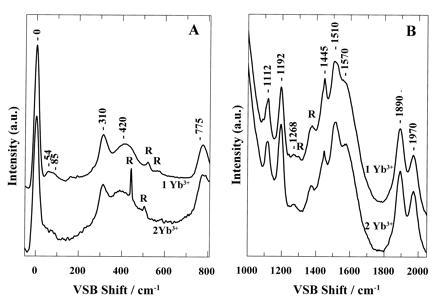
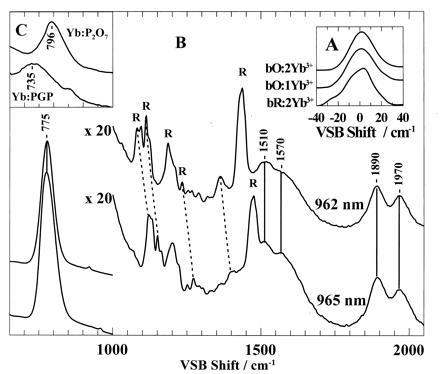
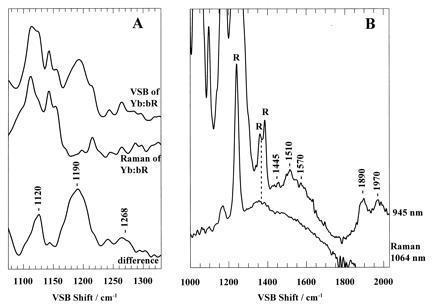
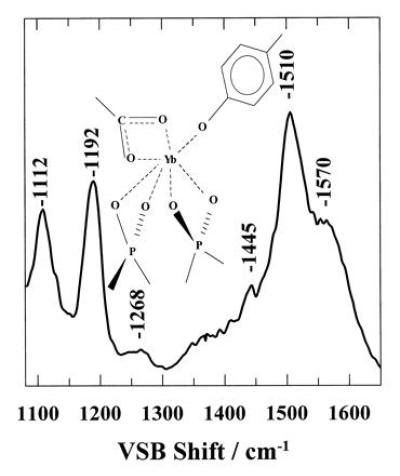
Near infrared Yb3+ vibronic sideband spectroscopy was used to characterize specific lanthanide binding sites in bacteriorhodopsin (bR) and retinal free bacteriorhodopsin (bO). The VSB spectra for deionized bO regenerated with a ratio of 1:1 and 2:1 ion to bO are identical. Application of a two-dimensional anti-correlation technique suggests that only a single Yb3+ site is observed. The Yb3+ binding site in bO is observed to consist of PO2- groups and carboxylic acid groups, both of which are bound in a bidentate manner. An additional contribution most likely arising from a phenolic group is also observed. This implies that the ligands for the observed single binding site are the lipid head groups and amino acid residues. The vibronic sidebands of Yb3+ in deionized bR regenerated at a ratio of 2:1 ion to bR are essentially identical to those in bO. The other high-affinity binding site is thus either not evident or its fluorescence is quenched. A discussion is given on the difference in binding of Ca2+ (or Mg2+) and lanthanides in phospholipid membrane proteins.
Figures
References
-
- Stoeckenius W, Lozier R, Bogomolni R A. Biochim Biophys Acta. 1979;505:215–278. - PubMed
-
- Lanyi J K. J Bioenerg Biomembr. 1992;24:169–179. - PubMed
-
- Mathies R A, Lin S W, Ames J B, Pollard W T. Annu Rev Biophys Biophys Chem. 1991;20:491–518. - PubMed
-
- Khorana H G. J Biol Chem. 1988;263:7439–7442. - PubMed
-
- Bridgen J, Walker I. Biochemistry. 1976;15:792–798. - PubMed
Publication types
MeSH terms
Substances
LinkOut - more resources
Full Text Sources
Miscellaneous
