


Protein engineering of Bacillus thuringiensis delta-endotoxin: mutations at domain II of CryIAb enhance receptor affinity and toxicity toward gypsy moth larvae
- PMID: 8962052
- PMCID: PMC26133
- DOI: 10.1073/pnas.93.25.14338
Protein engineering of Bacillus thuringiensis delta-endotoxin: mutations at domain II of CryIAb enhance receptor affinity and toxicity toward gypsy moth larvae
Abstract
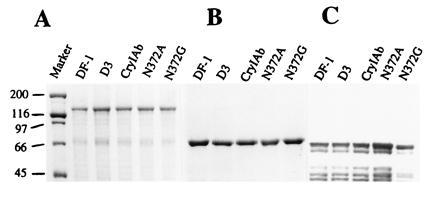
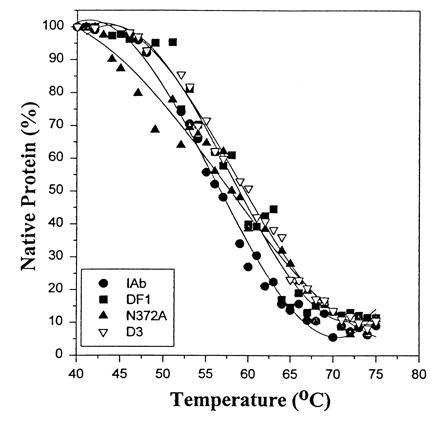
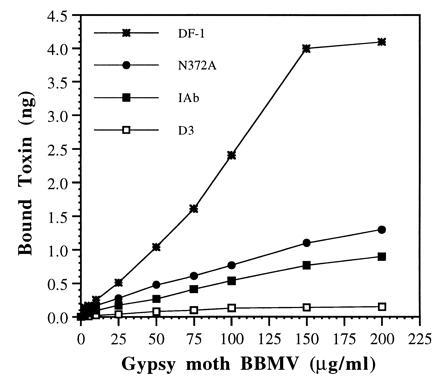
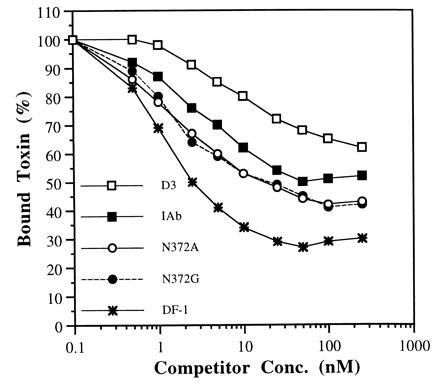
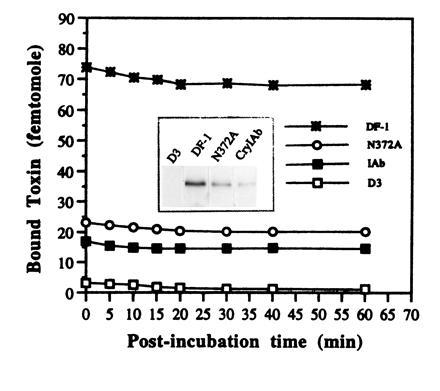
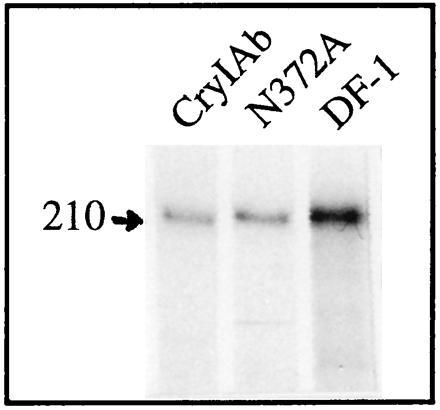
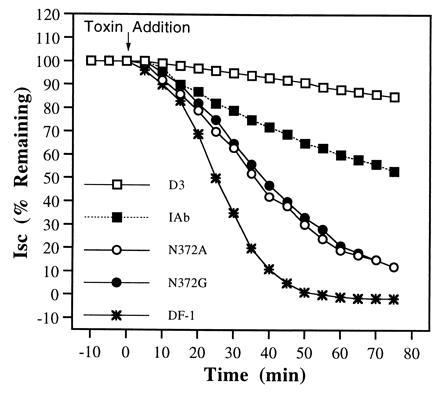
Substitutions or deletions of domain II loop residues of Bacillus thuringiensis delta-endotoxin CryIAb were constructed using site-directed mutagenesis techniques to investigate their functional roles in receptor binding and toxicity toward gypsy moth (Lymantria dispar). Substitution of loop 2 residue N372 with Ala or Gly (N372A, N372G) increased the toxicity against gypsy moth larvae 8-fold and enhanced binding affinity to gypsy moth midgut brush border membrane vesicles (BBMV) approximately 4-fold. Deletion of N372 (D3), however, substantially reduced toxicity (> 21 times) as well as binding affinity, suggesting that residue N372 is involved in receptor binding. Interestingly, a triple mutant, DF-1 (N372A, A282G and L283S), has a 36-fold increase in toxicity to gypsy moth neonates compared with wild-type toxin. The enhanced activity of DF-1 was correlated with higher binding affinity (18-fold) and binding site concentrations. Dissociation binding assays suggested that the off-rate of the BBMV-bound mutant toxins was similar to that of the wild type. However, DF-1 toxin bound 4 times more than the wild-type and N372A toxins, and it was directly correlated with binding affinity and potency. Protein blots of gypsy moth BBMV probed with labeled N372A, DF-1, and CryIAb toxins recognized a common 210-kDa protein, indicating that the increased activity of the mutants was not caused by binding to additional receptor(s). The improved binding affinity of N372A and DF-1 suggest that a shorter side chain at these loops may fit the toxin more efficiently to the binding pockets. These results offer an excellent model system for engineering delta-endotoxins with higher potency and wider spectra of target pests by improving receptor binding interactions.
Figures
References
-
- Yamamoto T, Powell G K. In: Advanced Engineered Pesticides. Kim L, editor. New York: Dekker; 1993. pp. 3–42.
-
- Hofmann C, Lüthy P, Hutter R, Pliska V. Eur J Biochem. 1988;173:85–91. - PubMed
-
- Lorence A, Darszon A, Díaz C, Liévano A, Quintero R, Bravo A. FEBS Lett. 1995;360:217–222. - PubMed
-
- Schwartz J-L, Garneau L, Masson L, Brousseau R. Biochim Biophys Acta. 1991;1065:250–260. - PubMed
-
- Martin G F, Wolfersberger M G. J Exp Biol. 1995;198:91–96. - PubMed
Publication types
MeSH terms
Substances
Grants and funding
LinkOut - more resources
Full Text Sources
Other Literature Sources
Miscellaneous
